Compare
Wall Decor: six styles, side by side
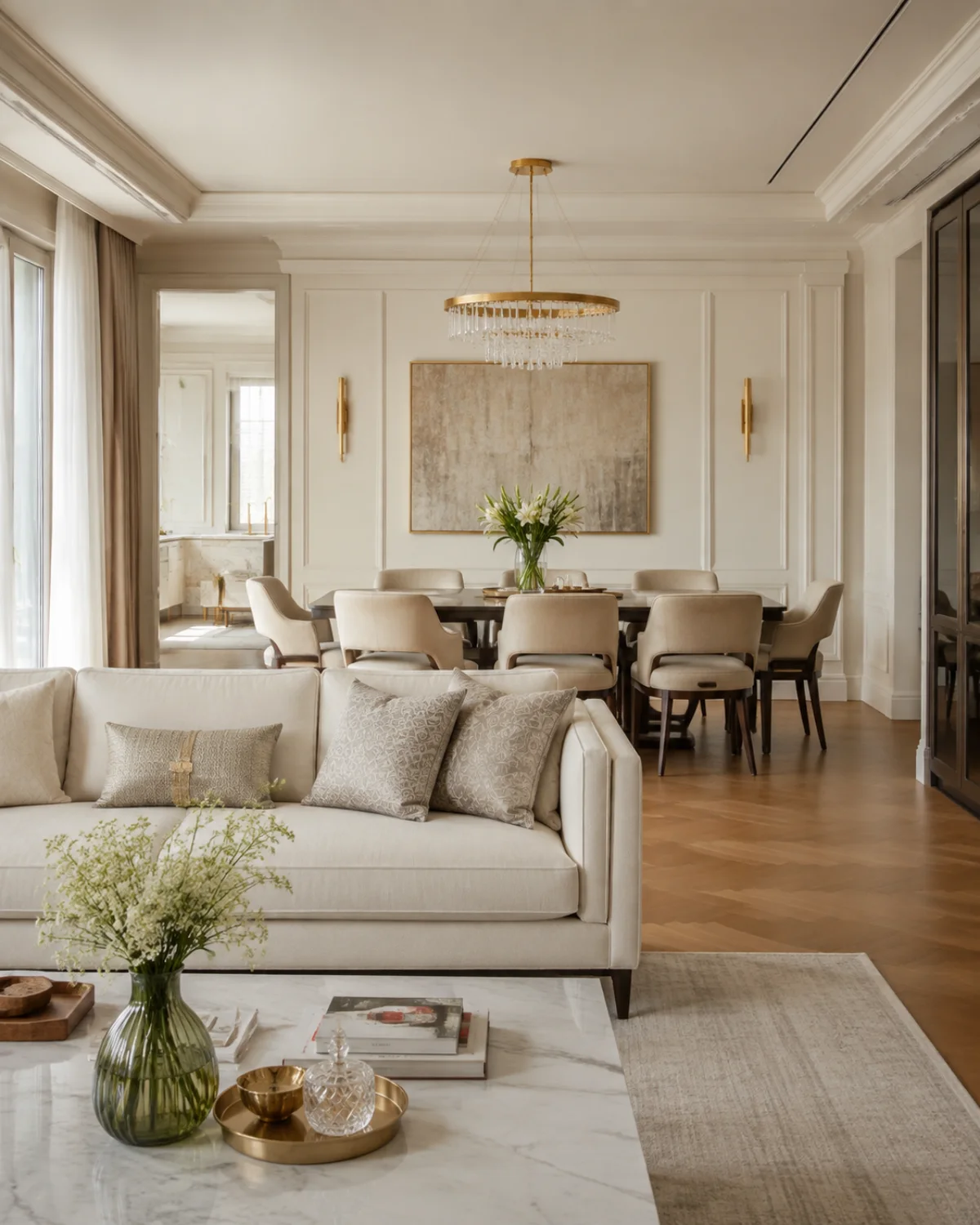
The same wall decor brief resolved six ways. Walls are the last thing done and the first thing seen. We plan the hanging lines and the lighting at design stage, not after the paint has dried.

Side by side
All six, in one row
Scroll sideways to compare, or filter down to the styles you are choosing between.
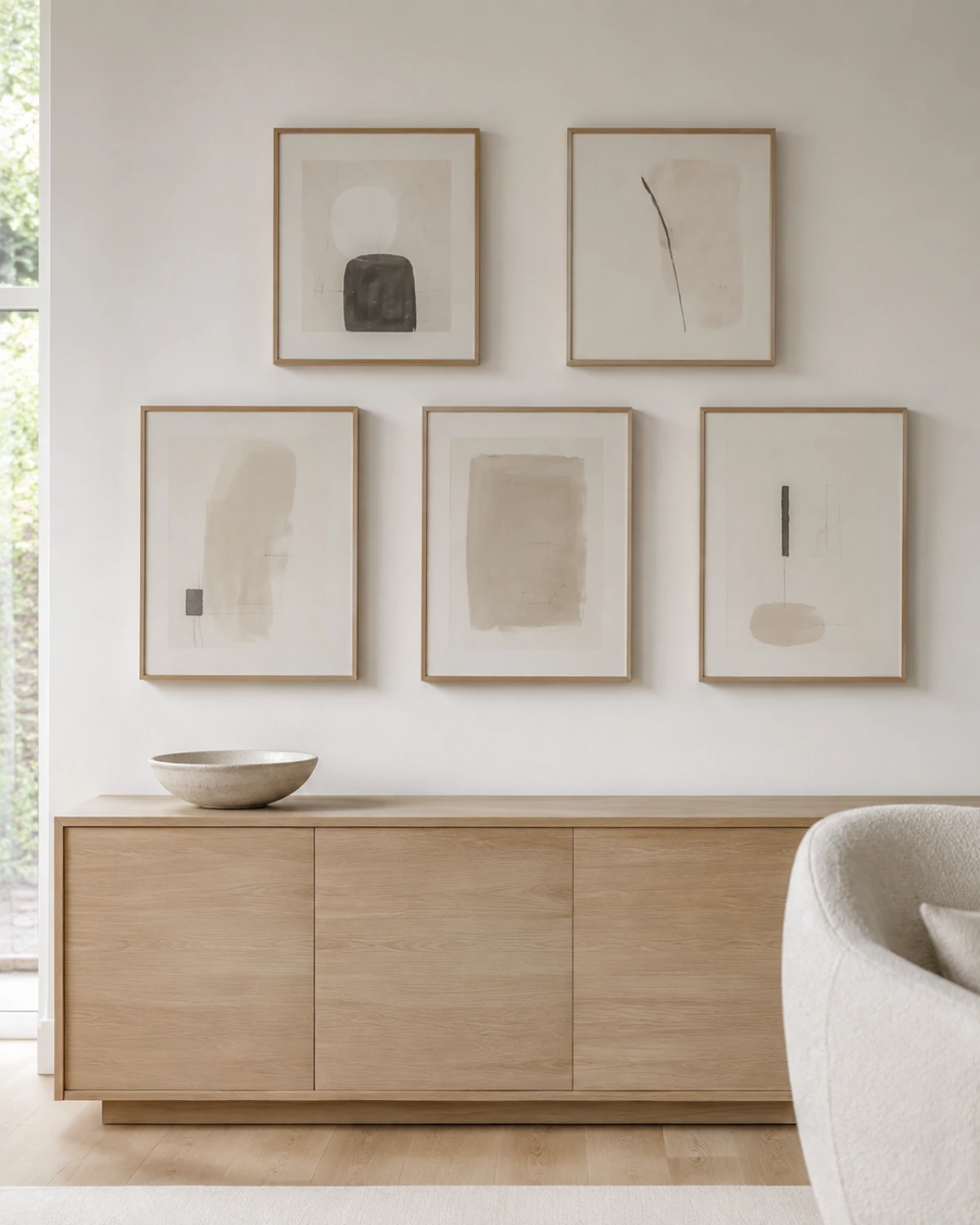
- Layout
- Single large artwork
- Format
- One 48″ canvas
- Framing
- Frameless canvas
What changes: One large piece, centred, and nothing else on the wall.
- Layout
- Dark gallery wall
- Format
- Nine-frame gallery grid
- Framing
- Black box frames, white mount
What changes: A nine-frame grid with an even 2″ gap.

- Layout
- Craft panel in teak and brass
- Format
- Carved teak relief panel
- Framing
- Teak frame with a brass corner
What changes: A hand-carved teak relief panel.

- Layout
- Symmetrical gilt-framed pair
- Format
- Two gilt-framed works, symmetrical
- Framing
- Gilt frame with a linen mount
What changes: Two gilt-framed works either side of a mirror.

- Layout
- Open shelf with objects
- Format
- Birch picture ledge, 72″
- Framing
- No frame — ledge display
What changes: A long birch picture ledge with objects leaning.

- Layout
- Mirror and brass composition
- Format
- Antique-mirror panels with brass
- Framing
- Brass frame with a bevelled mirror
What changes: Antique-mirror panels with brass inlay.
At a glance
The differences in one table
| Style | Layout | Format | Ideal for |
|---|---|---|---|
| Serene Minimal | Single large artwork | One 48″ canvas | Homes wanting one confident gesture per room |
| Bold Contemporary | Dark gallery wall | Nine-frame gallery grid | Owners with a collection to display |
| Modern Heritage | Craft panel in teak and brass | Carved teak relief panel | Craft-led homes wanting a made object on the wall |
| Classic Luxe | Symmetrical gilt-framed pair | Two gilt-framed works, symmetrical | Formal rooms with symmetrical composition |
| Indo-Scandinavian | Open shelf with objects | Birch picture ledge, 72″ | Families who like changing the display often |
| Art Deco Glam | Mirror and brass composition | Antique-mirror panels with brass | Statement walls in dining rooms and bars |
Sizing
Wall Decor dimensions by home size
| Home size | Typical room dimension | Layout that usually fits |
|---|---|---|
| 1 BHK | One piece per room | Single large artwork |
| 2 BHK | Gallery wall in the living room | Dark gallery wall |
| 3 BHK | Craft panel in the foyer | Craft panel in teak and brass |
| 4 BHK | Symmetrical scheme in formal rooms | Symmetrical gilt-framed pair |
| 4+ BHK / Villa | Full curated scheme | Open shelf with objects |
How to choose
Picking between the six
The honest way to choose is to eliminate rather than select: rule out the styles that clash with what is already fixed in the home — the flooring, the window frames, an existing kitchen you are not replacing — and choose from what remains. Most people arrive certain about one style and leave having picked a different one once the elimination is done.
Layout tends to decide the choice before palette does. Two or three of the six styles above will suit your actual room dimensions and door positions; the rest will look right in the photograph and fight the room in practice. Start from the layout column in the table below, not the material column.
If two styles both work on paper, the deciding question is usually maintenance: how much upkeep the household will actually do. A high-gloss Bold scheme and a hand-oiled Heritage one both look considered on day one; only one of them stays that way without regular attention.
A group of works reads as one piece if the spacing between them is tighter than the distance from the group to the furniture.
Leave 8–10″ between the top of a sofa back and the bottom of the frame.
In a corridor, hang along one wall only and light from the opposite side to avoid glare as you walk.
Objects on a console want odd numbers and varied heights; three pieces at three heights beat five at the same height.
Questions
Choosing a wall decor style
Which of these six suits a family with young children?
Serene Minimal and Indo-Scandinavian tend to wear best under daily family use — pale, matt surfaces show less than high gloss, and both specify durable, easily cleaned materials by default. Bold Contemporary and Art Deco Glam ask for more careful living.
Can wall decor mix two of these styles in one room?
Within reason. The six are coherent palettes rather than fixed rules, and most finished homes borrow across two. What rarely works is switching palette within one sightline in the same room.
Does the layout change between styles, or only the material?
Both. Each style resolves the wall decor brief with a different layout logic as well as a different material direction — see the layout column in the table above for exactly how.
Which style costs the least for a wall decor?
None of the six carries an inherent price premium over the others at the same specification tier — the cost difference between two wall decor projects usually comes from hardware grade and finish level, not from which of the six styles was chosen.
How do I see my own room in more than one of these styles?
Bring the floor plan to a consultation. We draw your actual room in the two or three styles you are choosing between rather than a generic version of each, which is usually what settles it.
Do the six styles take different lengths of time to build?
Not meaningfully — the production and installation programme for a wall decor runs on joinery quantity and finish complexity rather than on which palette is chosen. A heavily detailed scheme in any of the six styles adds time; a restrained one in any of the six saves it.
Can I see this comparison for a room size other than the default shown?
Yes — the wall decor category page carries the full sizing table across every home size, in all six styles, if you want the comparison scaled to your own room.
More questions
Wall Decor — the practical side
Living with wall decor, whichever style you choose
- Keep works on paper out of direct sun entirely; UV damage is cumulative and cannot be reversed.
- Dust frames with a dry cloth and never spray cleaner onto glass near a frame edge.
- Check hanging fixings annually, particularly for heavy pieces on plasterboard.
- Rotate seasonal pieces rather than leaving everything up permanently; a room reads better when it changes.
How high should Wall Decor be hung?
With the centre of the piece at about 60″ from the floor, which is average eye level. In a room with very high ceilings, resist the urge to raise it — the furniture, not the ceiling, sets the relationship.
How do I light it?
A narrow-beam framing spot or an adjustable track head at roughly 30 degrees from vertical, aimed to avoid glare from the glass. Lighting is the difference between owning art and seeing it.
What size should I choose?
Roughly two-thirds the width of the furniture beneath, or a group that reads as a single mass of that width. Undersized art is the most common error in otherwise well-finished rooms.
Can pieces be fixed to a false ceiling or panelled wall?
Only into the structure behind. Anything over a few kilos needs a backing plate or a fixing into the sub-frame, planned before the panelling closes up.
How is wall Decor protected from Indian light and humidity?
Keep works on paper out of direct sun and use UV-filtering glazing. In coastal humidity, leave an air gap behind the frame rather than fixing it flush to the wall.
Should I buy as a set?
A considered set works in a corridor or a stair wall. Elsewhere, one strong piece almost always beats three safe ones.
More comparisons
Other rooms, side by side
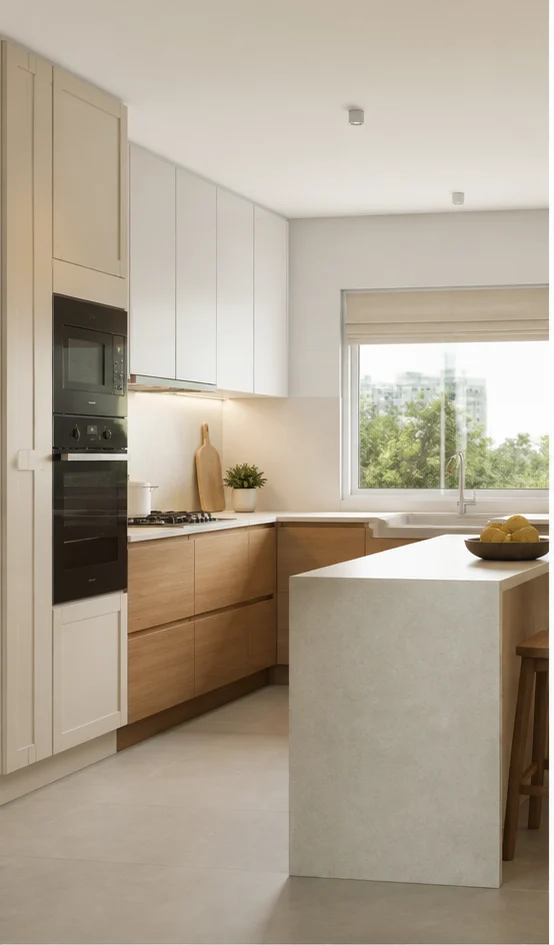
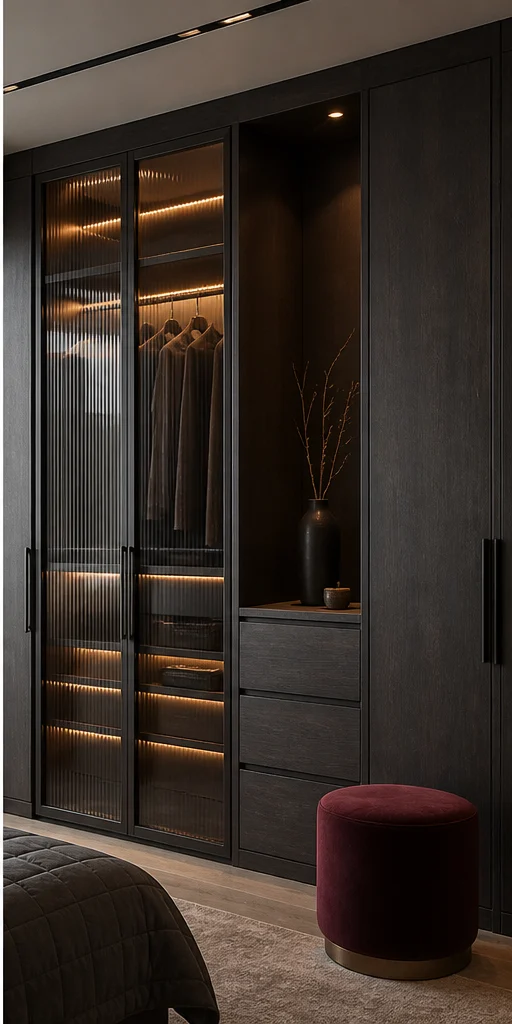
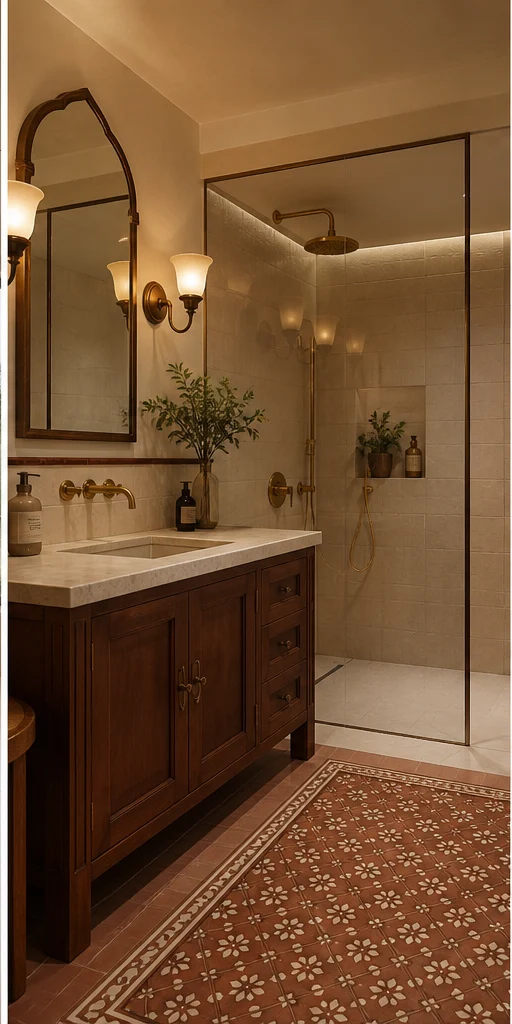
Next step
Choose your wall decor style with a designer.
Send the plan. We will draw your actual room in the two you are torn between and put them next to each other.