Tile
Bathroom Tile Designs
Setting-out and fall matter more than the tile. Plan the cuts to land full at the visible corners and slope the wet zone properly.
Every style, in full
Bathroom Tile in all six house styles
Each style has its own page with the full specification and sizing.

Minimal Bathroom Tile
Chalk · Pale Oak · Linen
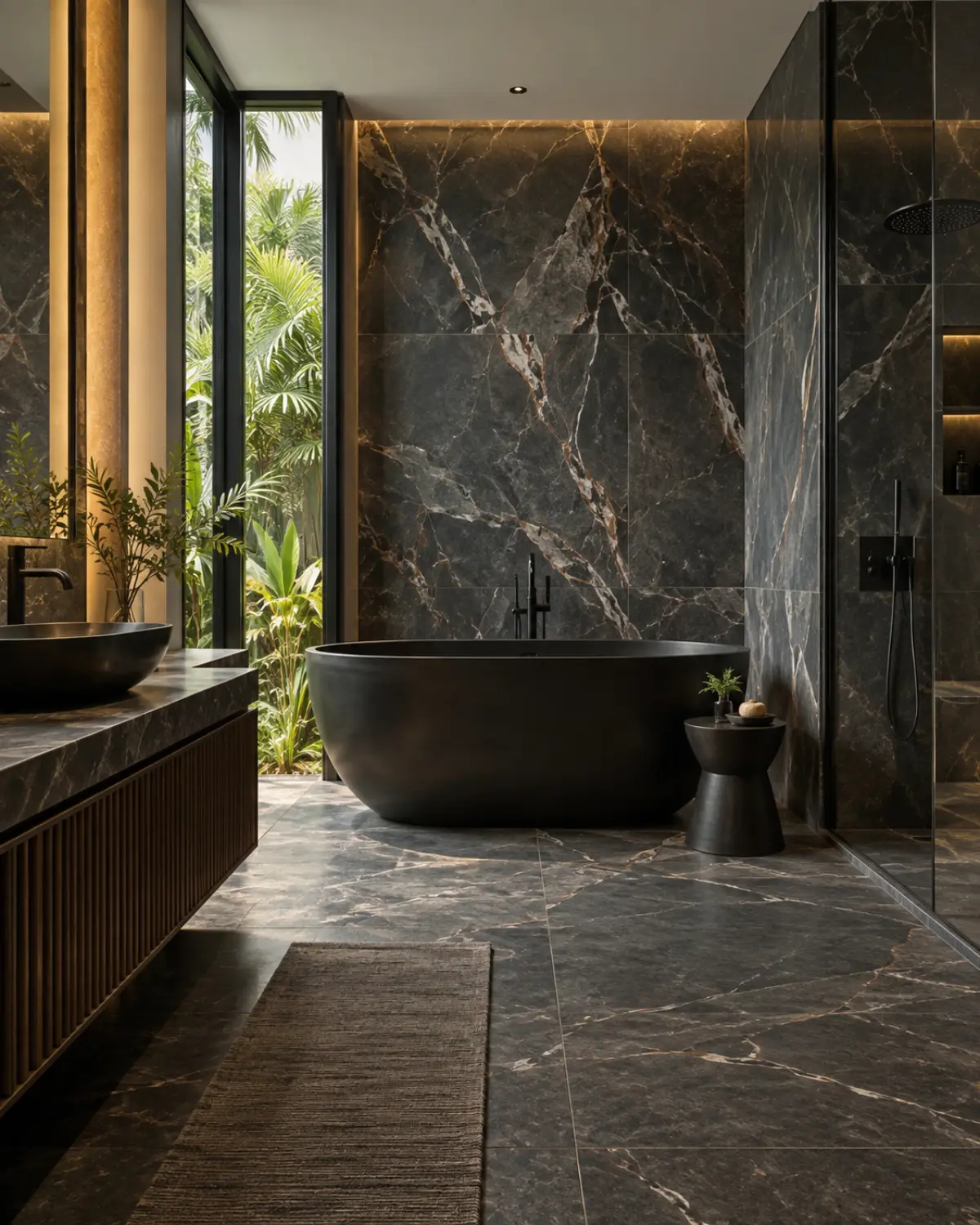
See this designBold Bathroom Tile
Charcoal · Oxblood · Smoked Oak
See this design
Heritage Bathroom Tile
Teak · Cane · Antique Brass
See this design
Classic Bathroom Tile
Ivory · Statuario · Gold
See this design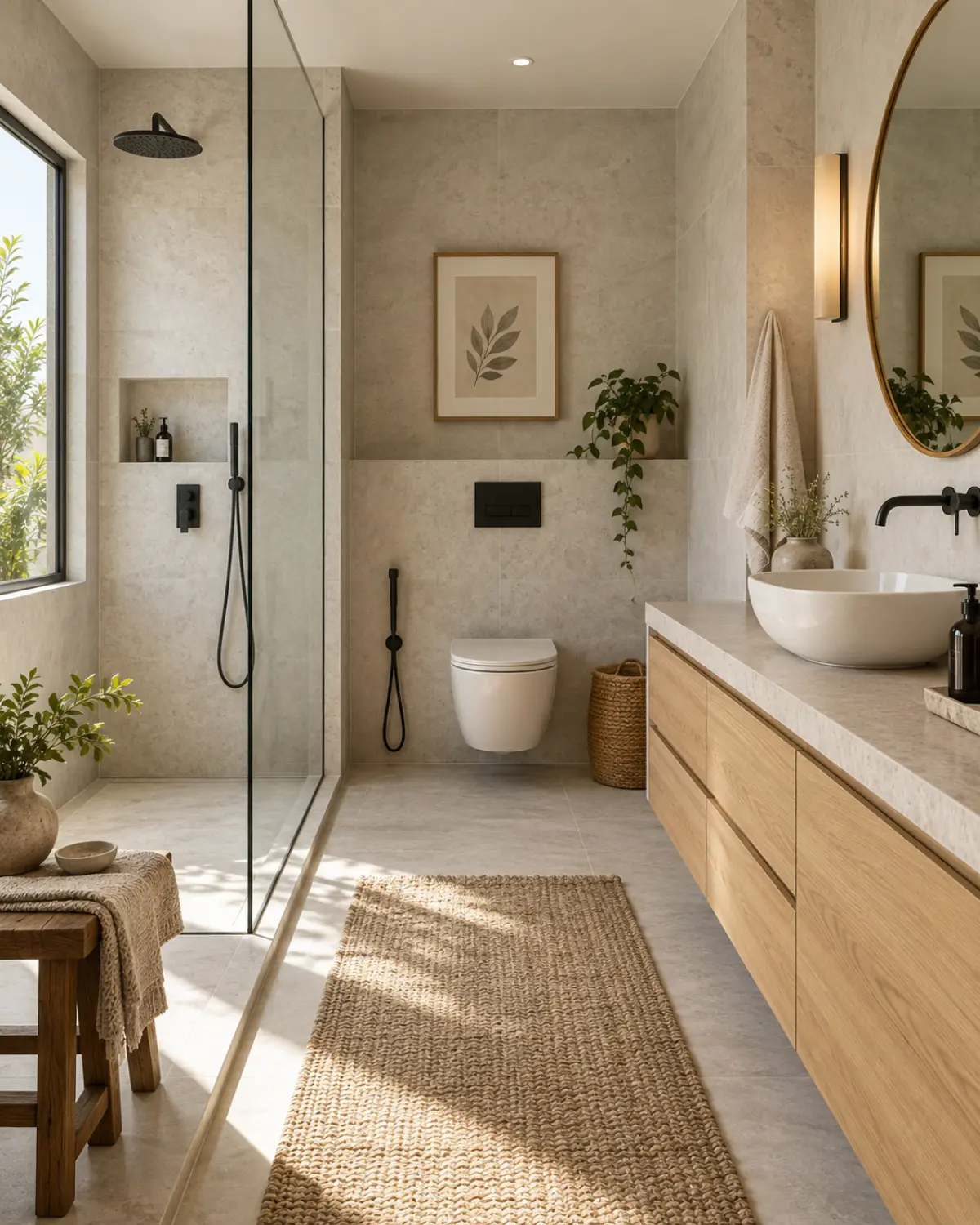
Scandi Bathroom Tile
Birch · Chalk · Sage
See this design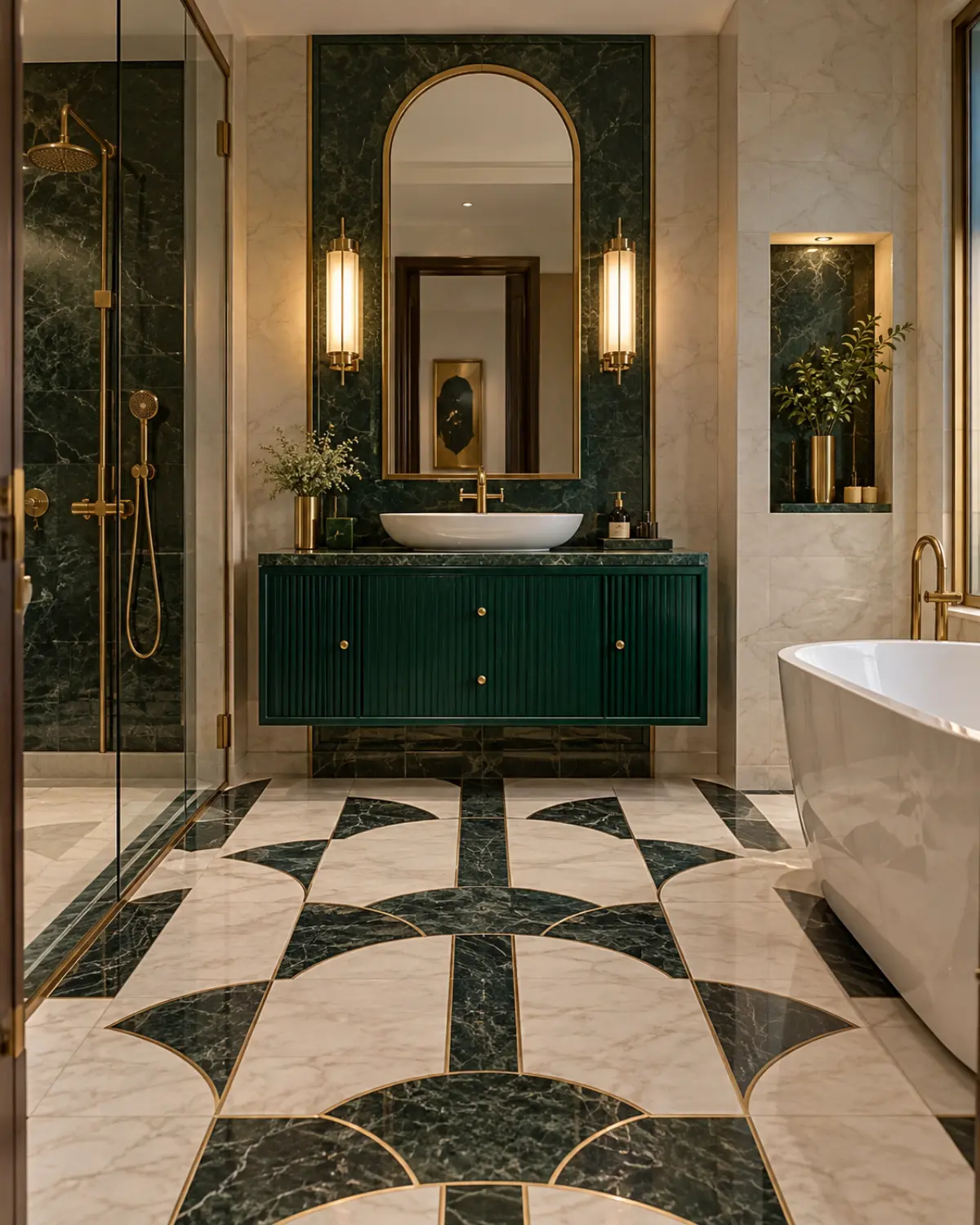
Deco Bathroom Tile
Emerald · Brass · Lacquer
See this designDesigns
Bathroom Tile Designs in four house styles
Setting-out and fall matter more than the tile. Plan the cuts to land full at the visible corners and slope the wet zone properly.
Chalk Minimal Large-format, minimal joint Tile Design
Nothing decorative survives unless it also does work. Long uninterrupted planes, shadow-gap joints, one quiet grain.
- Layout
- Large-format, minimal joint
- Style
- Serene Minimal
- Palette
- Chalk · Pale Oak · Linen
- Format
- 800×800 rectified porcelain
- Finish
- Honed matt
- Grout
- Colour-matched, 2mm
- Layout
- Grid, no offset
- Room dimension
- Full wet areas plus the foyer
Storage features
- Full-height tiling to remove a paint maintenance line
- A tiled niche in the shower wall
- A tiled skirting detail
Special features
- One tile size everywhere so joints line through
- Grout the exact colour of the tile
- Joints set out to land full at the corners
Ideal forHomes wanting the quietest possible tiled surface
Charcoal Bold Ribbed charcoal, stack bond Tile Design
High contrast, confident mass, a single saturated move per room. Dark joinery held against light stone.
- Layout
- Ribbed charcoal, stack bond
- Style
- Bold Contemporary
- Palette
- Charcoal · Oxblood · Smoked Oak
- Format
- 300×600 ribbed, stack bond
- Finish
- Ribbed matt in charcoal
- Grout
- Dark, 3mm, epoxy
- Layout
- Stack bond, vertical
- Room dimension
- Full wet areas plus the foyer
Storage features
- A ribbed feature wall in the wet zone
- A tiled bench in the shower
- A recessed shampoo niche
Special features
- Ribbed tile turning a flat wall into texture
- Dark epoxy grout that stays clean
- Vertical stack bond adding apparent height
Ideal forBathrooms and kitchens wanting texture without pattern
Teak Heritage Handmade zellige Tile Design
Indian craft detailing on a contemporary frame — jaali, cane, inlay and hand-finished brass, used sparingly.
- Layout
- Handmade zellige
- Style
- Modern Heritage
- Palette
- Teak · Cane · Antique Brass
- Format
- 100×100 handmade zellige
- Finish
- Glazed with a variable gloss
- Grout
- Contrasting sand tone
- Layout
- Hand-laid with visible variation
- Room dimension
- Full wet areas plus the foyer
Storage features
- A zellige splashback behind the hob
- A hand-tiled niche
- A tiled counter return
Special features
- Handmade zellige with genuine colour variation
- Every tile slightly different
- A sand-toned grout that lets the variation read
Ideal forCraft-led homes where handmade variation is the point
Ivory Classic Book-matched slab Tile Design
Proportioned panelling, cornice and moulding, book-matched stone and warm gilt detail on ivory.
- Layout
- Book-matched slab
- Style
- Classic Luxe
- Palette
- Ivory · Statuario · Gold
- Format
- 1,200×2,400 slab, book-matched
- Finish
- Polished with a mitred edge
- Grout
- Matched to the vein
- Layout
- Book-matched butterfly
- Room dimension
- Full wet areas plus the foyer
Storage features
- A book-matched slab behind the vanity
- A slab return on the counter
- A mitred external corner
Special features
- Book-matched slabs opening symmetrically
- Mitred corners so no edge profile shows
- Grout matched to the vein
Ideal forFormal bathrooms and kitchens with a stone budget
Sizing
Dimensions by home size
| Home size | Typical room dimension | Layout that usually fits |
|---|---|---|
| 1 BHK | Bathroom only | Large-format, minimal joint |
| 2 BHK | Bathroom and kitchen splashback | Ribbed charcoal, stack bond |
| 3 BHK | Full wet areas plus the foyer | Handmade zellige |
| 4 BHK | All wet areas and formal floors | Book-matched slab |
| 4+ BHK / Villa | Full-home tile scheme | Subway, vertical stack |
Questions
Bathroom Tile Designs questions
How do I set out tile so it does not end on a sliver?
Start from the most visible corner and centre the field, so the cuts land equally at both ends and are never less than half a tile. Dry-lay the first row before fixing anything.
Should grout match or contrast?
Match it if you want the surface to read as one plane; contrast it if the pattern is the point. In kitchens and bathrooms use epoxy grout either way — it does not stain or harbour mould.
Can large-format tile go on walls?
Yes, with the right adhesive and back-buttering, and mechanical support for anything above about 1.2m in a single piece. It gives you far fewer joints, which is usually the goal.
Are handmade tiles harder to maintain?
The glaze is durable but the uneven surface holds more grease behind a hob. They are a beautiful choice for a splashback and a poor one for a shower floor.
One more thing
Before you decide on bathroom tile designs
How is bathroom tile designs priced?
Against a material schedule specific to this cut — the running length of joinery, the hardware specified and the finish grade, rather than a flat rate for the category as a whole.
What should I check before committing to bathroom tile designs?
Reserve 10–12% extra from the same batch. Cuts, wastage and a future repair all come out of that reserve, and a matching batch will not exist in two years.
What maintenance does it need long term?
Neutral cleaner weekly, spills wiped promptly, and re-sealing on a schedule. Avoid acidic cleaners entirely. Handled that way the surface outlives the rest of the interior.
Is Bathroom Tile Designs suitable for Indian kitchens?
Yes, with the right finish and sealing. The kitchen is the harshest surface environment in the house — turmeric, oil and standing water all attack an unsealed surface — so specify a dense, low-absorption grade, seal it before handover and re-seal annually.
How much extra material should I order?
Order 10–12% over the measured area for a straight lay and up to 20% where the pattern has to be matched or the room has many cuts. The reserve also covers a future repair, which is the reason it matters most.
Does Bathroom Tile Designs need sealing?
Anything with meaningful porosity does. A penetrating sealer does not change the look, it buys you the minutes between a spill and a stain. Test it by dropping water on the surface: if it darkens instead of beading, it is time to re-seal.
How does bathroom tile designs compare with the standard version of this category?
It is a narrower cut, not a cheaper or lesser one — setting-out and fall matter more than the tile. The specification discipline is identical to the parent category; only the brief is more specific.
Detail
Getting bathroom tile designs right
Detailing worth knowing
- Skirting is where a stone floor is won or lost. A shadow-gap or flush skirting keeps the plane clean; a proud skirting collects dust in exactly the line your eye follows.
- Set out from the most-seen corner, not the wall the mason starts at. Cut pieces belong behind furniture and under joinery, never at the entrance.
- Continuous veining across a wall and floor needs the slabs sequenced from one block. Ask for the block number on the invoice.
- Grout colour changes the surface more than most people expect. A shade darker than the stone reads as a grid; a shade lighter disappears.
Mistakes worth avoiding
- Buying on a sample the size of a postcard. Pattern and veining only make sense at slab scale — always see a full slab or a laid-out mock-up.
- Sealing a damp surface. Sealer applied before the substrate has dried traps moisture and produces a cloudy bloom that has to be ground back.
- Ignoring movement joints on large floors. A continuous stone floor over 6m without a joint will telegraph every structural movement as a crack.
- Treating polish as permanent. Every polished surface is a maintenance commitment; if that is not wanted, a honed or leathered finish is the honest choice.
Next step
Talk it through with a designer.
Bring the plan and the constraint. We will tell you honestly whether this is the right approach for your room.