Wall Decor · Modern Heritage
Teak Heritage Craft panel in teak and brass Wall Decor Design
Indian craft detailing on a contemporary frame — jaali, cane, inlay and hand-finished brass, used sparingly. Walls are the last thing done and the first thing seen. We plan the hanging lines and the lighting at design stage, not after the paint has dried.

Specification
Wall Decor design details
| Detail | Specification |
|---|---|
| Layout | Craft panel in teak and brass |
| Style | Modern Heritage |
| Palette | Teak · Cane · Antique Brass |
| Format | Carved teak relief panel |
| Framing | Teak frame with a brass corner |
| Hanging | Panel fixed on a French cleat |
| Lighting | Brass uplight grazing the carving |
| Home size | Room dimension |
|---|---|
| 1 BHK | One piece per room |
| 2 BHK | Gallery wall in the living room |
| 3 BHK | Craft panel in the foyer |
| 4 BHK | Symmetrical scheme in formal rooms |
| 4+ BHK / Villa | Full curated scheme |
Storage features
- A ply backing behind the plaster for the panel weight
- Concealed uplight in the skirting
- A shelf for objects
Special features
- A hand-carved teak relief panel
- Brass uplight grazing across the carving
- Craft treated as architecture
Ideal forCraft-led homes wanting a made object on the wall
Compare
The same wall decor in the other five styles
One brief, six resolutions. Each carries its own layout, material specification and storage strategy.
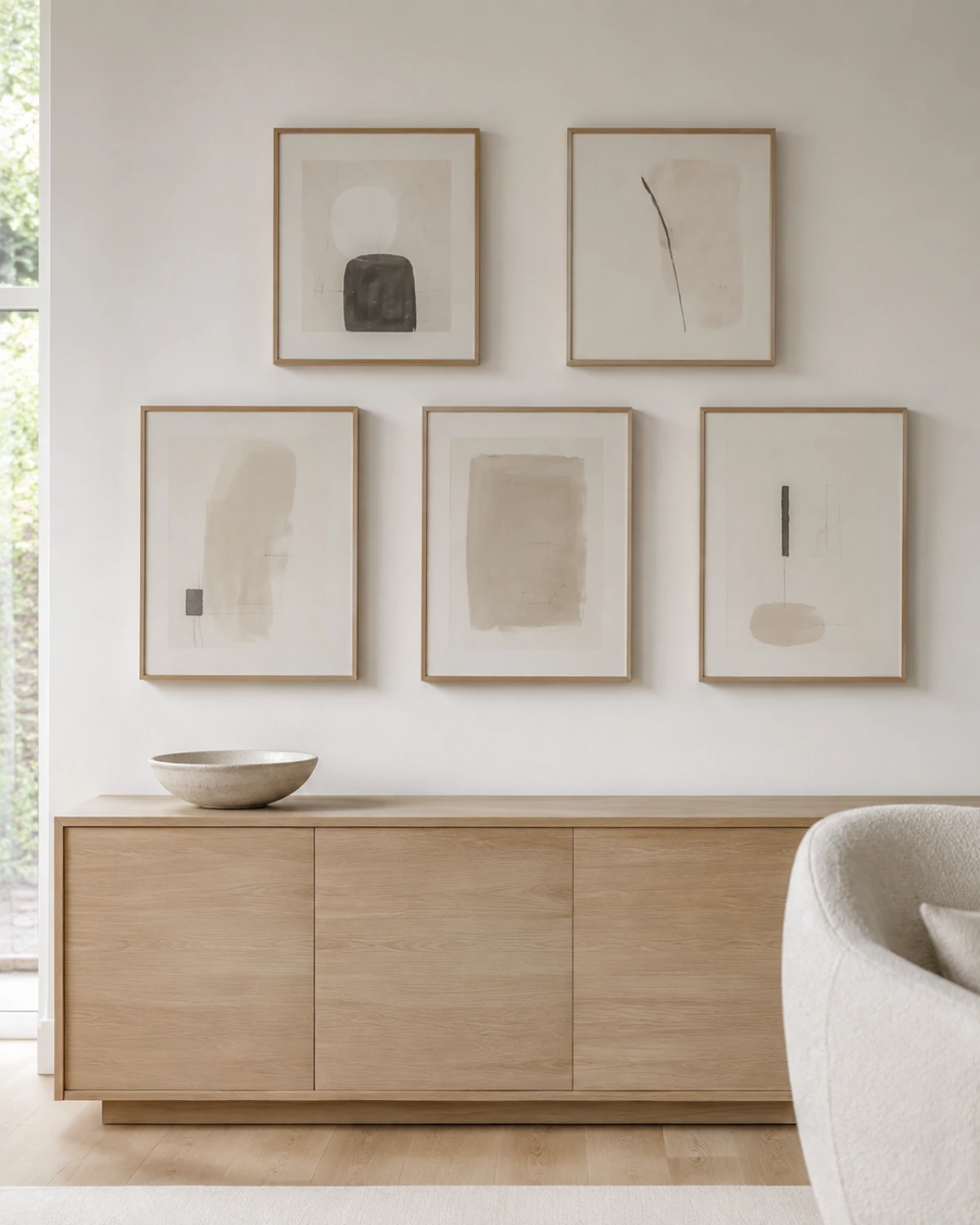
Minimal Single large artwork Wall Decor
Chalk · Pale Oak · Linen
See this design
Bold Dark gallery wall Wall Decor
Charcoal · Oxblood · Smoked Oak
See this design
Classic Symmetrical gilt-framed pair Wall Decor
Ivory · Statuario · Gold
See this design
Scandi Open shelf with objects Wall Decor
Birch · Chalk · Sage
See this design
Deco Mirror and brass composition Wall Decor
Emerald · Brass · Lacquer
See this designDetail
Specifying and living with this wall decor
Indian craft detailing on a contemporary frame — jaali, cane, inlay and hand-finished brass, used sparingly. That governs every material decision on this page — the layout and the storage strategy come first, and wall decor is where the modern heritage palette gets applied to a plan that already works.
A specification is only as good as what happens after handover. wall decor in this style is chosen as much for how it ages as for how it photographs on day one — the joinery finish, the hardware grade and the way an edge is sealed all show up in year three, long after the render is forgotten.
Modern Heritage is a coherent palette rather than a fixed rule, and most finished homes borrow across two styles rather than committing to one throughout. What rarely works is switching the palette room to room within one sightline — the transition needs a threshold, a change of material, or a corridor to read as intentional rather than accidental.
The specification below is what we issue to the factory and the site for this exact style and layout. It is also what a warranty is enforced against, which is why it is written as grades and dimensions rather than as adjectives.
Nothing on this page is a fixed catalogue item. The layout, the palette and every material line are redrawn against your own room dimensions before anything is priced — what you see here is the starting specification, not the finished drawing.
Modern Heritage suits a household that already knows roughly what it wants a wall decor to feel like, rather than one still deciding between opposites — the palette is distinctive enough that it rewards commitment and looks unresolved applied half-heartedly.
This reads best in a home where at least the adjoining rooms share the same direction, even if not the same materials. Modern Heritage carried into one room and abandoned at the next doorway tends to make both rooms look like an afterthought rather than a choice.
If you are drawn to modern heritage but unsure it will hold up to daily use, that is worth raising directly at the survey — the palette can usually be adapted toward more forgiving materials without losing the character that made it appealing in the first place.
Worth checking before sign-off
- Size to the wall and the furniture below it. Art hung at two-thirds the width of the sofa is the reliable proportion; anything smaller floats.
- Hang the centre at eye level — around 60″ — regardless of ceiling height. Art hung high to fill a wall never looks right.
- Light it deliberately with a narrow-beam framing spot. Unlit art in a well-lit room disappears at night.
- Buy for the room's light. Colours that sing in a gallery can go flat under warm domestic lighting.
- Use museum or anti-reflective glass where the piece faces a window; otherwise you will look at a reflection of the window.
- Fix into structure, not into a false ceiling or a hollow panel, and use two points so the piece cannot rotate.
Living with it
- Keep works on paper out of direct sun entirely; UV damage is cumulative and cannot be reversed.
- Dust frames with a dry cloth and never spray cleaner onto glass near a frame edge.
- Check hanging fixings annually, particularly for heavy pieces on plasterboard.
- Rotate seasonal pieces rather than leaving everything up permanently; a room reads better when it changes.
Mistakes worth avoiding
- Hanging too high and too small — the two errors that account for most badly hung walls.
- Lighting art with the same downlights that light the room.
- Fixing heavy pieces into gypsum without a backing plate.
- Buying to fill a wall rather than because the piece is wanted.
Budget on a wall decor in this style moves with a small number of decisions rather than with the style label itself: the work itself, which is a market rather than a specification. and framing and glazing, where museum glass is a significant addition. are usually the two line items that separate two otherwise similar quotes. Lighting: a framing projector costs several times a standard spot and does a different job.
Detailing
Finer points of this wall decor
A group of works reads as one piece if the spacing between them is tighter than the distance from the group to the furniture.
Leave 8–10″ between the top of a sofa back and the bottom of the frame.
In a corridor, hang along one wall only and light from the opposite side to avoid glare as you walk.
Objects on a console want odd numbers and varied heights; three pieces at three heights beat five at the same height.
Questions
Wall Decor in Modern Heritage — answered
How do I light it?
A narrow-beam framing spot or an adjustable track head at roughly 30 degrees from vertical, aimed to avoid glare from the glass. Lighting is the difference between owning art and seeing it.
What size should I choose?
Roughly two-thirds the width of the furniture beneath, or a group that reads as a single mass of that width. Undersized art is the most common error in otherwise well-finished rooms.
Can pieces be fixed to a false ceiling or panelled wall?
Only into the structure behind. Anything over a few kilos needs a backing plate or a fixing into the sub-frame, planned before the panelling closes up.
How is wall Decor protected from Indian light and humidity?
Keep works on paper out of direct sun and use UV-filtering glazing. In coastal humidity, leave an air gap behind the frame rather than fixing it flush to the wall.
Should I buy as a set?
A considered set works in a corridor or a stair wall. Elsewhere, one strong piece almost always beats three safe ones.
Questions
Wall Decor questions
At what height should artwork be hung?
Centre of the piece at about 60″ from the floor — roughly eye level. Above a sofa or console, drop it so the gap to the furniture below is 8–10″.
How do I plan a gallery wall?
Lay it out on the floor first, keep a consistent gap of 2–3″, and align either a common centre line or a common top line. Mixed frames work if the gap and the mounts stay consistent.
Can heavy mirrors be hung on plasterboard?
Not on the board alone. You need a ply backing or fixings into the studs. Plan this before the wall is closed if you can — retro-fitting means opening the wall.
What lighting suits artwork?
A recessed adjustable spot at about 30 degrees from vertical, or a picture light on the frame. Aim it so the beam covers the piece without hitting the glass at the viewer's eye angle.
Next step
Build this wall decor.
Send the floor plan and the room dimensions. We come back with this design adapted to your space and priced line by line.