Compare
Door: six styles, side by side
The same door brief resolved six ways. Doors set the quality of a house before anyone touches a finish. Ironmongery and reveal detail are where the money shows.

Side by side
All six, in one row
Scroll sideways to compare, or filter down to the styles you are choosing between.
- Layout
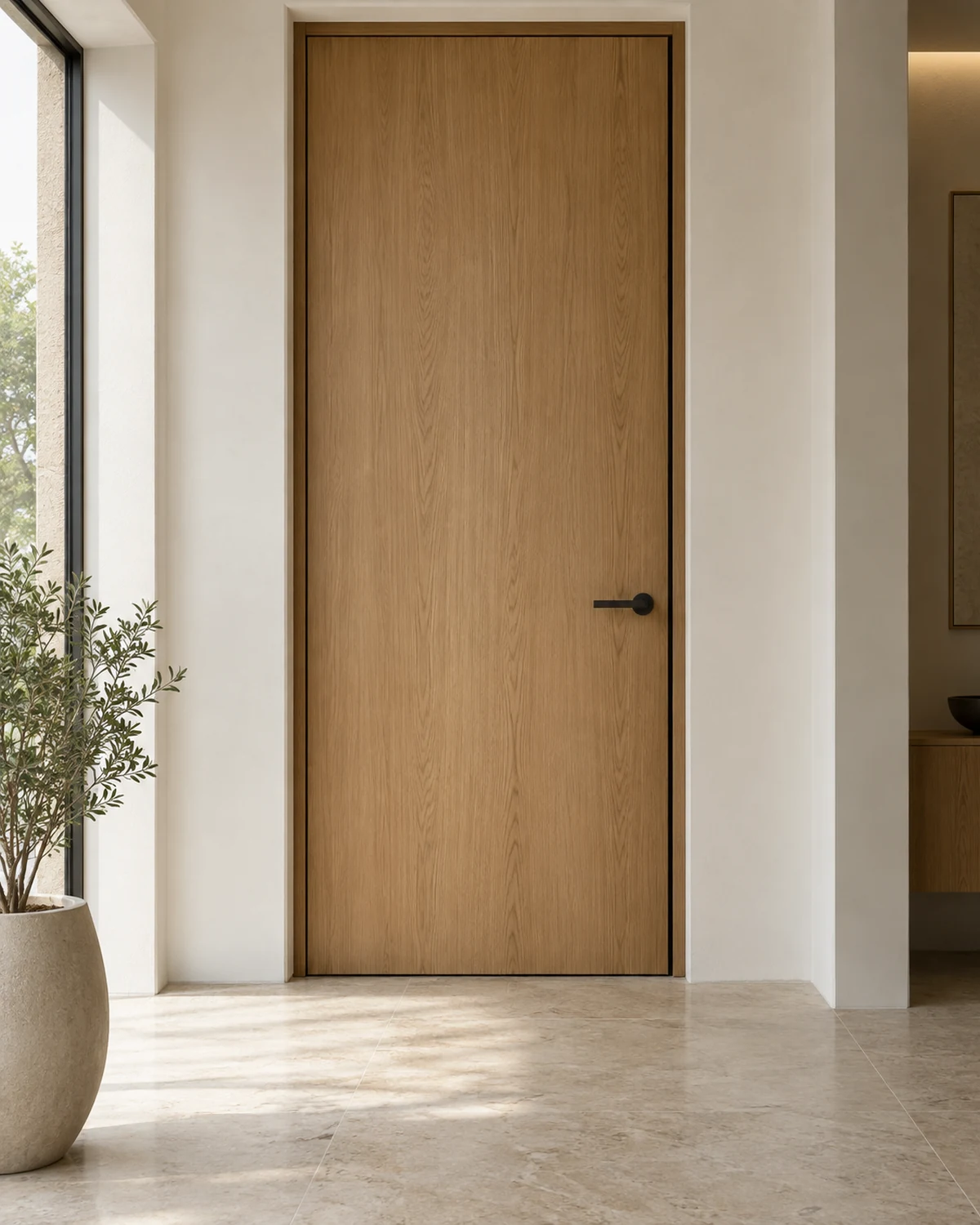
- Flush, floor-to-ceiling
- Leaf
- Flush ply, chalk laminate
- Frame
- Concealed frame, no architrave
What changes: A floor-to-ceiling flush leaf that reads as wall.
- Layout
- Dark pivot with a black frame
- Leaf
- Solid-core pivot, charcoal veneer
- Frame
- Black powder-coated steel
What changes: A wide pivot door turning on a floor spring.

- Layout
- Carved teak with brass
- Leaf
- Solid teak, hand-carved
- Frame
- Teak frame with a carved head
What changes: A hand-carved teak leaf with a decorated head.

- Layout
- Panelled with a moulded architrave
- Leaf
- Moulded panel door, ivory PU
- Frame
- Moulded architrave with a gilt bead
What changes: A classical panelled door with a moulded architrave.

- Layout
- Birch flush with a cane insert
- Leaf
- Birch flush with a cane vision panel
- Frame
- Birch frame, square edge
What changes: A cane vision panel keeping the passage bright.

- Layout
- Fluted with brass inlay
- Leaf
- Fluted lacquer with brass inlay
- Frame
- Brass-trimmed frame
What changes: Vertical fluting with brass inlay between panels.
At a glance
The differences in one table
| Style | Layout | Leaf | Ideal for |
|---|---|---|---|
| Serene Minimal | Flush, floor-to-ceiling | Flush ply, chalk laminate | Homes wanting doors to disappear into the wall |
| Bold Contemporary | Dark pivot with a black frame | Solid-core pivot, charcoal veneer | Apartments wanting a dramatic entrance or study door |
| Modern Heritage | Carved teak with brass | Solid teak, hand-carved | Craft-led homes wanting timber at every threshold |
| Classic Luxe | Panelled with a moulded architrave | Moulded panel door, ivory PU | Formal villas and larger apartments |
| Indo-Scandinavian | Birch flush with a cane insert | Birch flush with a cane vision panel | Bright family homes with dark internal passages |
| Art Deco Glam | Fluted with brass inlay | Fluted lacquer with brass inlay | Premium apartments where doors are a design feature |
Sizing
Door dimensions by home size
| Home size | Typical room dimension | Layout that usually fits |
|---|---|---|
| 1 BHK | Standard 36×84″ | Flush, floor-to-ceiling |
| 2 BHK | Full-height 36×96″ | Dark pivot with a black frame |
| 3 BHK | Double 60×96″ | Carved teak with brass |
| 4 BHK | Pivot 43×106″ | Panelled with a moulded architrave |
| 4+ BHK / Villa | Bespoke to the opening | Birch flush with a cane insert |
How to choose
Picking between the six
The honest way to choose is to eliminate rather than select: rule out the styles that clash with what is already fixed in the home — the flooring, the window frames, an existing kitchen you are not replacing — and choose from what remains. Most people arrive certain about one style and leave having picked a different one once the elimination is done.
Layout tends to decide the choice before palette does. Two or three of the six styles above will suit your actual room dimensions and door positions; the rest will look right in the photograph and fight the room in practice. Start from the layout column in the table below, not the material column.
If two styles both work on paper, the deciding question is usually maintenance: how much upkeep the household will actually do. A high-gloss Bold scheme and a hand-oiled Heritage one both look considered on day one; only one of them stays that way without regular attention.
A door reads best when its frame is either flush with the wall plane or expressed deliberately. The half-hearted 1/2″ architrave is what makes joinery look builder-grade.
Floor clearance should be set for the finished floor plus any rug. Doors planed on site after flooring never look right at the bottom edge.
Pivot doors need a structural head and a level floor. Both are civil decisions taken long before the door is ordered.
Where a door leads to a bathroom, undercut it for return air or the exhaust fan will not move anything.
Questions
Choosing a door style
Which of these six suits a family with young children?
Serene Minimal and Indo-Scandinavian tend to wear best under daily family use — pale, matt surfaces show less than high gloss, and both specify durable, easily cleaned materials by default. Bold Contemporary and Art Deco Glam ask for more careful living.
Can door mix two of these styles in one room?
Within reason. The six are coherent palettes rather than fixed rules, and most finished homes borrow across two. What rarely works is switching palette within one sightline in the same room.
Does the layout change between styles, or only the material?
Both. Each style resolves the door brief with a different layout logic as well as a different material direction — see the layout column in the table above for exactly how.
Which style costs the least for a door?
None of the six carries an inherent price premium over the others at the same specification tier — the cost difference between two door projects usually comes from hardware grade and finish level, not from which of the six styles was chosen.
How do I see my own room in more than one of these styles?
Bring the floor plan to a consultation. We draw your actual room in the two or three styles you are choosing between rather than a generic version of each, which is usually what settles it.
Do the six styles take different lengths of time to build?
Not meaningfully — the production and installation programme for a door runs on joinery quantity and finish complexity rather than on which palette is chosen. A heavily detailed scheme in any of the six styles adds time; a restrained one in any of the six saves it.
Can I see this comparison for a room size other than the default shown?
Yes — the door category page carries the full sizing table across every home size, in all six styles, if you want the comparison scaled to your own room.
More questions
Door — the practical side
Living with door, whichever style you choose
- Lubricate hinges and locks once a year with a dry lubricant, not oil, which attracts dust.
- Clean sliding tracks quarterly; grit is what wears a roller and makes a heavy slide.
- Check external frame sealant annually before the monsoon and renew where it has separated.
- Wipe condensation off double-glazed frames in winter in northern cities to protect the seal.
How is Door measured and ordered?
The opening is measured on site after plaster, with the finished floor level marked. Ordering from a drawing dimension instead of a site dimension is the most common cause of a door that never closes properly.
What is the lead time?
Four to eight weeks for made-to-order work. Site measurement, shop drawing approval and factory production are the three stages, and the approval stage is usually the one that slips.
Does it need maintenance?
Annual hardware lubrication, quarterly track cleaning where it slides, and an annual check of external sealant. That is all a well-installed opening needs.
Can it improve sound insulation?
Yes, substantially, but through the seal and frame rather than the leaf alone. A well-sealed solid-core door outperforms a heavier door hung with gaps.
How does Door handle Indian weather?
Correctly specified, well. The failures we see are water at the frame junction, timber used externally without protection, and glass chosen without regard to orientation.
Is a warranty provided?
Yes, on manufacturing and finish. Hardware carries the manufacturer's own warranty, which is why we specify hardware by model rather than by category.
More comparisons
Other rooms, side by side
Next step
Choose your door style with a designer.
Send the plan. We will draw your actual room in the two you are torn between and put them next to each other.