Crockery Unit · Serene Minimal
Chalk Minimal Wall-hung glass display Crockery Unit Design
Nothing decorative survives unless it also does work. Long uninterrupted planes, shadow-gap joints, one quiet grain. A crockery unit is a display problem and a storage problem at once. What goes behind glass has to earn it; everything else gets a door.

Specification
Crockery Unit design details
| Detail | Specification |
|---|---|
| Layout | Wall-hung glass display |
| Style | Serene Minimal |
| Palette | Chalk · Pale Oak · Linen |
| Body | Chalk laminate, wall-hung |
| Doors | Frameless clear glass |
| Interior | Pale grey melamine, unlit |
| Lighting | None — daylight only |
| Home size | Room dimension |
|---|---|
| 1 BHK | 3×6 feet wall-hung |
| 2 BHK | 4×7 feet |
| 3 BHK | 6×8 feet |
| 4 BHK | 8×9 feet full height |
| 4+ BHK / Villa | 10×9 feet with a bar |
Storage features
- Two glazed shelves above, closed storage below
- A drawer for table linen
- A base cabinet for serving dishes
Special features
- Frameless glass so only the contents read
- Closed storage below keeping the clutter invisible
- Wall-hung, floor left clear
Ideal forCompact dining areas needing display without bulk
Compare
The same crockery unit in the other five styles
One brief, six resolutions. Each carries its own layout, material specification and storage strategy.
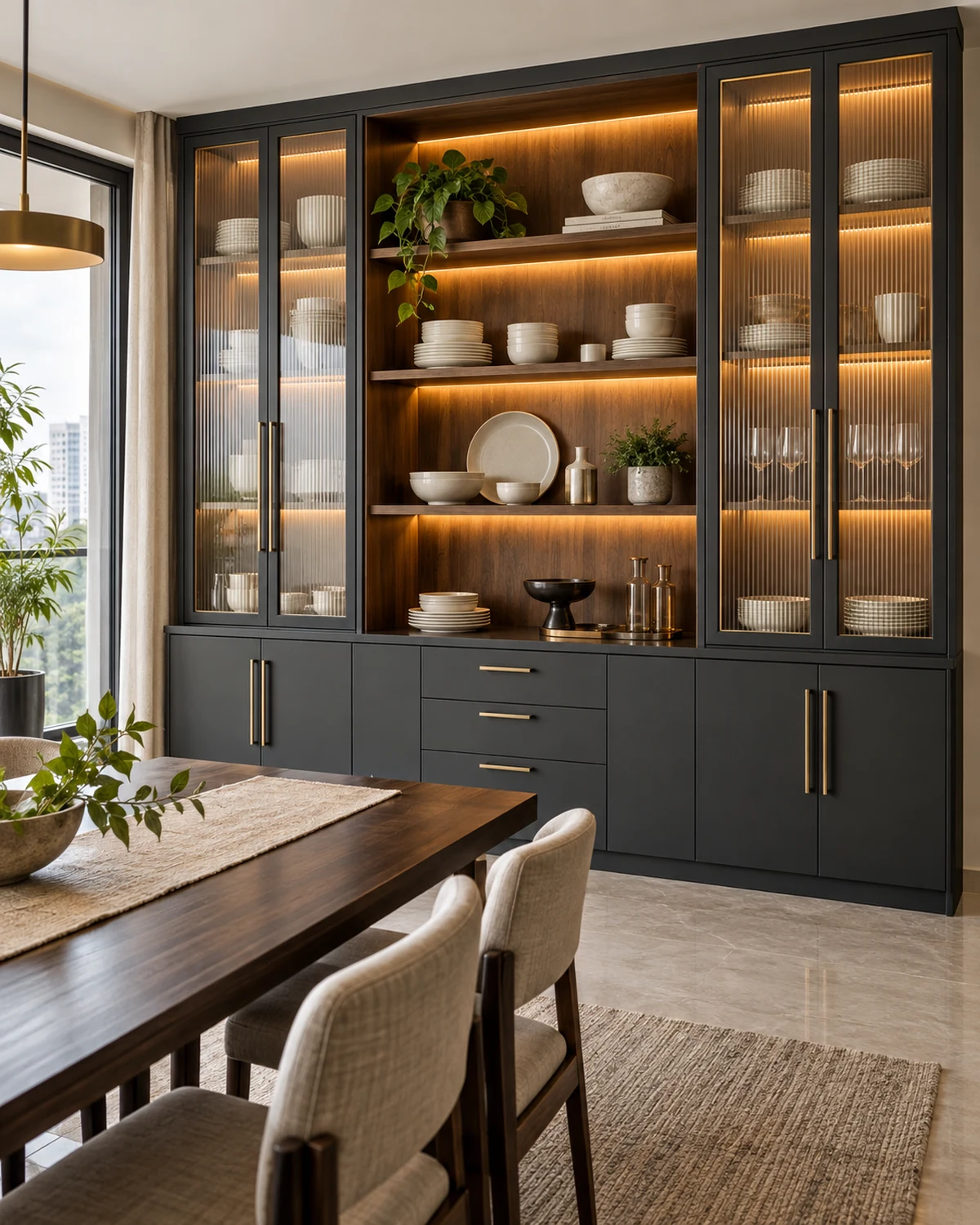
Bold Dark full-height with lit bays Crockery Unit
Charcoal · Oxblood · Smoked Oak
See this design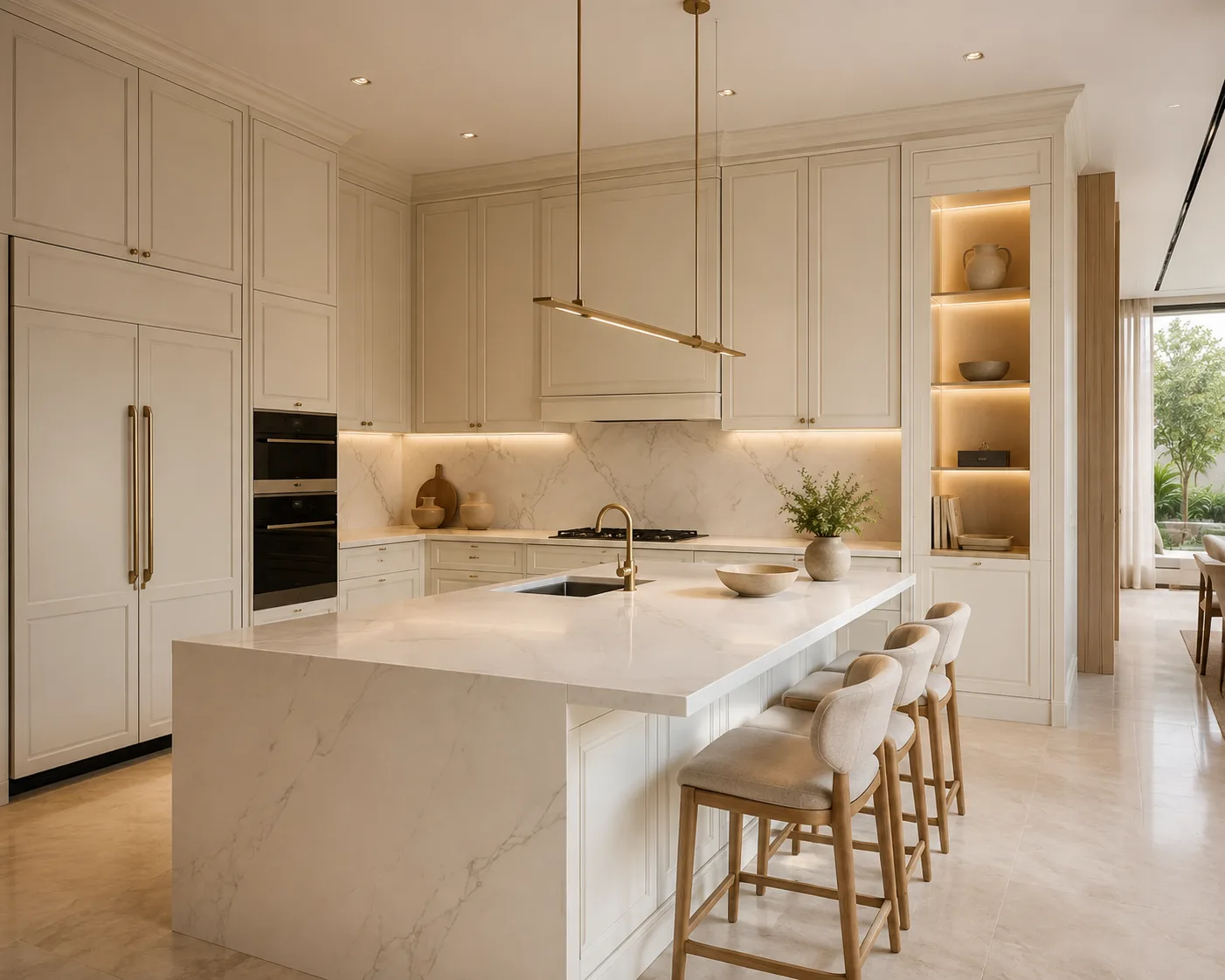
Heritage Teak with cane and glass Crockery Unit
Teak · Cane · Antique Brass
See this design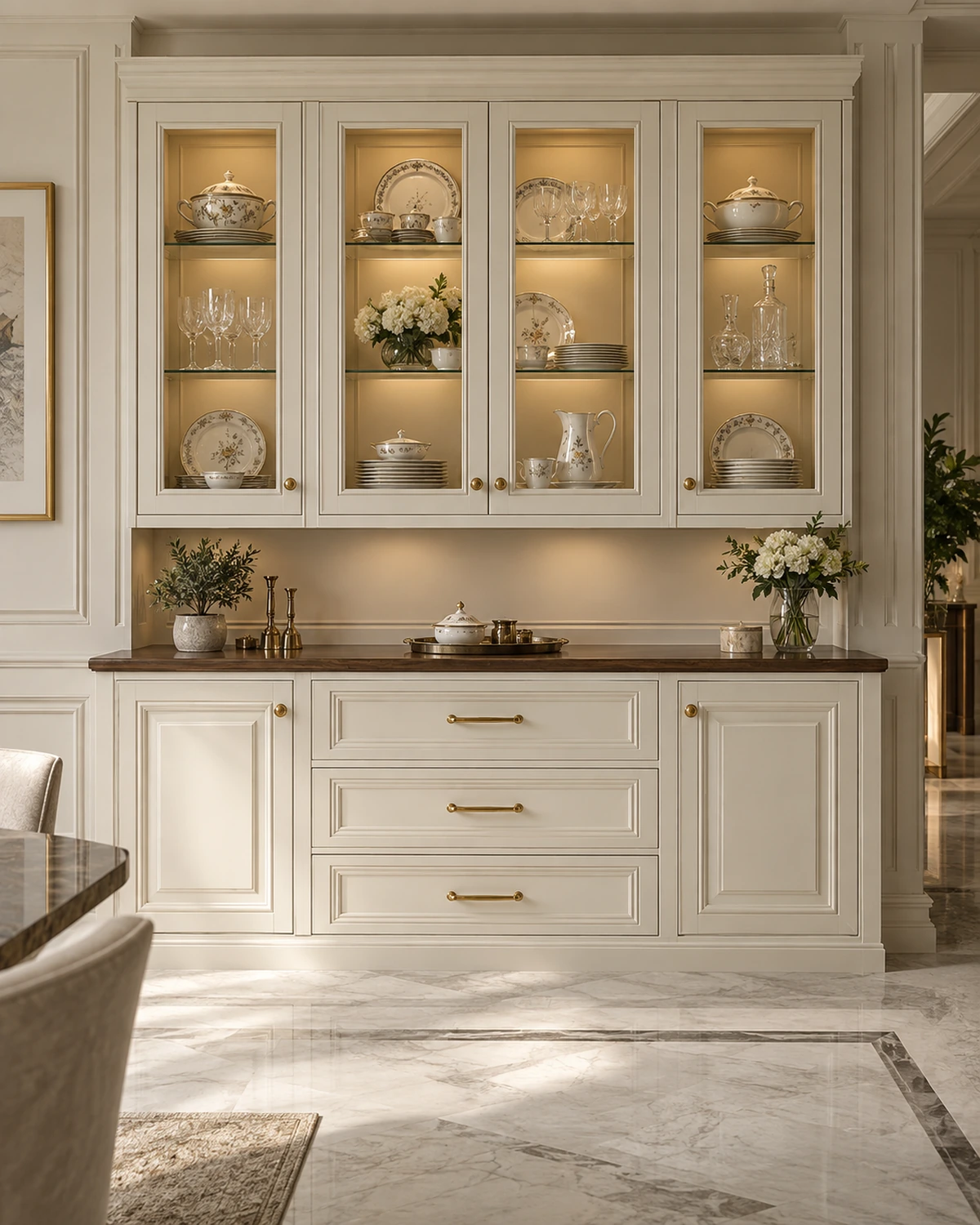
Classic Glazed classic with a gilt bead Crockery Unit
Ivory · Statuario · Gold
See this design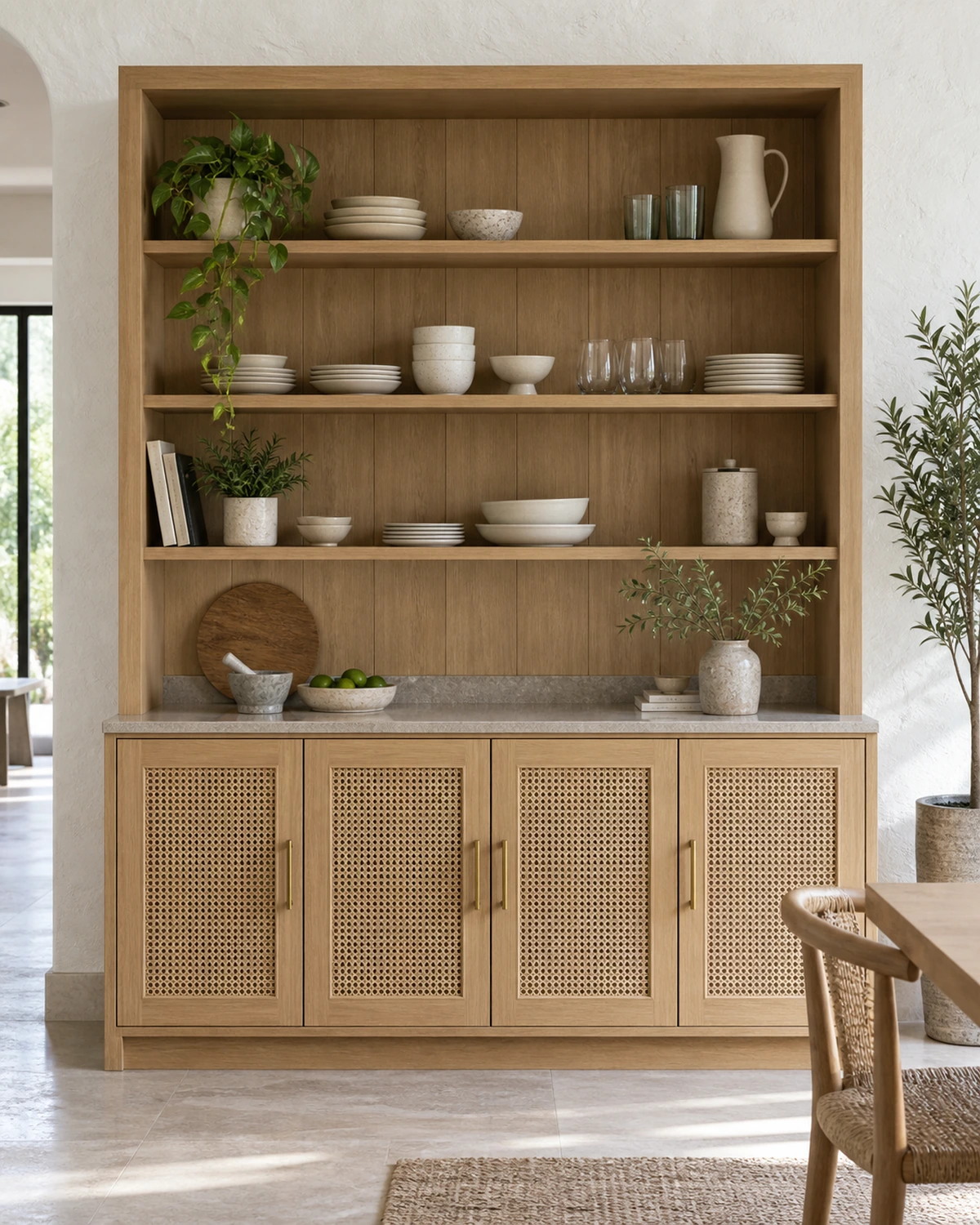
Scandi Birch open shelving Crockery Unit
Birch · Chalk · Sage
See this design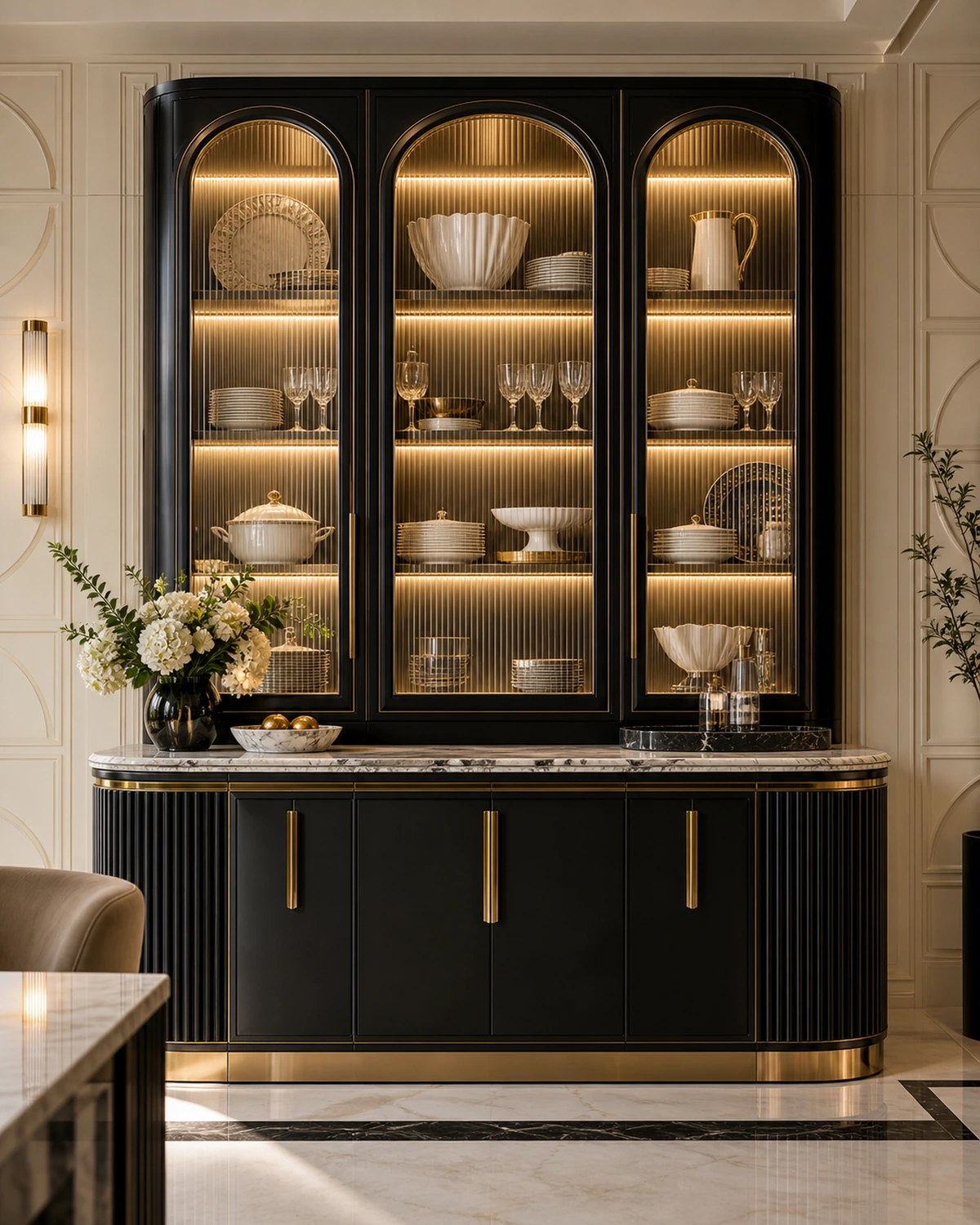
Deco Fluted with mirror-backed bays Crockery Unit
Emerald · Brass · Lacquer
See this designDetail
Specifying and living with this crockery unit
Nothing decorative survives unless it also does work. Long uninterrupted planes, shadow-gap joints, one quiet grain. That governs every material decision on this page — the layout and the storage strategy come first, and crockery unit is where the serene minimal palette gets applied to a plan that already works.
A specification is only as good as what happens after handover. crockery unit in this style is chosen as much for how it ages as for how it photographs on day one — the joinery finish, the hardware grade and the way an edge is sealed all show up in year three, long after the render is forgotten.
Serene Minimal is a coherent palette rather than a fixed rule, and most finished homes borrow across two styles rather than committing to one throughout. What rarely works is switching the palette room to room within one sightline — the transition needs a threshold, a change of material, or a corridor to read as intentional rather than accidental.
The specification below is what we issue to the factory and the site for this exact style and layout. It is also what a warranty is enforced against, which is why it is written as grades and dimensions rather than as adjectives.
Nothing on this page is a fixed catalogue item. The layout, the palette and every material line are redrawn against your own room dimensions before anything is priced — what you see here is the starting specification, not the finished drawing.
Serene Minimal suits a household that already knows roughly what it wants a crockery unit to feel like, rather than one still deciding between opposites — the palette is distinctive enough that it rewards commitment and looks unresolved applied half-heartedly.
This reads best in a home where at least the adjoining rooms share the same direction, even if not the same materials. Serene Minimal carried into one room and abandoned at the next doorway tends to make both rooms look like an afterthought rather than a choice.
If you are drawn to serene minimal but unsure it will hold up to daily use, that is worth raising directly at the survey — the palette can usually be adapted toward more forgiving materials without losing the character that made it appealing in the first place.
Worth checking before sign-off
- Sit on it for ten minutes, not ten seconds. Seat depth and back angle decide comfort, and neither is visible in a photograph.
- Ask what the frame is. Kiln-dried hardwood holds its geometry in Indian humidity; particle-board frames do not, whatever the upholstery costs.
- Check the foam density, not the softness. A low-density foam feels identical in the showroom and collapses in eighteen months.
- Measure the route into the room — lift, stair turn, door width — before ordering anything large. It is the most common reason a piece goes back.
- For leather, ask whether it is full-grain, top-grain or bonded. The three age in completely different directions.
- Confirm whether covers are removable. In a house with children or pets, that single feature decides the piece's life.
Living with it
- Rotate and plump loose cushions weekly. Nearly all uneven wear in a sofa comes from one favourite seat.
- Keep upholstery out of direct sun; it fades far faster than the frame ages.
- Vacuum upholstery monthly with a brush head. Dust in the weave is what cuts fibres over time.
- Feed leather twice a year with the manufacturer's conditioner — Indian summers dry it faster than European guidance assumes.
Mistakes worth avoiding
- Buying to the showroom's scale rather than the room's. Showrooms are enormous and everything looks smaller in them.
- Ordering a fixed-cover sofa for a family with young children.
- Ignoring the lift and stair dimensions until delivery day.
- Choosing a low seat height for a household with elderly members.
Budget on a crockery unit in this style moves with a small number of decisions rather than with the style label itself: frame construction and whether the joints are engineered or bolted. and fill quality and the suspension system, which are invisible and decide the life. are usually the two line items that separate two otherwise similar quotes. Fabric grade — the same sofa in three fabrics can span a wide price range.
Detailing
Finer points of this crockery unit
Leave 30″ of circulation behind a dining chair pulled out, and 16″ between a sofa and a coffee table. Rooms fail on these two numbers more than on style.
A sofa floated off the wall usually makes a room look larger, not smaller, because it lets the floor read as continuous behind it.
Match the seat height to the flooring build-up. A 3/4″ rug plus a 16-1/2″ seat is a different chair to sit in.
Specify the arm width honestly: a 8″ arm on a three-seater removes a whole seat of usable width.
Questions
Crockery Unit in Serene Minimal — answered
How should crockery Unit be maintained?
Weekly rotation of cushions, monthly vacuuming with a brush head, no direct sun, and conditioning for leather twice a year.
Is there a warranty?
Frames and suspension carry a multi-year warranty; upholstery and finishes are warranted against manufacturing defects rather than wear.
Can Crockery Unit be made to a custom size?
Yes. Bespoke sizing is the main reason to build rather than buy, and it costs less than most people expect — usually 10 to 20% over a standard size in the same specification.
How long is the lead time?
Six to twelve weeks depending on the frame, fabric and finish. Imported fabric is usually the long pole, so it is chosen first.
What is the right fabric for a family home?
A performance weave with a removable cover. It resists staining, cleans without specialist help, and can be replaced in five years without replacing the piece.
Questions
Crockery Unit questions
What should actually go behind glass?
Things that look better in a set — glassware, a dinner service, brass. Daily mismatched crockery behind glass just makes the unit look untidy; give it a door.
Does a crockery unit need lighting?
If it is glazed, yes. A concealed strip at the front edge of each shelf lights the contents rather than the back panel, which is what makes a display read.
How deep should a crockery unit be?
12–14″ for display and everyday crockery, 18″ for the base if it needs to take large platters and appliances. A stepped unit — deep below, shallow above — works best.
Can it be combined with a bar?
It is one of the better combinations. Put stemware and bottles in the lit glazed section and the everyday storage in the closed base.
Next step
Build this crockery unit.
Send the floor plan and the room dimensions. We come back with this design adapted to your space and priced line by line.