Finishes
Wood Veneer
Wood Veneer, specified the way a site actually needs it — format, substrate, fixing, sealing and the maintenance the family will really do.
Overview
Wood Veneer, in plain specification
Written for the decision, not for the mood board.
We specify wood veneer against three questions: what the surface has to survive, how it will be cleaned, and who repairs it in five years. A material that answers all three is worth more than a material that only looks better in a showroom.
Wood Veneer is chosen twice — once for how it looks in a sample, and once for how it behaves over a decade of Indian weather, cleaning and daily use. The second choice is the one that decides whether you are happy with it. Every specification on this page is written from that second view: the substrate under it, the way it is fixed, the joint it sits in, and the maintenance it will realistically get in a working household.
In our work this sits alongside the rest of the home rather than as an isolated decision. Wood Veneer touches the electrical layout, the ceiling, the flooring build-up and often the civil work, so it is fixed early in the drawing set and reviewed against every other trade before production starts.
Six house styles
Wood Veneer in six personalities
The same brief resolved six ways. Each carries its own material, finish and detailing.
Minimal Wood Veneer
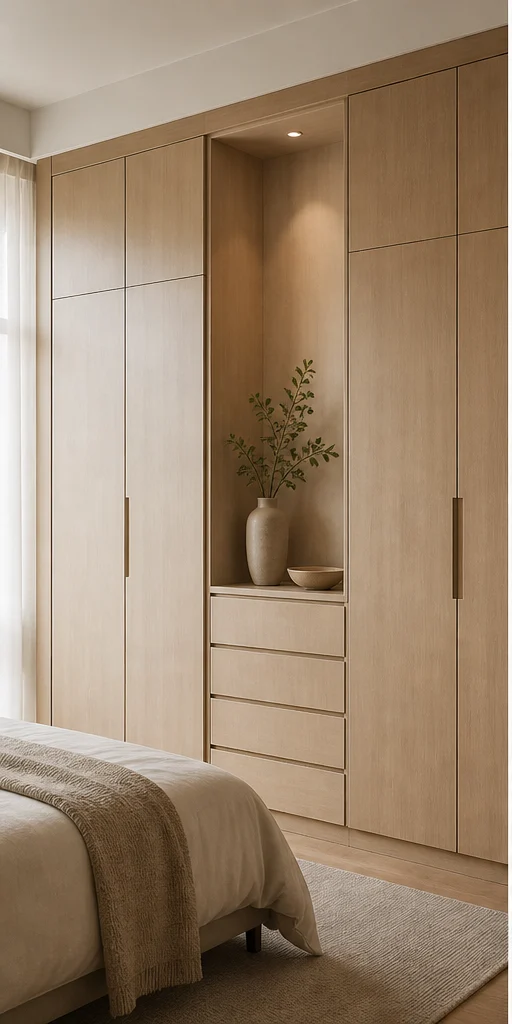
Serene Minimal draws wood veneer as chalk · pale oak · linen — nothing decorative survives unless it also does work. Surface: Suede matt. Bonding: PUR hot-press. Edge: 0.8mm colour-matched.
See this style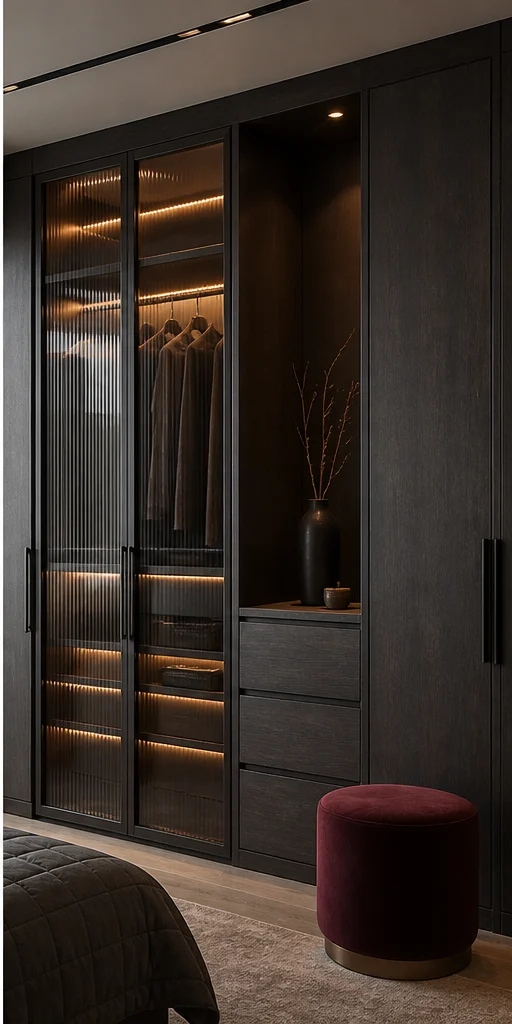
Bold Wood Veneer
Bold Contemporary draws wood veneer as charcoal · oxblood · smoked oak — high contrast, confident mass, a single saturated move per room. Surface: High gloss, mirror grade. Bonding: PUR hot-press, 12 bar. Edge: 2mm laser edge.
See this styleHeritage Wood Veneer
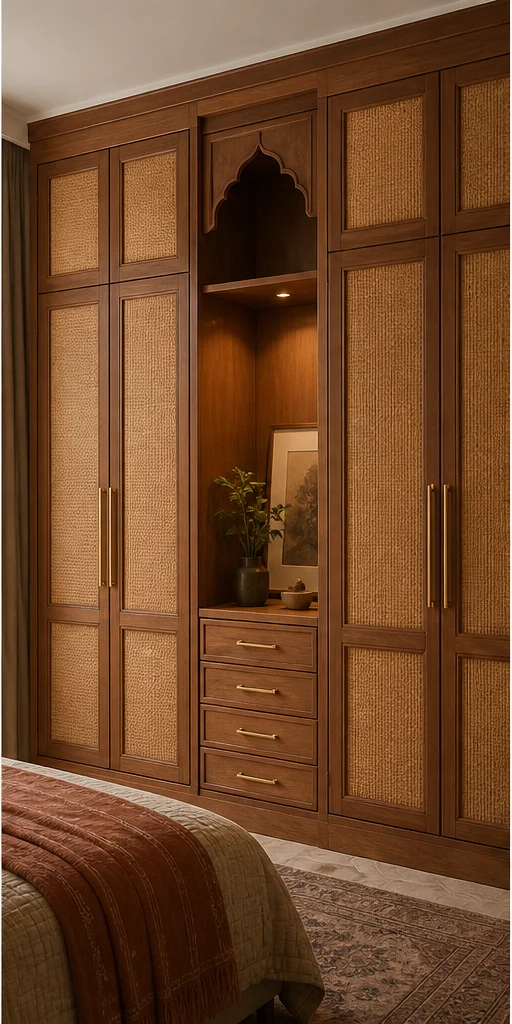
Modern Heritage draws wood veneer as teak · cane · antique brass — indian craft detailing on a contemporary frame — jaali, cane, inlay and hand-finished brass, used sparingly. Surface: Hand-rubbed open pore. Bonding: Hand-pressed with hide glue. Edge: Solid timber lipping.
See this style Photo: flooringclarity · BY 2.0
Classic Wood Veneer
Classic Luxe draws wood veneer as ivory · statuario · gold — proportioned panelling, cornice and moulding, book-matched stone and warm gilt detail on ivory. Surface: Satin with soft sheen. Bonding: Cold press, 24 hours. Edge: Beaded and painted.
See this style Photo: VillaEarlySunset · BY 2.0
Scandi Wood Veneer
Indo-Scandinavian draws wood veneer as birch · chalk · sage — pale timber, soft daylight and muted green — nordic restraint adapted for indian light, dust and humidity. Surface: Super matt, anti-fingerprint. Bonding: PUR hot-press. Edge: 1mm matt.
See this style Photo: andrechinn · BY 2.0
Deco Wood Veneer
Art Deco Glam draws wood veneer as emerald · brass · lacquer — fluting, fans and geometry. Surface: Fluted with brass reveal. Bonding: Vacuum press over profile. Edge: 2mm acrylic, polished.
See this styleSpecification
Wood Veneer specification, style by style
This is the table we issue to the factory and the site. It is also what a warranty is enforced against, which is why it reads in grades and dimensions.
| Specification | Minimal | Bold | Heritage | Classic | Scandi | Deco |
|---|---|---|---|---|---|---|
| Sheet size | 8x4ft, 1mm | 8x4ft, 1.5mm post-forming | 10x4ft, hand-selected | 8x4ft with matched pairs | 8x4ft, 0.8mm | 10x4ft, book-matched pairs |
| Surface | Suede matt | High gloss, mirror grade | Hand-rubbed open pore | Satin with soft sheen | Super matt, anti-fingerprint | Fluted with brass reveal |
| Bonding | PUR hot-press | PUR hot-press, 12 bar | Hand-pressed with hide glue | Cold press, 24 hours | PUR hot-press | Vacuum press over profile |
| Edge | 0.8mm colour-matched | 2mm laser edge | Solid timber lipping | Beaded and painted | 1mm matt | 2mm acrylic, polished |
| Light-fastness | Grade 6 | Grade 6 | Grade 5, natural ageing | Grade 6 | Grade 6 | Grade 5, lacquered |
| Scratch class | 3 | 4 | 2, patinates | 3 | 4, anti-scratch | 3 |
| Cleanability | Neutral cleaner, dry wipe | Microfibre only | Wax refresh yearly | Neutral cleaner | Dry microfibre | Neutral cleaner, no solvents |
| Repairability | Panel-level replacement | Panel-level replacement | Sandable and re-oilable | Touch-up and re-coat | Panel-level replacement | Re-lacquer in situ |
Before you commit
How to choose wood veneer
Six checks that prevent the failures we are most often called to fix.
- See the finish under the light the room will actually have. Warm 2700K light and cool 4000K light make two different materials of the same sample.
- For anything glossy, check the reflection of a straight line across the panel. Waviness in the sample is waviness on your wall, multiplied.
- Ask for the anti-fingerprint spec by name if the surface is dark and matt — the difference between a treated and untreated super-matt is visible from day one.
- Natural veneer is sold in bundles; insist that shutters in one run come from a single bundle, sequenced, or the colour will step across the elevation.
- Confirm the bonding method. PUR-bonded panels survive Indian summers on a west wall; ordinary adhesive does not.
- Get a sample panel made in the exact finish, edge and handle before the full order is pressed. It costs a few days and settles most arguments.
Bangalore
Wood Veneer in Bangalore
What the city's climate, water, housing stock and society rules mean for this specification.
Working in Bangalore means working around two practical constraints more than around climate. Apartment societies restrict working hours, service-lift access and debris removal; and the new high-rise stock along the eastern corridor is handed over as a bare shell, so wood veneer arrives at the same time as every other trade.
Dust along the metro and ORR construction corridors is a real specification input. Sealed joinery, washable finishes and casement or sliding windows with good seals pay for themselves in these pockets in the first year.
Balcony enclosure rules vary sharply between societies, and a few refuse them entirely. Anything involving a balcony gets checked against the society's own rules before design, not after — including in Indiranagar and Koramangala, where older buildings often have their own restrictions.
The mild climate is a genuine advantage: solid timber and veneer move far less here than in Delhi or Chennai, which makes craft detailing more durable and more affordable than it would be elsewhere. It is one of the few Indian cities where that is true year-round.
For Bangalore homes we hold material with the grade and batch recorded, and we plan deliveries around society access rules rather than around our own convenience.
Sizing
Wood Veneer by home size
Quantities below are the areas we typically specify wood veneer for, by home size. They assume a straight lay with a 10 to 12 per cent reserve from the same lot.
| Home size | Typical scope | Planning note |
|---|---|---|
| 1 BHK | 180–260 sq ft | Compact planning, one clear gesture |
| 2 BHK | 320–420 sq ft | Standard scope, most common brief |
| 3 BHK | 480–650 sq ft | Full scope with storage planned in litres |
| 4 BHK | 700–900 sq ft | Extended scope, bespoke elements |
| 4+ BHK / Villa | 1,100 sq ft and above | Villa scale, bespoke throughout |
Cost
What moves the price of wood veneer
We quote line by line rather than per square foot, because these are the items that actually differ between two estimates.
- The face material itself: laminate, acrylic, veneer, PU and lacquer sit at clearly different levels.
- Whether panels are pressed in a factory or finished on site.
- Sequencing and matching, which adds wastage rather than labour.
- Edge treatment — a 2mm laser edge or a polished acrylic edge is a per-metre cost across every shutter.
- Profiling: fluting, grooves and shadow gaps are machine time on every panel.
Process
How the work runs
Five stages, with the decisions each one locks.
We measure the space ourselves rather than working from the builder's drawing, note the services, water quality, daylight and society rules, and write down how the room is actually used. Wood Veneer is specified against that survey, not against a catalogue.
Plans, elevations and details, with the specification written as grades and dimensions. You approve an elevation, not a render — this is the stage where changes cost nothing.
Material, finish, hardware and services are locked, and the estimate becomes a line-by-line document. We tell you exactly what this date locks and what can still change afterwards.
Factory production runs to the approved drawing while site work is prepared. Material is checked against the approved sample on arrival, in daylight, and stored correctly until the programme calls for it.
Installation, testing, snagging and a documentation file with drawings, warranties, decor codes and hardware models. A first-year service visit is scheduled at handover.
Living with it
Maintaining wood veneer
The honest routine, and the mistakes that cost the most to undo.
Care and maintenance
- Dry microfibre for daily cleaning. Most damage to premium finishes comes from abrasive cloths and general-purpose sprays, not from use.
- Never use a solvent, thinner or alcohol-based cleaner on a lacquered or acrylic face.
- Keep steam away from the seam. A kettle or rice cooker directly under a wall unit will lift an edge in a season — plan the appliance position for that.
- For natural veneer, refresh with the recommended wax or oil once a year to keep the colour even as it ages.
What goes wrong
- Specifying dark super-matt in a busy family kitchen without the anti-fingerprint treatment.
- Approving a finish from a small sample and a phone photograph.
- Mixing batches on one elevation, which shows up as a colour step precisely where the light rakes across.
- Choosing high gloss for a room with a bright window opposite — the reflection becomes the dominant feature.
Detailing
Wood Veneer detailing notes
The small decisions that separate built work from assembled work.
Grain direction is a design decision. Running veneer horizontally across a wall of tall units makes the room read wider; vertically makes it read taller.
Match the edge to the intent. A colour-matched thin edge disappears; a contrasting 2mm edge draws every shutter outline as a line.
On gloss, plan the lighting to graze rather than face the surface. A downlight directly opposite a gloss panel becomes a permanent glare spot.
Keep one finish continuous around a corner rather than changing material at the return; a change at an internal corner always looks like a mistake.
Questions
Wood Veneer — answered
Is Wood Veneer durable in daily use?
Yes, within its class. The face survives normal domestic use for a decade or more; what shortens its life is abrasive cleaning, standing steam at a seam and solvent-based cleaners.
Can I see a full-size sample before ordering?
You should insist on it. A pressed sample panel in the exact finish, edge band and handle, seen in the room's own light, is the only reliable way to approve a finish.
How does it behave in humid coastal cities?
The bonding decides it. PUR-bonded panels on a stable core handle coastal humidity; the failures are almost always edge lifting on cheaply bonded boards.
Can a damaged panel be replaced later?
Individual panels can be replaced, and this is the practical reason to record the exact decor code and batch at handover. Colour matching against a five-year-old panel is otherwise guesswork.
Does Wood Veneer fade?
Direct sun on a south or west elevation will shift any pigmented surface over years. Light-fastness grade 6 materials hold their colour; natural veneer is expected to warm as it ages, which is part of its character.
What is the maintenance routine?
Dry microfibre for dust, a damp cloth with neutral cleaner for marks, nothing abrasive and no solvents. That is the entire routine.
Do you work on wood veneer projects across Bangalore?
Yes — Bangalore is where most of our projects are, from apartments along Sarjapur Road, Whitefield and Hebbal to independent homes in Jayanagar, Indiranagar and Malleshwaram. We survey the space ourselves, work within the society's access and working-hour rules, and hand over with a documentation file. There is a dedicated page for our work in the city if you want the full picture.
Does Bangalore's climate or water affect this choice?
The climate helps and the water does not. Mild year-round temperatures are kinder to timber and joinery than almost any other Indian city, so craft detailing lasts. Hard borewell water in the eastern and northern corridors is the real constraint — it scales glass, chrome and stone, and it changes what we specify and what maintenance we ask the family to commit to.
Explore more
More in Veneers
Related pages
Next step
Planning wood veneer for your home?
Send your floor plan and we come back with a layout, a material direction and a line-by-line estimate. Free survey across Bangalore.