Door guide
Veneer Door vs Laminate Door vs Acrylic Door vs Teak Door
A detailed comparison of appearance, durability, cost, maintenance and best use for four popular residential door finishes.
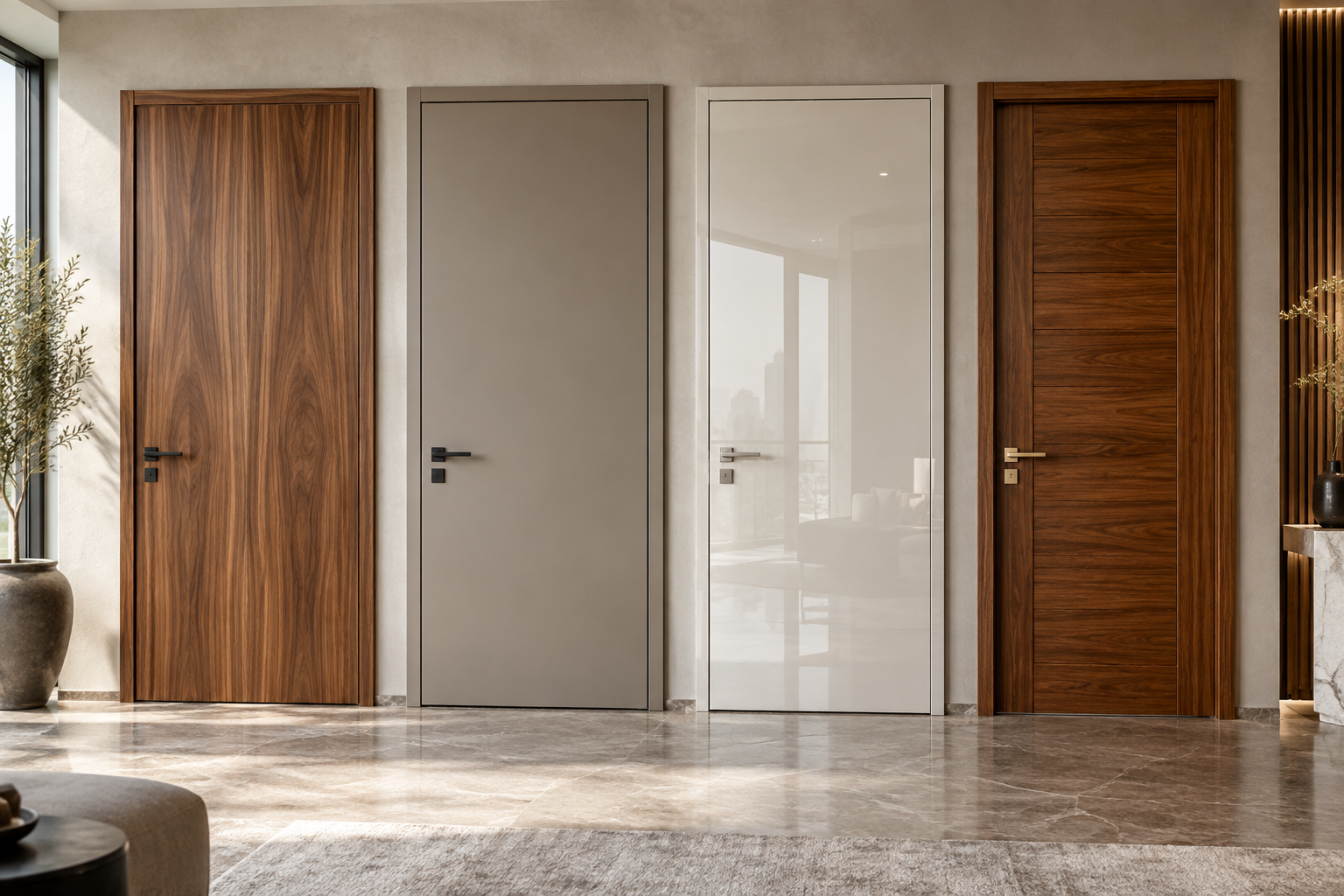
Overview
The real comparison
A practical note for homeowners and designers.
Veneer door vs laminate door vs acrylic door vs teak door is not a single winner-takes-all decision. These four options sit on different points of the same map: natural beauty, practical repeatability, polished modernity and solid timber depth. The right answer depends on where the door is used, what the home is trying to express and how much maintenance the household is willing to accept.
A door is a moving piece of interior architecture. It is larger than a cabinet shutter, more frequently touched than a wall panel and more exposed to impact than most furniture. That is why the comparison has to include the shutter core, frame, lipping, hinges, lock body, stopper, finish system and cleaning routine, not just the visible sheet or wood on the face.
The best homes often use more than one finish. A teak main door can sit beside veneer bedroom doors, laminate utility doors and acrylic wardrobe shutters without conflict if the palette is controlled. The goal is not to prove one material superior everywhere. The goal is to assign each material to the place where its strengths matter most.
Veneer
Where veneer doors work best
A practical note for homeowners and designers.
A veneer door uses a thin layer of real wood over an engineered shutter. Its strength is atmosphere. Veneer gives natural grain, subtle variation and a furniture-like presence without the full cost and weight of solid timber. It is especially good for bedrooms, studies, formal passages and living spaces where the door should feel warm but refined.
The tradeoff is that veneer asks for better finishing discipline. Grain matching, lipping, polishing and protection from site moisture all matter. A poor polish can make good veneer look dull, while careless edge treatment can make an expensive shutter vulnerable. Veneer is not difficult to live with, but it should be treated like a finished wood surface rather than a washable plastic sheet.
Choose veneer when the interior palette already includes timber, stone, fabric and warm light. It pairs well with quiet walls, brushed metal hardware and simple profiles. Avoid overusing strong grain in small corridors, because many doors with busy grain can make a compact apartment feel visually restless.
Reference
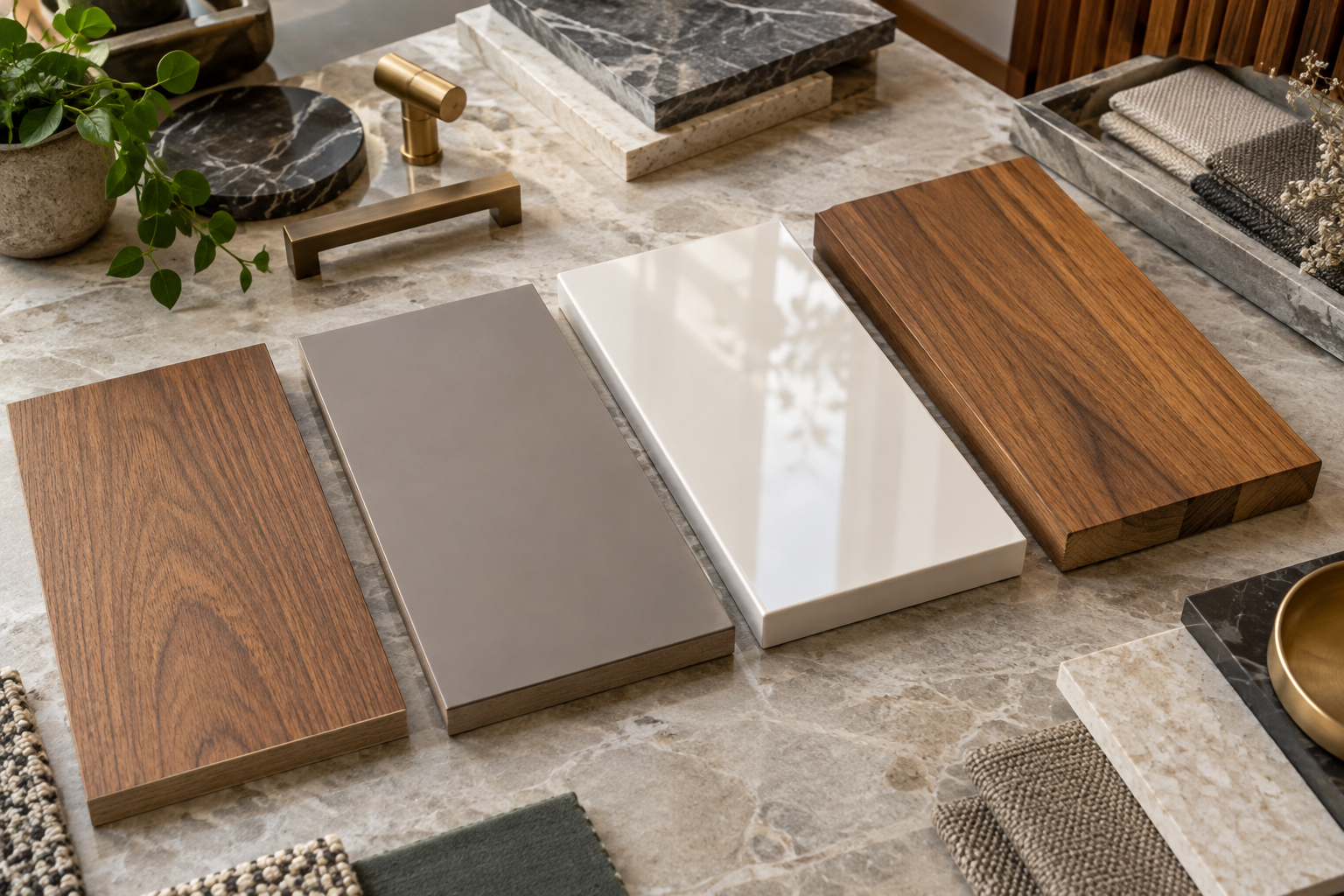
Door finish samples for close comparison
Use the image as a finish cue, then confirm the real sample in site light.
Laminate
Where laminate doors make sense
A practical note for homeowners and designers.
A laminate door is the practical workhorse. It is available in many colours, textures and wood-look finishes, and it gives excellent repeatability across multiple shutters. For rental units, children's rooms, guest rooms, utility passages and homes that need easy cleaning, laminate is often the most sensible choice.
The quality spread is wide. A premium laminate with proper edge banding and a stable core can look crisp for years. A cheap laminate on a weak substrate can chip, peel or look flat quickly. The decision should therefore include laminate grade, thickness, texture, edge detail and shutter construction.
Laminate is strongest when used honestly. Matte solids, subtle textures and restrained woodgrains usually age better than imitation luxury surfaces. If the rest of the home is rich in stone, veneer or metal, a quiet laminate door can be the calm background that lets those materials speak.
Acrylic
Where acrylic doors earn their place
A practical note for homeowners and designers.
An acrylic door gives gloss, reflection and a very contemporary feel. It can make a passage or bedroom door look sleek, especially in homes that already use polished surfaces, concealed lighting and minimal profiles. Acrylic is also common on shutters where a high-gloss furniture finish is desired.
Its weakness is visibility of marks. Fingerprints, scratches, waviness and edge flaws can become more obvious because the surface reflects light. Acrylic should be specified with care in high-touch doors, especially where children, pets or heavy use are expected. It rewards clean detailing and punishes careless installation.
Use acrylic selectively. One feature zone can look sharp; an entire corridor of glossy doors can feel harsh and require constant wiping. It works best where the design intentionally wants reflectivity and where the household accepts that gloss needs more visual maintenance than matte finishes.
Teak
Where teak doors still matter
A practical note for homeowners and designers.
A teak door has weight, depth and a sense of permanence that engineered finishes imitate but do not fully replace. For main doors, puja rooms, heritage homes, villas and statement internal doors, teak can be the most emotionally satisfying option. It feels architectural rather than merely decorative.
The cost is higher, and the responsibility is higher too. Timber sourcing, seasoning, joinery, frame compatibility and polishing have to be right. A solid teak shutter made badly can move, crack or become difficult to operate. A well-made teak door, however, can be repaired, re-polished and kept for decades.
Teak should be used where its presence is justified. If every internal door is teak without a design reason, the home can feel heavy and expensive in the wrong way. Used with restraint, teak gives hierarchy: the entrance, the temple door, the study or the principal suite can feel special without making every door compete.
Decision
How to choose room by room
A practical note for homeowners and designers.
For a main entrance, teak is often the strongest choice if the budget allows and the building conditions suit it. Veneer can work for internal feature doors where warmth matters but solid timber is unnecessary. Laminate is the reliable option for service areas and repeated bedroom doors. Acrylic is best used when gloss is part of the interior concept rather than a default upgrade.
For families, durability is not only scratch resistance. It is the ability to clean, repair, replace hardware and live without anxiety. Laminate usually wins on easy replacement and repeatability. Veneer wins on visual warmth. Acrylic wins on polished impact. Teak wins on depth, repairability and long-term character when made correctly.
The final specification should name the core, thickness, frame, lipping, finish, hardware and maintenance method. Without those details, material names become vague labels. With those details, veneer door vs laminate door vs acrylic door vs teak door becomes a clear schedule of decisions for each room.
Reference
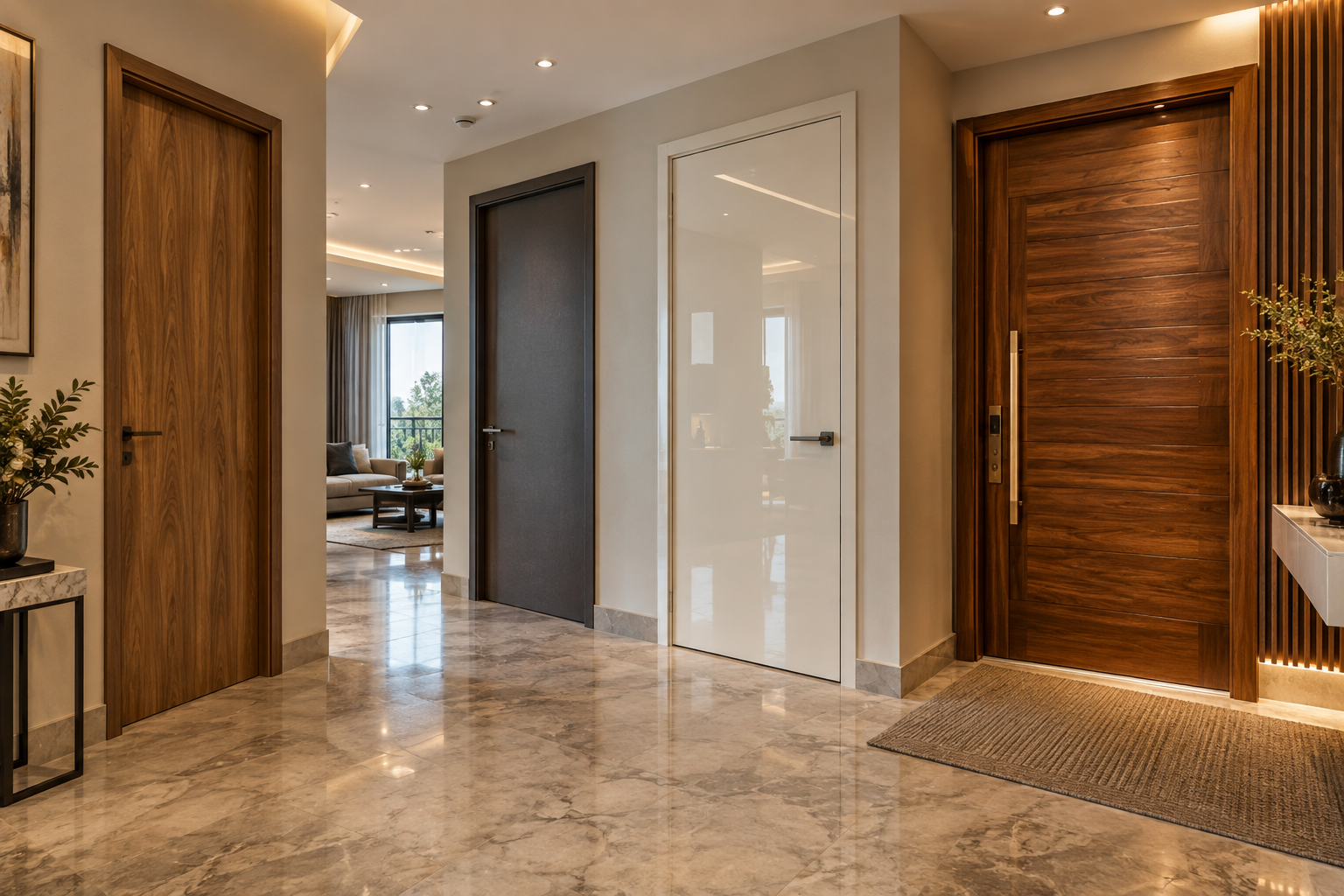
Door finishes used together in a real home context
Use the image as a finish cue, then confirm the real sample in site light.
Cost
How the budget really changes
A practical note for homeowners and designers.
Door budgets are often misunderstood because people compare only the visible finish. The actual cost includes shutter core, frame, lipping, finish sheet or timber, adhesive, polish, hinges, lock body, handle, stopper, labour, protection and site adjustment. A quote that names only the finish is not detailed enough for a fair comparison.
Laminate usually gives the most controlled budget because the sheet cost and labour are predictable. Veneer can rise depending on species, grain matching and polish. Acrylic adds cost through the surface grade, backing, edge quality and the care needed to avoid visual waviness. Teak is usually the highest investment because timber selection, seasoning and joinery skill matter so much.
A useful budgeting method is to divide doors into categories. Main entrance, feature internal doors, regular bedroom doors, toilet doors and service doors do not need the same specification. Spending more on every door may not improve the home. Spending well on the few doors people notice first often gives a more elegant result.
Maintenance
Cleaning, repair and ageing
A practical note for homeowners and designers.
Every finish ages differently. Veneer develops a softer patina if protected and polished well. Laminate stays consistent but may show chipped edges if abused. Acrylic keeps its shine when cleaned carefully but can reveal hairline scratches under direct light. Teak can be re-polished and repaired, which is why it often feels more forgiving over a long life.
Cleaning products should be decided before handover, not after a problem appears. Abrasive pads, harsh chemicals and excessive water can damage most door finishes. A simple soft cloth routine is usually enough for veneer and teak. Laminate can take more frequent wiping. Acrylic needs gentle cleaning because gloss makes small scratches more visible.
Repairability is a major difference. A damaged laminate or acrylic face may need replacement of the surface or shutter depending on construction. Veneer and teak can often be re-polished by a skilled team, but only if the original finish has enough quality to accept repair. That future repair path should be part of the purchase decision.
Schedule
How to write the door schedule
A practical note for homeowners and designers.
A proper door schedule lists door number, room, shutter size, core, frame, finish, edge, hardware, lock type, swing direction and any special note such as toilet ventilation or acoustic requirement. This document prevents site confusion and allows every finish decision to be checked before fabrication begins.
For a full home, place the door schedule beside the flooring, skirting and wall-finish schedule. Doors do not stand alone. A teak door against a busy wood-look floor may feel heavy. A glossy acrylic door beside a high-gloss wardrobe may feel excessive. A pale laminate door may look perfect if the surrounding wall and skirting are calm.
The schedule also protects delivery. Finished shutters should arrive after wet work has stabilized, with adequate protection during installation. Hardware should be available before final fitting so the carpenter does not cut twice. Small sequencing errors can damage expensive finishes, which is why planning matters as much as material selection.
Mistakes
Common mistakes to avoid
A practical note for homeowners and designers.
Do not choose from a catalogue image alone. Real samples, full-height mockups and site lighting change the decision. Do not mix too many wood tones in one view. Do not place a delicate finish where bags, toys or cleaning equipment will hit it daily. Do not install finished shutters before wet work has stabilized.
Another mistake is comparing only the face cost. A teak door without good hardware is not premium. An acrylic door with poor edge treatment is not modern. A veneer door with careless polishing is not luxury. A laminate door with a weak core is not economical if it has to be replaced early.
The safest approach is to prepare a door schedule for the whole home. Mark the main door, bedroom doors, toilet doors, utility doors, balcony doors and feature doors separately. Then assign the finish according to use, visibility and maintenance, rather than repeating one material everywhere out of habit.
That discipline is what makes the final home feel intentional.
Comparison
Best use by door finish
This table gives a starting point for the room-by-room door schedule.
| Decision | Best choice | Why it matters |
|---|---|---|
| Warm natural interior | Veneer | Gives real wood character with manageable cost and weight. |
| Budget control and repeatability | Laminate | Easy to specify across many doors and practical for daily cleaning. |
| Glossy modern statement | Acrylic | Best where reflection and polish are intentional design features. |
| Main door or heirloom feel | Teak | Offers solid timber depth, repairability and long service life. |
| High-traffic service zones | Laminate | Forgiving and easier to replace if damaged. |
| Premium bedroom suite | Veneer or teak | Choose based on budget, weight and desired richness. |
Next step
Choosing door finishes for a full home?
Send the floor plan and door schedule so veneer, laminate, acrylic and teak can be assigned where each one makes sense.