Decor & Inspiration
Layering a Room: The Order Professionals Actually Work In
Rooms that look effortless were assembled in a specific sequence.

In this article
Rooms that look effortless were assembled in a specific sequence. The points below are written in the order we would actually raise them on site, because the order usually matters as much as the content — a decision made two steps too late is often no longer a decision, just a repair. Rooms that look effortless were assembled in a specific sequence. None of what follows depends on style or budget tier; it applies whether the room is being done on a tight number or a generous one. What changes with budget is the material, not the sequence of decisions. Rooms that look effortless were assembled in a specific sequence. Treat each point as a check rather than a rule — the right answer depends on your room, and the value here is in knowing which question to ask before a decision becomes expensive to reverse. This is written from projects rather than from a general principle, which is why it names specific dimensions and specific failure modes rather than staying at the level of advice. Where your own room differs from the assumption behind a point, the point still applies — just adjust the number. Nothing here requires taking our word for it; each point is the kind of thing you can verify yourself on a site visit or ask a contractor to confirm in writing. That verification is usually the difference between advice that gets followed and advice that gets nodded at and ignored. A few of these points contradict what gets repeated as conventional wisdom. Where that happens we say so directly and explain why, because the conventional version is usually true in general and wrong for the specific case it gets applied to.
It is easy to treat this as a minor decision because it does not show up in a rendered image. In practice it is one of the decisions that determines whether the finished room actually works the way it was intended to, independent of how it looks. None of the points below meaningfully change the budget on their own — they change whether the budget you already have is spent on the right things. Getting them right does not cost more; getting them wrong costs a rework later that was never in the original estimate. The right moment to act on any of this is whichever comes first: the design drawing that fixes it, or the trade on site that executes past it. After either, changing course gets progressively more expensive. We raise this early in every project for the same reason it is worth raising here: it is cheap to decide correctly up front and expensive to correct once the trades that depend on it have moved past it.
Architecture first
Ceiling plane, floor material, window treatment and joinery. These are fixed for a decade and everything else responds to them. Choosing a sofa before the flooring is the usual reason a scheme fights itself.
Then the large soft pieces
Sofa, bed, rug, curtains. These carry the largest areas of colour and texture in the room, so they set the palette rather than following it.
Then lighting, in three layers
Ambient for the room, task for what you do in it, accent for what you want seen. A room with only one layer — usually a central ceiling light — is the most common lighting failure in Indian homes.
Then the hard accents
Side tables, lamps, mirrors, frames. This is where metal finishes get coordinated: pick one primary metal and one secondary, and hold that line.
Objects last, and slowly
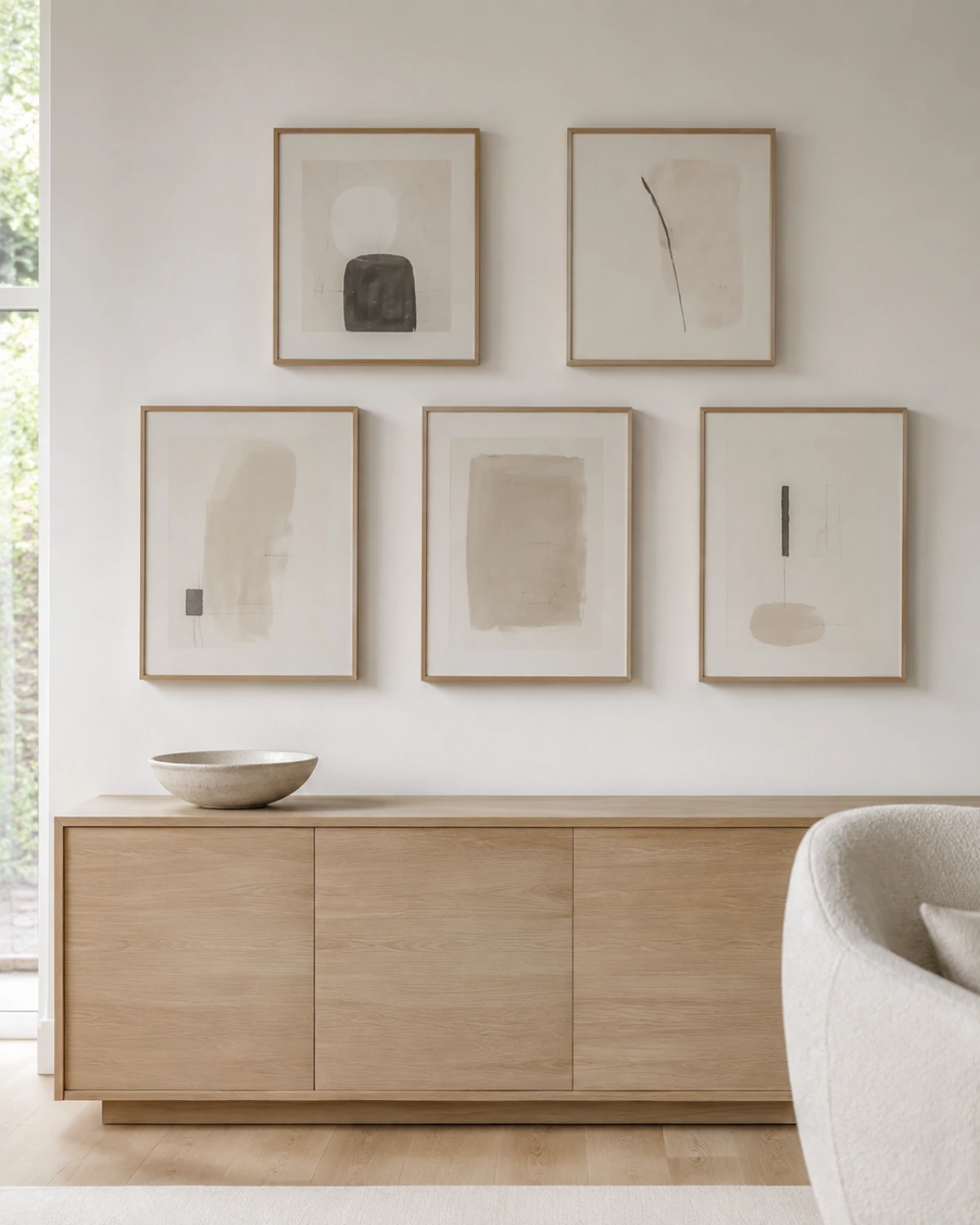
Books, ceramics, art, plants. The layer that makes a room look lived in is also the layer that should never be bought in a single afternoon.
Summary
Key takeaways
The short version, if you read nothing else on this page:
- Architecture first
- Then the large soft pieces
- Then lighting, in three layers
- Then the hard accents
- Objects last, and slowly
Where any of this conflicts with something specific about your building — a low slab height, an odd civil constraint, a society rule — the building wins. Bring it to the conversation rather than designing around an assumption. Nothing here is specific to one house style. Whichever of the six palettes you are drawn to, the decision covered in this article is made the same way — what changes downstream is the material, not the reasoning that gets you there.
Questions
About decor & inspiration
Does this apply to a resale flat as well as new construction?
Yes, with one difference: in a resale flat we verify what is actually behind the wall or ceiling before relying on it, since the original drawing is often no longer accurate to what was built or altered.
How much does getting this right or wrong actually cost?
Usually far less to get right at the drawing stage than to fix after installation. Most of what is covered here is free to change before sign-off and expensive to change after, which is the whole reason it is worth deciding early.
Is this something I can plan myself, or do I need a designer?
You can plan the intent yourself; a designer earns their place in translating it into a drawing the factory and the site can execute without ambiguity, and in catching the version of this that does not suit your specific room.
Does this apply outside a full renovation — say, a single-room refresh?
Yes. Most of what is covered here is scoped to one room or one decision rather than to a whole-home project, and applies just as directly to a smaller scope.
How confident should I be applying this without a site visit?
Confident enough to plan around, not confident enough to finalise a drawing from. Every point here is a starting assumption that a measured survey either confirms or adjusts — treat it as the question to ask, not the final answer.
Where can I see this specified in full for my own room size?
The design category and home-size pages linked below carry the full buildable specification — layout, material, dimension and cost — for the decision covered in this article.
Does this article assume a particular house style?
No — the decision it covers applies before style enters the picture. Whichever of the six palettes the room ends up in, the underlying reasoning here does not change, only the material chosen to answer it.
How was this article actually written?
From a decision made on a real project, then generalised carefully enough to be useful without losing the specificity that makes it worth reading over a general search result.
Is there a warranty?
Frames and suspension carry a multi-year warranty; upholstery and finishes are warranted against manufacturing defects rather than wear.
Can Home Bar be made to a custom size?
Yes. Bespoke sizing is the main reason to build rather than buy, and it costs less than most people expect — usually 10 to 20% over a standard size in the same specification.
How long is the lead time?
Six to twelve weeks depending on the frame, fabric and finish. Imported fabric is usually the long pole, so it is chosen first.
Related
Where this shows up in the design categories
Home Bar
Fabric grade — the same sofa in three fabrics can span a wide price range.
Staircase
Balustrade type, with frameless glass and brass channels at the top.
Door
Hardware, which on a pivot or a sliding system can exceed the leaf cost.
Window
Hardware, which on a pivot or a sliding system can exceed the leaf cost.
More
More in Decor & Inspiration
Mixing Metal Finishes Without It Looking Accidental
The rule is not one metal. It is a hierarchy.
ReadFive Palettes That Hold Up in Indian Daylight
Indian daylight is brighter and warmer than the light most colour cards are photographed in.
Read
Why Texture Beats Colour in a Neutral Room
Neutral schemes fail when everything in them is smooth.
Read
Buying Art for a Home Without Overthinking It
A few practical rules that make a wall look considered rather than filled.
ReadNext step
Want this applied to your home?
Send the plan. We will tell you which of these actually matter for your building and your budget.