Window · Modern Heritage
Teak Heritage Teak-framed with a jaali shutter Window Design
Indian craft detailing on a contemporary frame — jaali, cane, inlay and hand-finished brass, used sparingly. Windows decide how a room feels at 4pm. We work on the glazing, the treatment and the reveal together — a good curtain cannot rescue a bad opening.

Specification
Window design details
| Detail | Specification |
|---|---|
| Layout | Teak-framed with a jaali shutter |
| Style | Modern Heritage |
| Palette | Teak · Cane · Antique Brass |
| Frame | Teak-clad with brass fittings |
| Glazing | Clear with a teak jaali shutter outside |
| Treatment | Cane roman blind |
| Reveal | Teak-lined reveal |
| Home size | Room dimension |
|---|---|
| 1 BHK | 4×4 feet |
| 2 BHK | 5×5 feet |
| 3 BHK | 6×6 feet |
| 4 BHK | 7×8 feet bay |
| 4+ BHK / Villa | Full-height glazed wall |
Storage features
- A teak sill deep enough to sit on
- A cane blind rolled into the reveal
- Shutter storage in the reveal
Special features
- An external teak jaali shutter cutting the west sun
- A cane roman blind inside
- Brass casement stays and handles
Ideal forWest-facing rooms that overheat in the afternoon
Compare
The same window in the other five styles
One brief, six resolutions. Each carries its own layout, material specification and storage strategy.

Minimal Slim casement, full-height Window
Chalk · Pale Oak · Linen
See this design
Bold Black-framed grid Window
Charcoal · Oxblood · Smoked Oak
See this design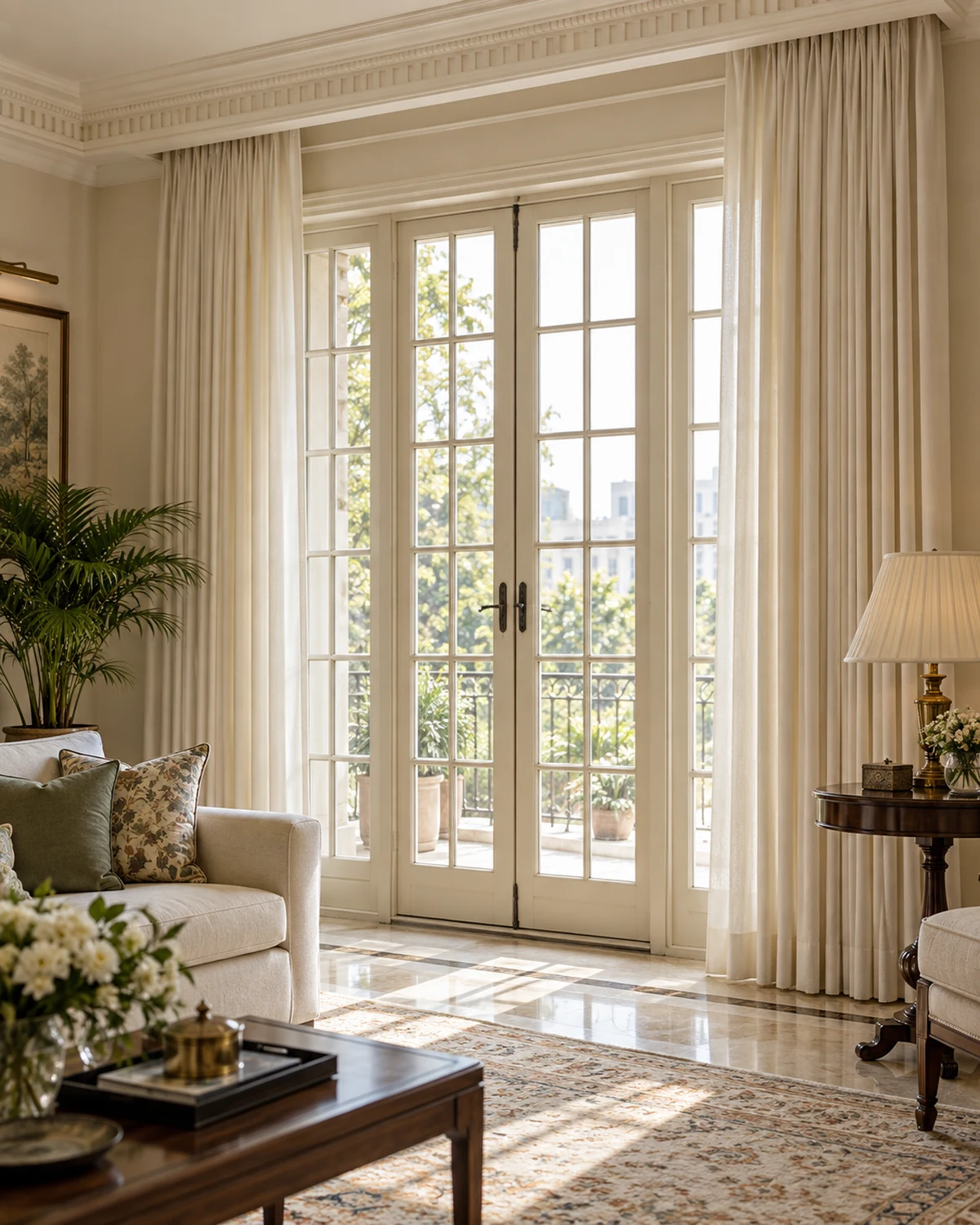
Classic Bay window with a seat Window
Ivory · Statuario · Gold
See this design
Scandi Sliding folding to a balcony Window
Birch · Chalk · Sage
See this design
Deco Arched with fluted glass Window
Emerald · Brass · Lacquer
See this designDetail
Specifying and living with this window
Indian craft detailing on a contemporary frame — jaali, cane, inlay and hand-finished brass, used sparingly. That governs every material decision on this page — the layout and the storage strategy come first, and window is where the modern heritage palette gets applied to a plan that already works.
A specification is only as good as what happens after handover. window in this style is chosen as much for how it ages as for how it photographs on day one — the joinery finish, the hardware grade and the way an edge is sealed all show up in year three, long after the render is forgotten.
Modern Heritage is a coherent palette rather than a fixed rule, and most finished homes borrow across two styles rather than committing to one throughout. What rarely works is switching the palette room to room within one sightline — the transition needs a threshold, a change of material, or a corridor to read as intentional rather than accidental.
The specification below is what we issue to the factory and the site for this exact style and layout. It is also what a warranty is enforced against, which is why it is written as grades and dimensions rather than as adjectives.
Nothing on this page is a fixed catalogue item. The layout, the palette and every material line are redrawn against your own room dimensions before anything is priced — what you see here is the starting specification, not the finished drawing.
Modern Heritage suits a household that already knows roughly what it wants a window to feel like, rather than one still deciding between opposites — the palette is distinctive enough that it rewards commitment and looks unresolved applied half-heartedly.
This reads best in a home where at least the adjoining rooms share the same direction, even if not the same materials. Modern Heritage carried into one room and abandoned at the next doorway tends to make both rooms look like an afterthought rather than a choice.
If you are drawn to modern heritage but unsure it will hold up to daily use, that is worth raising directly at the survey — the palette can usually be adapted toward more forgiving materials without losing the character that made it appealing in the first place.
Worth checking before sign-off
- Check the opening size on site before ordering anything. Indian civil openings are rarely square, and the frame absorbs the error only if it is measured first.
- Decide the swing direction with the furniture layout in hand. A door that opens against a switchboard or a bed is a permanent irritation.
- For external doors and windows, specify the glass for the orientation. West-facing glazing without a low-E coating turns a room unusable in summer.
- Ask about the frame-to-wall interface. Water ingress at the frame joint, not through the product, causes most window failures.
- For acoustic performance, the seal and the frame do the work, not the leaf thickness alone.
- Confirm hardware handing and finish at the order stage — the lock, hinge and handle are all handed items.
Living with it
- Lubricate hinges and locks once a year with a dry lubricant, not oil, which attracts dust.
- Clean sliding tracks quarterly; grit is what wears a roller and makes a heavy slide.
- Check external frame sealant annually before the monsoon and renew where it has separated.
- Wipe condensation off double-glazed frames in winter in northern cities to protect the seal.
Mistakes worth avoiding
- Ordering before the floor level and finish are decided.
- Using an interior-grade leaf in a bathroom, where humidity delaminates it from the bottom edge.
- Skipping the sub-frame on an aluminium system, which makes future replacement destructive.
- Choosing an oversized single leaf that no hinge set can carry without dropping.
Budget on a window in this style moves with a small number of decisions rather than with the style label itself: leaf construction and species of the face. and glazing specification — double glazing and low-E coatings are the biggest single variable. are usually the two line items that separate two otherwise similar quotes. Hardware, which on a pivot or a sliding system can exceed the leaf cost.
Detailing
Finer points of this window
A door reads best when its frame is either flush with the wall plane or expressed deliberately. The half-hearted 1/2″ architrave is what makes joinery look builder-grade.
Floor clearance should be set for the finished floor plus any rug. Doors planed on site after flooring never look right at the bottom edge.
Pivot doors need a structural head and a level floor. Both are civil decisions taken long before the door is ordered.
Where a door leads to a bathroom, undercut it for return air or the exhaust fan will not move anything.
Questions
Window in Modern Heritage — answered
Does it need maintenance?
Annual hardware lubrication, quarterly track cleaning where it slides, and an annual check of external sealant. That is all a well-installed opening needs.
Can it improve sound insulation?
Yes, substantially, but through the seal and frame rather than the leaf alone. A well-sealed solid-core door outperforms a heavier door hung with gaps.
How does Window handle Indian weather?
Correctly specified, well. The failures we see are water at the frame junction, timber used externally without protection, and glass chosen without regard to orientation.
Is a warranty provided?
Yes, on manufacturing and finish. Hardware carries the manufacturer's own warranty, which is why we specify hardware by model rather than by category.
How is Window measured and ordered?
The opening is measured on site after plaster, with the finished floor level marked. Ordering from a drawing dimension instead of a site dimension is the most common cause of a door that never closes properly.
Questions
Window questions
What is the best window treatment for a west-facing room?
An external shading layer — a jaali shutter, a louvre or a deep reveal — plus low-E glazing. Internal curtains stop the glare but the heat is already inside by then.
Should curtains be hung at the ceiling or the window head?
At the ceiling, or at the cove line. It adds apparent height and lets the full glass area work when the curtain is open.
Are uPVC or aluminium frames better?
uPVC insulates better and costs less; slim aluminium gives you a much finer sightline and more glass. In humid coastal cities specify a marine-grade powder coat either way.
How do I keep dust out?
Good gaskets and a well-sealed reveal do most of it. Sliding windows leak more than casements; if dust is a serious problem, casement or tilt-and-turn is the better choice.
Next step
Build this window.
Send the floor plan and the room dimensions. We come back with this design adapted to your space and priced line by line.