Wall Paint · Art Deco Glam
Emerald Deco Emerald lacquered panel Wall Paint Design
Fluting, fans and geometry. Lacquered colour, brass inlay lines and mirror used as architecture. Paint is the cheapest lever in the house and the one most often pulled badly. We choose the sheen and the undertone for the light the room actually gets.

Specification
Wall Paint design details
| Detail | Specification |
|---|---|
| Layout | Emerald lacquered panel |
| Style | Art Deco Glam |
| Palette | Emerald · Brass · Lacquer |
| Colour | Deep emerald, high sheen |
| Sheen | High-gloss lacquer |
| Technique | Sprayed lacquer, mirror-flat |
| Trim | Trim in brass |
| Home size | Room dimension |
|---|---|
| 1 BHK | One tone, whole flat |
| 2 BHK | One accent per room |
| 3 BHK | Lime-wash in living areas |
| 4 BHK | Panelling in formal rooms |
| 4+ BHK / Villa | Full bespoke scheme |
Storage features
- A single high-gloss emerald panel
- Brass trim framing it
- Reflection used as a design element
Special features
- Sprayed high-gloss lacquer, mirror-flat
- A brass reveal at every edge
- Deep colour used with confidence
Ideal forStatement walls in dining rooms, bars and powder rooms
Compare
The same wall paint in the other five styles
One brief, six resolutions. Each carries its own layout, material specification and storage strategy.

Minimal Single chalk tone throughout Wall Paint
Chalk · Pale Oak · Linen
See this design
Bold Charcoal feature wall Wall Paint
Charcoal · Oxblood · Smoked Oak
See this design
Heritage Lime-wash in warm ochre Wall Paint
Teak · Cane · Antique Brass
See this design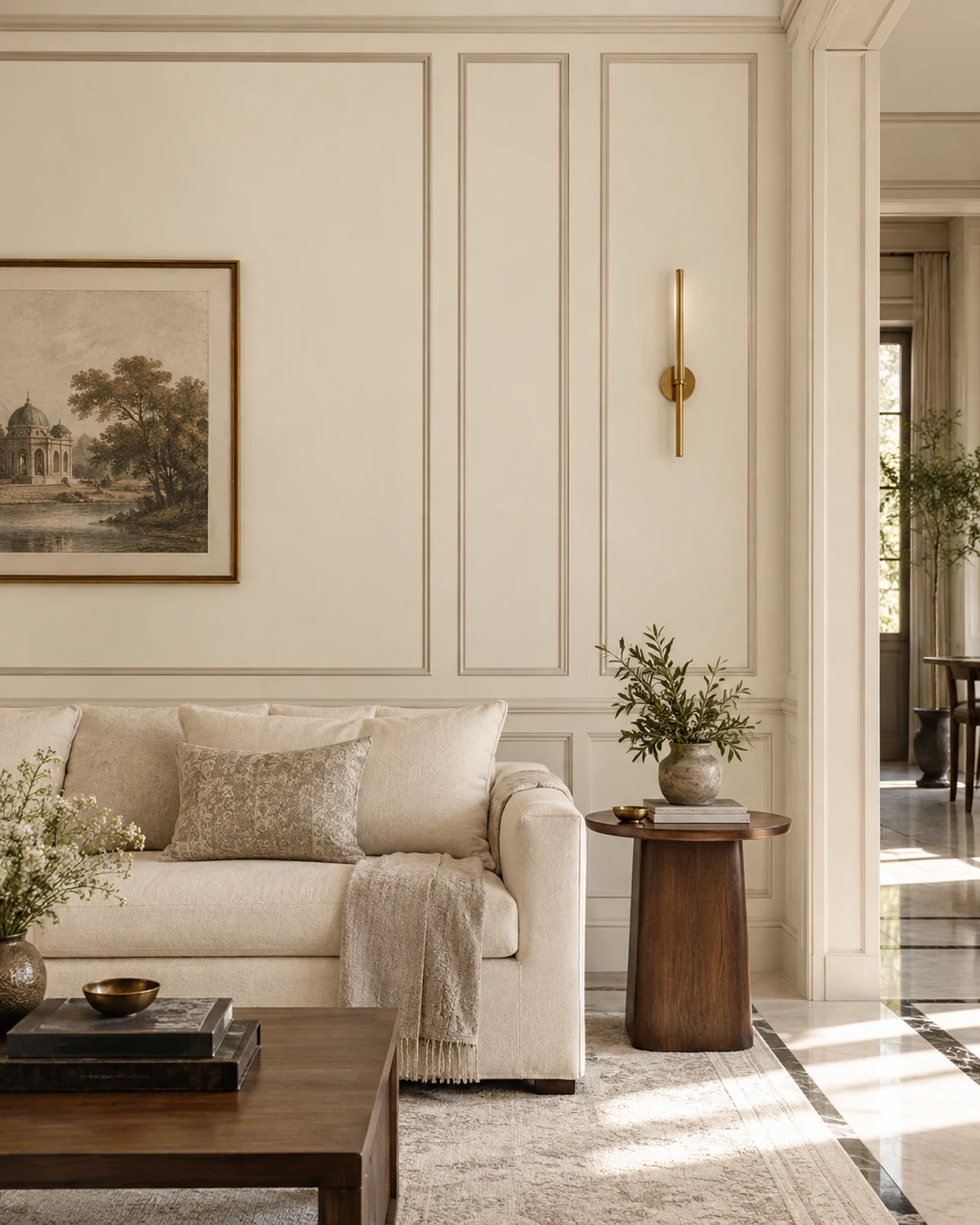
Classic Ivory with a picture rail Wall Paint
Ivory · Statuario · Gold
See this design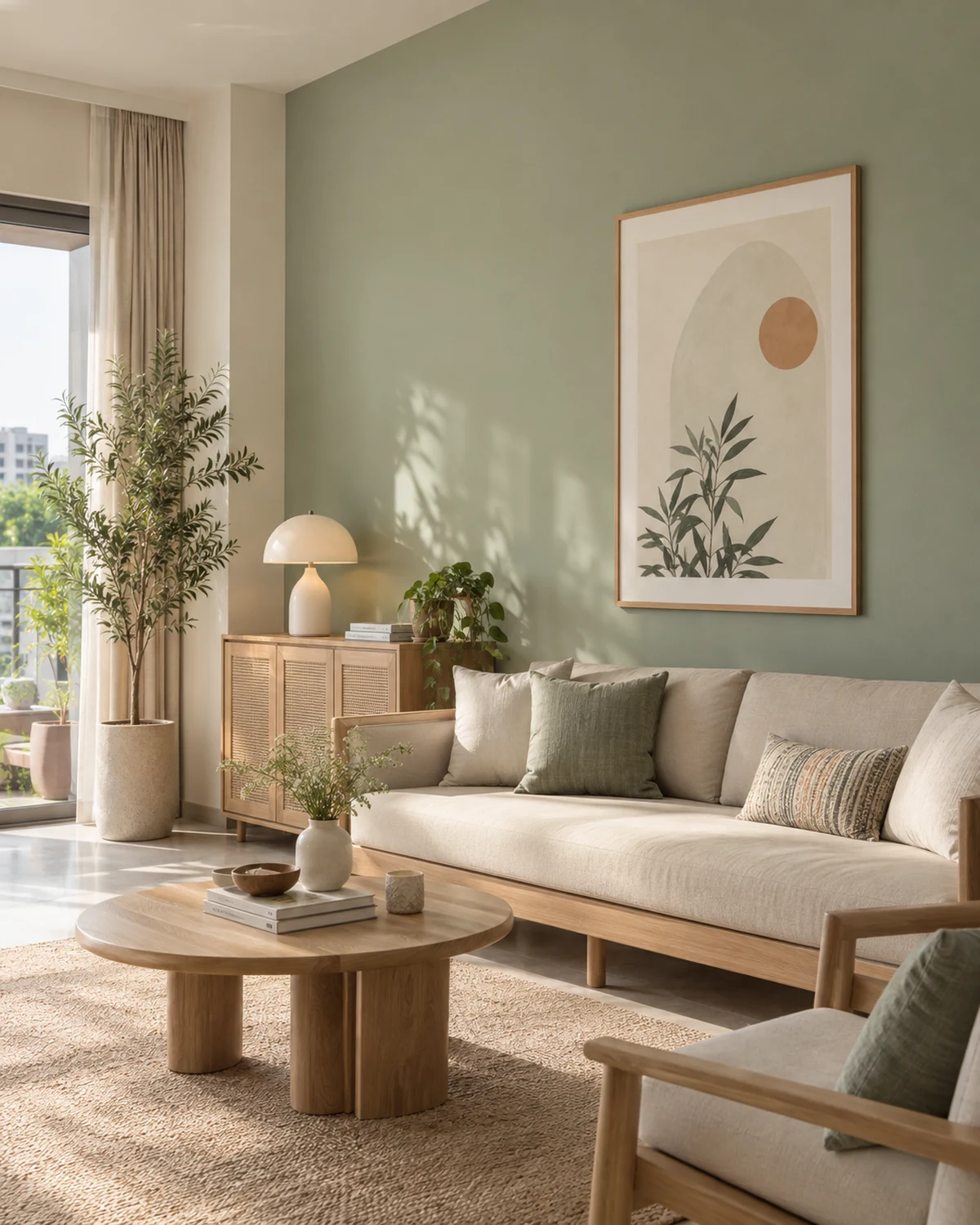
Scandi Sage half-wall with birch Wall Paint
Birch · Chalk · Sage
See this designDetail
Specifying and living with this wall paint
Fluting, fans and geometry. Lacquered colour, brass inlay lines and mirror used as architecture. That governs every material decision on this page — the layout and the storage strategy come first, and wall paint is where the art deco glam palette gets applied to a plan that already works.
A specification is only as good as what happens after handover. wall paint in this style is chosen as much for how it ages as for how it photographs on day one — the joinery finish, the hardware grade and the way an edge is sealed all show up in year three, long after the render is forgotten.
Art Deco Glam is a coherent palette rather than a fixed rule, and most finished homes borrow across two styles rather than committing to one throughout. What rarely works is switching the palette room to room within one sightline — the transition needs a threshold, a change of material, or a corridor to read as intentional rather than accidental.
The specification below is what we issue to the factory and the site for this exact style and layout. It is also what a warranty is enforced against, which is why it is written as grades and dimensions rather than as adjectives.
Nothing on this page is a fixed catalogue item. The layout, the palette and every material line are redrawn against your own room dimensions before anything is priced — what you see here is the starting specification, not the finished drawing.
Art Deco Glam suits a household that already knows roughly what it wants a wall paint to feel like, rather than one still deciding between opposites — the palette is distinctive enough that it rewards commitment and looks unresolved applied half-heartedly.
This reads best in a home where at least the adjoining rooms share the same direction, even if not the same materials. Art Deco Glam carried into one room and abandoned at the next doorway tends to make both rooms look like an afterthought rather than a choice.
If you are drawn to art deco glam but unsure it will hold up to daily use, that is worth raising directly at the survey — the palette can usually be adapted toward more forgiving materials without losing the character that made it appealing in the first place.
Worth checking before sign-off
- Look at the wall before the pattern. Anything applied to an uneven wall makes the unevenness more visible, not less.
- Check the repeat and calculate wastage honestly. A large half-drop repeat can add 25% to the quantity on a small wall.
- See a full drop, not a swatch. Scale is the thing people get wrong most often with pattern.
- For any wall that catches sun, ask for the light-fastness grade. A south-facing wall will bleach a low-grade print within two years.
- Confirm the substrate treatment in the quote — the preparation is most of the labour and is where a cheap quote hides.
- Order all rolls from one batch and check the batch numbers on delivery.
Living with it
- Dust with a dry microfibre on a soft broom head every few months, top to bottom.
- Spot-clean marks immediately with a barely damp cloth; rubbing hard burnishes the surface and leaves a shiny patch.
- Keep furniture a few millimetres off the wall — chair backs against a papered wall wear a line at exactly seat height.
- Fix damp at source before repairing any finish. Reapplying over a damp wall wastes the material twice.
Mistakes worth avoiding
- Applying over fresh plaster. New plaster needs weeks to dry and a sealing primer, or the finish will bubble.
- Using a bold repeat across a wall broken up by doors and windows, where the pattern never gets a chance to read.
- Skipping the primer to save a day. It is the layer that lets the finish be removed cleanly in ten years.
- Buying short and topping up from a different batch.
Where this style tends to cost more than a plainer one is in the detailing rather than the base material: pattern repeat and therefore wastage. and wall preparation, which on an old wall can exceed the material cost. are worth pricing explicitly before you compare quotes across studios. Whether the finish is hand-applied — lime, Venetian plaster and microcement are labour, not material.
Detailing
Finer points of this wall paint
Start the first drop on a plumb line, not on the corner. No corner in an Indian building is plumb, and the error compounds across the wall.
Plan where the pattern is cut by the ceiling. A motif sliced in half at the cornice is the detail people notice from the sofa.
Behind a bed, centre the pattern on the bed rather than the wall; the bed is what the eye reads it against.
Where a wall finish meets a switch plate, the plate should sit on the finish, not be papered around after fixing.
Questions
Wall Paint in Art Deco Glam — answered
Can one wall be done rather than the whole room?
Yes, and it is usually the better decision. Choose the wall the room is oriented around, and keep the remaining three quiet.
How is it removed later?
A primed wall releases cleanly with steam or a stripping solution. An unprimed wall takes the plaster skim with it, which is the argument for not skipping the primer.
How long does Wall Paint last?
Eight to twelve years in a bedroom or living room in normal use. Life is shortened most by damp behind the wall and by sunlight on unprotected pigment.
Can it be applied over an existing finish?
Only if the existing surface is sound, dry and non-glossy. Anything flaking, chalky or damp must be taken back and made good first.
Is it suitable for a bathroom or kitchen?
In the dry zone, with a washable grade and good ventilation. Behind a hob or inside a shower, use tile, glass or stone instead.
Questions
Wall Paint questions
How do I choose a paint colour that will not look wrong?
Test a large sample — at least A2 — on two walls and look at it at three times of day. Colours shift dramatically between north light, afternoon sun and artificial light.
What sheen should walls be?
Matt on walls, eggshell or satin on joinery and doors. Matt hides wall imperfection; the higher sheen on trim survives cleaning and knocks.
Is a feature wall still a good idea?
Only when it has a reason — behind a bed, inside an alcove, or where the architecture already changes. An arbitrary accent wall usually makes a room read as two half-rooms.
How many coats does a wall need?
Two full coats over a properly primed and sanded skim, and three when going dark over light. Skimping on primer is the most common cause of patchy finish.
Next step
Build this wall paint.
Send the floor plan and the room dimensions. We come back with this design adapted to your space and priced line by line.