Kitchen Sink · Serene Minimal
Chalk Minimal Single bowl, undermount Kitchen Sink Design
Nothing decorative survives unless it also does work. Long uninterrupted planes, shadow-gap joints, one quiet grain. The sink is used more than any other fitting in the house. Bowl depth, drainer and tap reach matter far more than the finish.
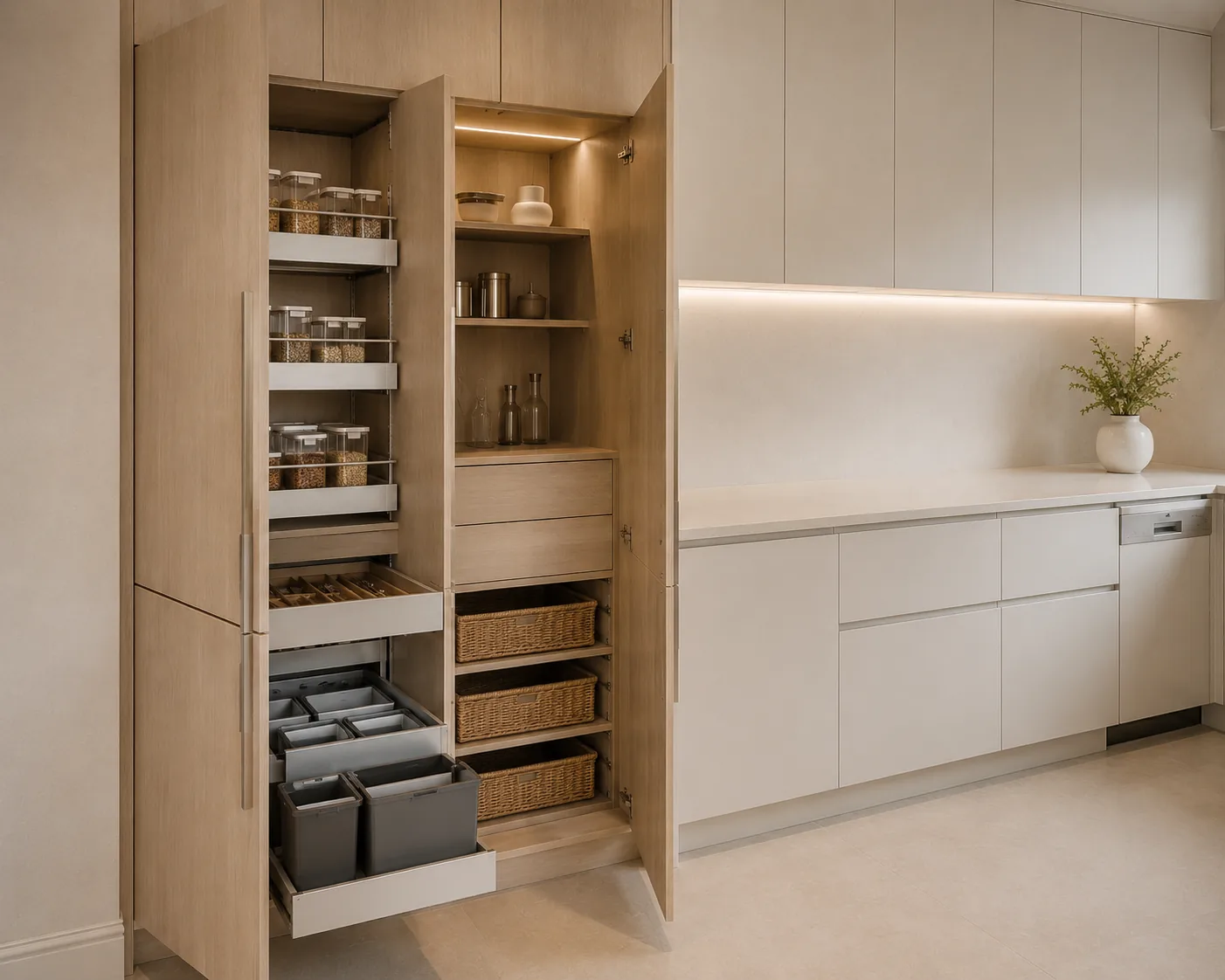
Specification
Kitchen Sink design details
| Detail | Specification |
|---|---|
| Layout | Single bowl, undermount |
| Style | Serene Minimal |
| Palette | Chalk · Pale Oak · Linen |
| Bowl | Single 550×450, undermount |
| Material | Brushed stainless, 304 grade |
| Tap | Pull-out spray, brushed steel |
| Accessories | Roll-up drainer mat |
| Home size | Room dimension |
|---|---|
| 1 BHK | Single bowl 21-1/2″ |
| 2 BHK | Single bowl 28″ |
| 3 BHK | Double bowl 32″ |
| 4 BHK | Double bowl with a drainer, 39″ |
| 4+ BHK / Villa | Twin bowl plus a prep sink |
Storage features
- Under-sink caddy on a pull-out
- Waste segregation bins in the base
- A detergent drawer clear of the trap
Special features
- An undermount bowl so the counter wipes straight in
- No drainer — a roll mat instead
- Tap in a brushed finish matching the bowl
Ideal forCompact kitchens where counter space is scarce
Compare
The same kitchen sink in the other five styles
One brief, six resolutions. Each carries its own layout, material specification and storage strategy.

Bold Large single bowl, matt black Kitchen Sink
Charcoal · Oxblood · Smoked Oak
See this design
Heritage Hammered brass bowl Kitchen Sink
Teak · Cane · Antique Brass
See this design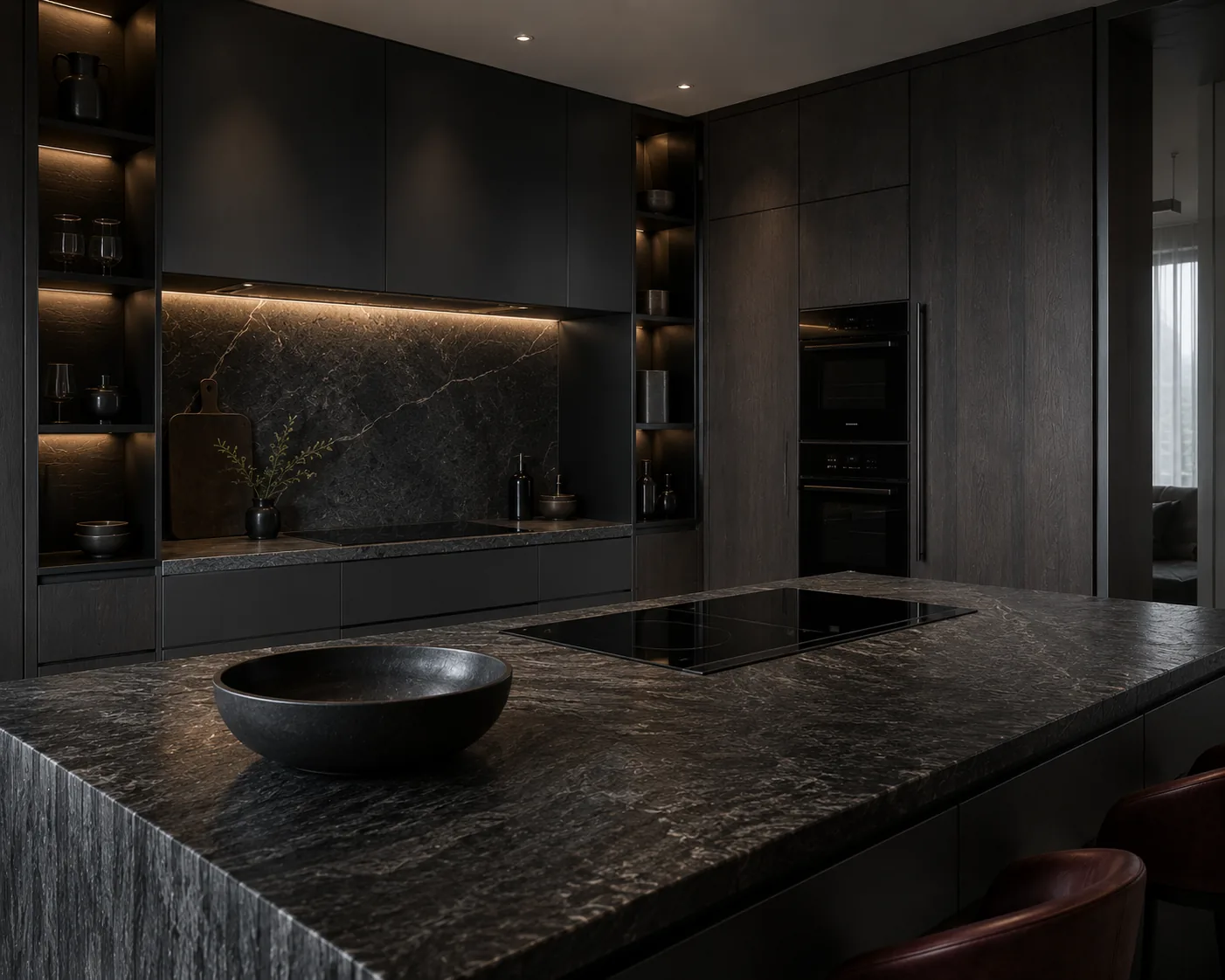
Classic Double bowl with a drainer Kitchen Sink
Ivory · Statuario · Gold
See this design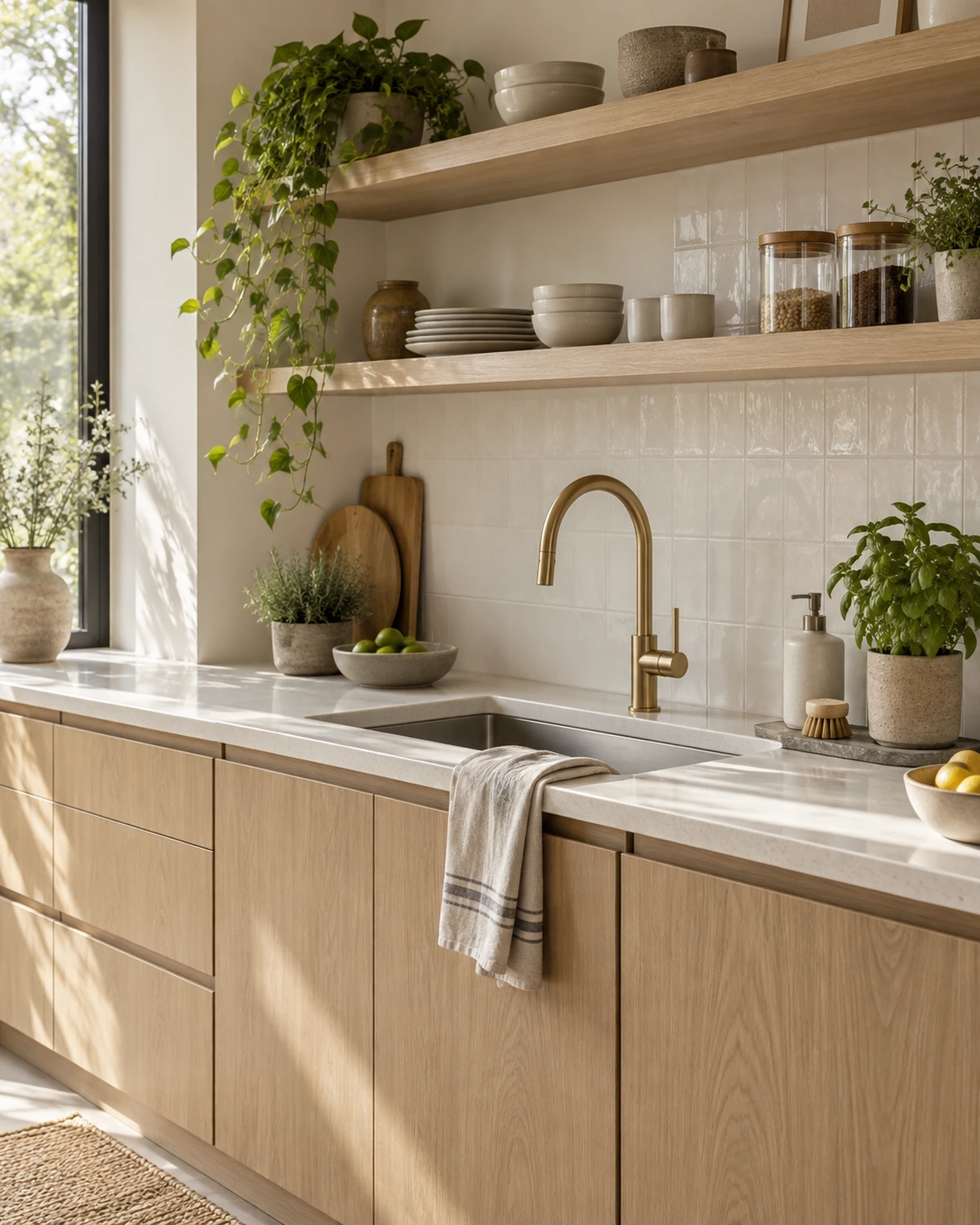
Scandi Twin bowl with a birch board Kitchen Sink
Birch · Chalk · Sage
See this design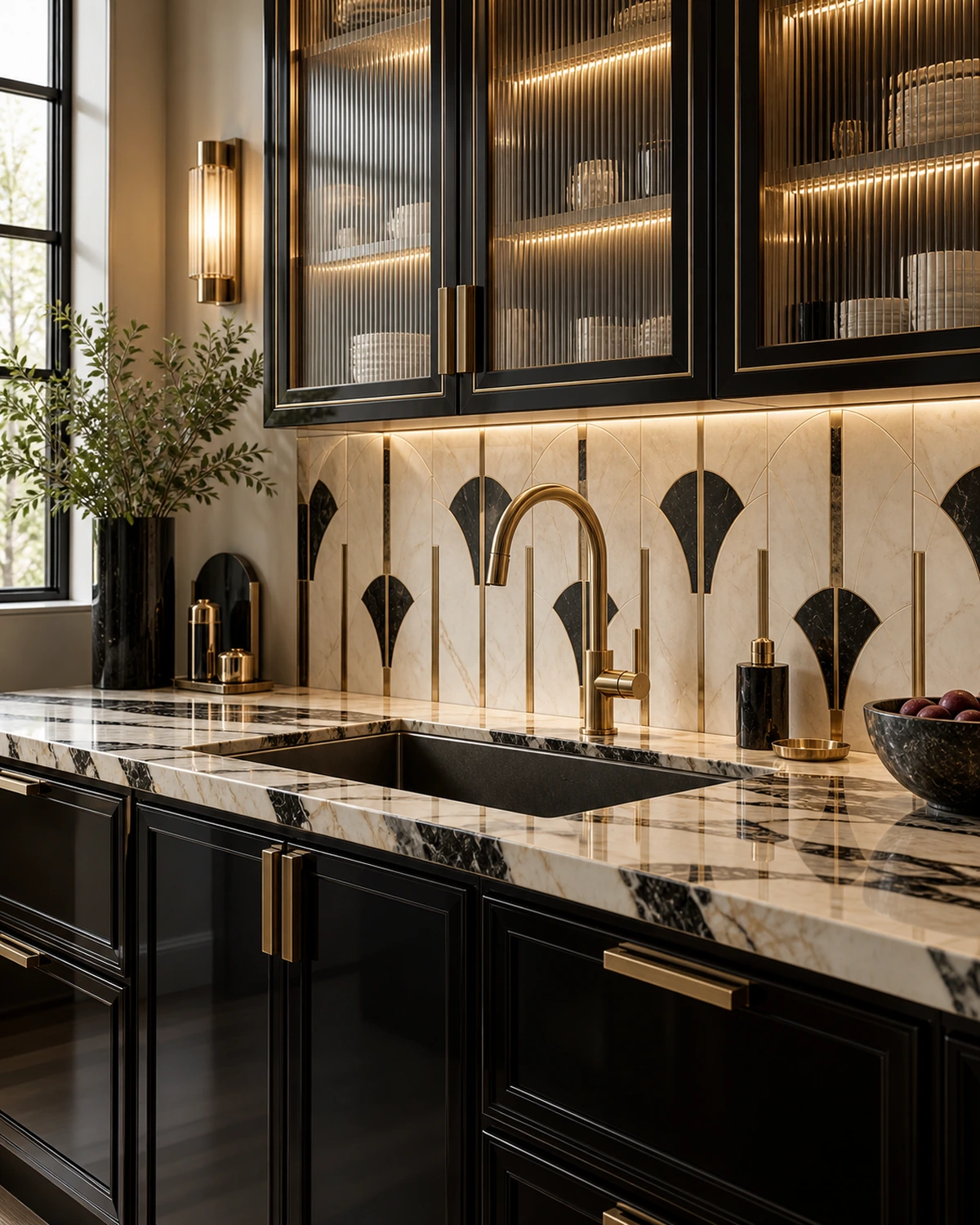
Deco Fluted apron front Kitchen Sink
Emerald · Brass · Lacquer
See this designDetail
Specifying and living with this kitchen sink
Nothing decorative survives unless it also does work. Long uninterrupted planes, shadow-gap joints, one quiet grain. That governs every material decision on this page — the layout and the storage strategy come first, and kitchen sink is where the serene minimal palette gets applied to a plan that already works.
A specification is only as good as what happens after handover. kitchen sink in this style is chosen as much for how it ages as for how it photographs on day one — the joinery finish, the hardware grade and the way an edge is sealed all show up in year three, long after the render is forgotten.
Serene Minimal is a coherent palette rather than a fixed rule, and most finished homes borrow across two styles rather than committing to one throughout. What rarely works is switching the palette room to room within one sightline — the transition needs a threshold, a change of material, or a corridor to read as intentional rather than accidental.
The specification below is what we issue to the factory and the site for this exact style and layout. It is also what a warranty is enforced against, which is why it is written as grades and dimensions rather than as adjectives.
Nothing on this page is a fixed catalogue item. The layout, the palette and every material line are redrawn against your own room dimensions before anything is priced — what you see here is the starting specification, not the finished drawing.
Serene Minimal suits a household that already knows roughly what it wants a kitchen sink to feel like, rather than one still deciding between opposites — the palette is distinctive enough that it rewards commitment and looks unresolved applied half-heartedly.
This reads best in a home where at least the adjoining rooms share the same direction, even if not the same materials. Serene Minimal carried into one room and abandoned at the next doorway tends to make both rooms look like an afterthought rather than a choice.
If you are drawn to serene minimal but unsure it will hold up to daily use, that is worth raising directly at the survey — the palette can usually be adapted toward more forgiving materials without losing the character that made it appealing in the first place.
Worth checking before sign-off
- Choose appliances before the cabinetry is drawn. Every one of them dictates an aperture, a clearance, a power point and sometimes a water and waste connection.
- Confirm the exact model, not the range. Aperture dimensions vary by 3/16″ to 3/8″ within a single manufacturer's line, and 3/16″ is the difference between fitted and forced.
- Check the electrical load against the flat's sanctioned load. Ovens, hobs and dishwashers running together trip an undersized board.
- Ask about service coverage in your city before buying. An imported appliance with no local service is a five-year problem.
- Plan the ducting route for extraction at the same time as the appliance choice; a long or crushed duct halves the effective performance.
- Leave a serviceable front. Anything that can be pulled forward for repair without dismantling the run will be repaired; anything that cannot, will be replaced.
Living with it
- Clean chimney baffle filters monthly in an Indian kitchen; degrease the duct annually.
- Run a dishwasher maintenance cycle monthly and check the filter weekly.
- Descale anything that heats water on a quarterly schedule in hard-water cities.
- Register warranties at handover and keep the model numbers with the project file.
Mistakes worth avoiding
- Finalising cabinetry before appliances, then cutting a carcass on site to fit.
- Recirculating hoods where the cooking is daily and Indian.
- Ignoring the sanctioned electrical load.
- Placing an appliance where its door cannot fully open against an adjacent wall.
Budget on a kitchen sink in this style moves with a small number of decisions rather than with the style label itself: brand tier and whether the appliance is integrated or freestanding. and extraction performance and ducting work. are usually the two line items that separate two otherwise similar quotes. Electrical upgrades where the existing board cannot carry the load.
Detailing
Finer points of this kitchen sink
Set the oven at a height where the middle shelf is at hand level, not at floor level. It costs a cabinet and changes daily use.
Give the dishwasher a position within the sink zone so plumbing runs are short and the loading path is natural.
Keep the microwave out of the tall unit stack unless it is at eye level; overhead is a burn risk when lifting hot dishes.
Plan a landing surface beside every hot appliance — the missing 12″ of counter beside an oven is the most common daily annoyance.
Questions
Kitchen Sink in Serene Minimal — answered
How is servicing handled later?
Design a pull-forward path for anything with a motor or a pump. If an appliance can be brought out on its own, it will be serviced rather than replaced.
What about Indian cooking?
Extraction is the whole question. Ducted extraction at 90cm width, short duct runs and monthly filter cleaning are what keep a kitchen — and the joinery around it — clean.
Is the warranty affected by installation?
Yes. Most manufacturers require installation to their clearance and electrical specification, which is another reason those numbers go into the drawing before production.
When should appliances be chosen?
Before the cabinetry drawing is frozen. Apertures, clearances, power points and water connections all follow the model, and changing the model after production has started means re-cutting panels.
Does Kitchen Sink need a dedicated electrical point?
Most built-in appliances do, usually 16A with an accessible isolator. That point has to be positioned so it is reachable without pulling the appliance out.
Questions
Kitchen Sink questions
Undermount or top-mount?
Undermount if the counter is quartz, granite or solid surface — you can wipe crumbs straight into the bowl and there is no rim to trap grime. Top-mount is the only option on laminate.
How deep should a kitchen sink be?
8″ to 8-3/4″. Deeper than that and you stoop; shallower and water splashes out when you fill a pot.
Is a double bowl worth it?
Only if you have at least 32″ of cabinet width to give it. Below that, two small bowls are less useful than one large one — a large single bowl takes trays and grills that no double bowl will.
Which sink material lasts best?
304-grade stainless at 0.9mm or thicker is the most forgiving. Composite granite resists scratches and stains well but can chip if you drop cast iron into it.
Next step
Build this kitchen sink.
Send the floor plan and the room dimensions. We come back with this design adapted to your space and priced line by line.