Lighting
Ceiling Lights
Ceiling Lights, planned around how the room is used before how it looks — layout, hardware, services and the six house styles we draw it in.
Overview
Ceiling Lights, in plain specification
Written for the decision, not for the mood board.
A good ceiling lights is invisible in use — everything within reach, nothing in the way, no door fouling another. Achieving that is a matter of dimensions and hardware rather than of style, which is why the specification table below matters more than the photographs.
Ceiling Lights is engineered before it is styled. The layout, the services behind it, the hardware carrying it and the clearances around it all get resolved on a drawing long before a finish is picked. Done in that order, the finish becomes a free choice. Done in reverse, the finish becomes a compromise.
In our work this sits alongside the rest of the home rather than as an isolated decision. Ceiling Lights touches the electrical layout, the ceiling, the flooring build-up and often the civil work, so it is fixed early in the drawing set and reviewed against every other trade before production starts.
Six house styles
Ceiling Lights in six personalities
The same brief resolved six ways. Each carries its own material, finish and detailing.
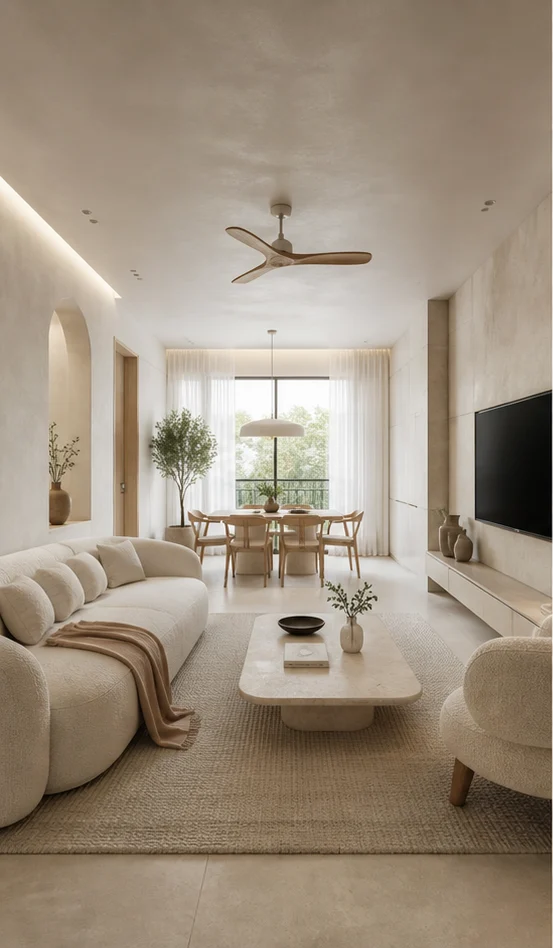
Minimal Ceiling Lights
Serene Minimal treats ceiling lights as chalk · pale oak · linen: nothing decorative survives unless it also does work. CRI: Ra 90. Beam angle: 36 degrees. Driver: Dimmable, external.
See this style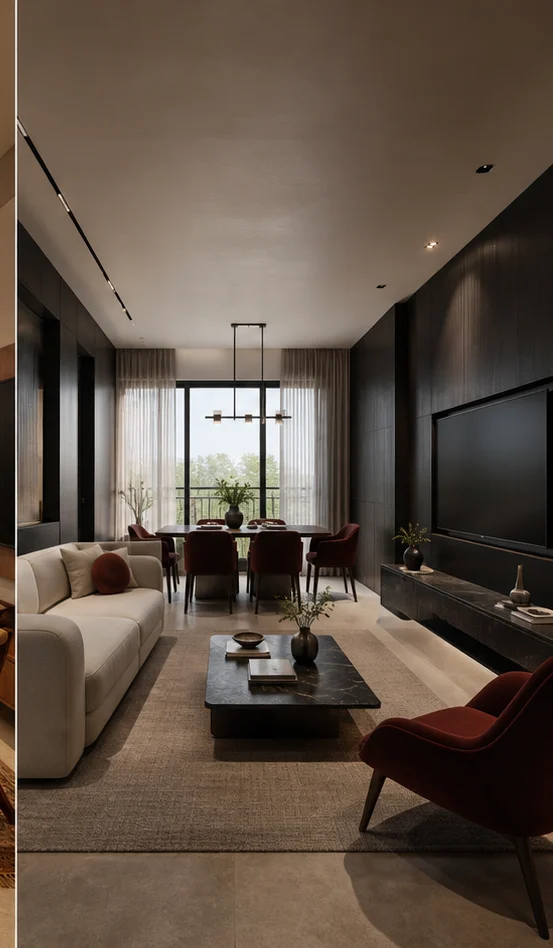
Bold Ceiling Lights
Bold Contemporary treats ceiling lights as charcoal · oxblood · smoked oak: high contrast, confident mass, a single saturated move per room. CRI: Ra 95. Beam angle: 24 degrees, adjustable. Driver: DALI dimmable.
See this styleHeritage Ceiling Lights
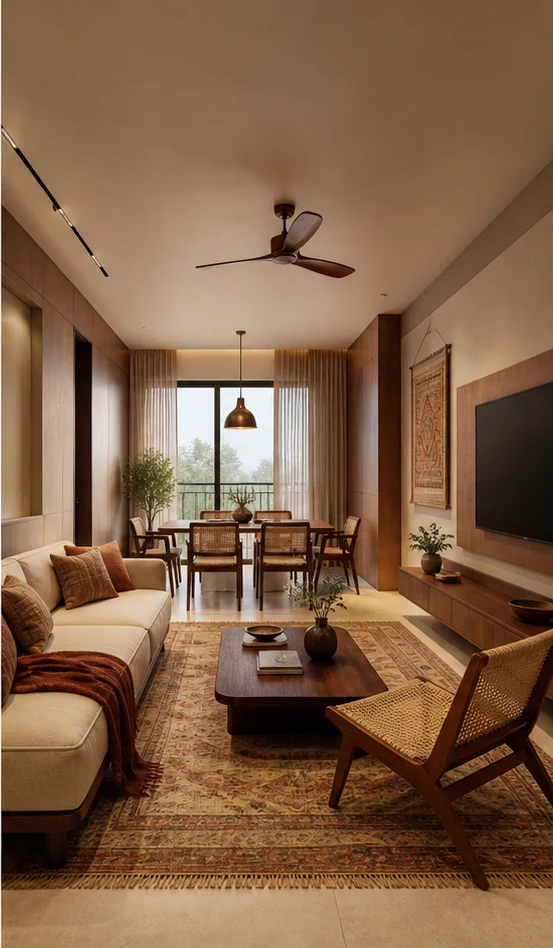
Modern Heritage treats ceiling lights as teak · cane · antique brass: indian craft detailing on a contemporary frame — jaali, cane, inlay and hand-finished brass, used sparingly. CRI: Ra 90. Beam angle: 38 degrees. Driver: Dimmable.
See this style Photo: Foto Miki Digital · PDM 1.0
Classic Ceiling Lights
Classic Luxe treats ceiling lights as ivory · statuario · gold: proportioned panelling, cornice and moulding, book-matched stone and warm gilt detail on ivory. CRI: Ra 95. Beam angle: 24 degrees. Driver: Phase-cut dimmable.
See this style Photo: flossyflotsam · BY 2.0
Scandi Ceiling Lights
Indo-Scandinavian treats ceiling lights as birch · chalk · sage: pale timber, soft daylight and muted green — nordic restraint adapted for indian light, dust and humidity. CRI: Ra 90. Beam angle: 36 degrees. Driver: Dimmable.
See this style Photo: footloosiety · BY 2.0
Deco Ceiling Lights
Art Deco Glam treats ceiling lights as emerald · brass · lacquer: fluting, fans and geometry. CRI: Ra 95. Beam angle: 15 degrees accent. Driver: DALI with scene control.
See this styleSpecification
Ceiling Lights specification, style by style
This is the table we issue to the factory and the site. It is also what a warranty is enforced against, which is why it reads in grades and dimensions.
| Specification | Minimal | Bold | Heritage | Classic | Scandi | Deco |
|---|---|---|---|---|---|---|
| Colour temperature | 3000K | 2700K | 2700K warm | 2700K | 3000K | 2700K |
| CRI | Ra 90 | Ra 95 | Ra 90 | Ra 95 | Ra 90 | Ra 95 |
| Beam angle | 36 degrees | 24 degrees, adjustable | 38 degrees | 24 degrees | 36 degrees | 15 degrees accent |
| Driver | Dimmable, external | DALI dimmable | Dimmable | Phase-cut dimmable | Dimmable | DALI with scene control |
| Mounting | Recessed, spring clip | Magnetic track | Surface, timber base | Recessed with trimless plaster-in | Recessed | Trimless plaster-in |
| Glare control | Deep recessed, black baffle | Honeycomb louvre | Shaded | Deep baffle | Black baffle | Honeycomb louvre |
| Lumen output | 600 lm per fitting | 800 lm per fitting | 500 lm | 700 lm | 600 lm | 450 lm accent |
| Control | Wall dimmer | App and scene control | Wall dimmer | Scene keypad | Wall dimmer | Scene keypad with astro timer |
Before you commit
How to choose ceiling lights
Six checks that prevent the failures we are most often called to fix.
- Design light in layers: ambient, task, accent and decorative. A room with only one layer never feels right regardless of how much light is in it.
- Fix the colour temperature across the whole home and do not vary it room to room. 2700K to 3000K reads as warm and residential; 4000K reads as an office.
- Ask for CRI 90 or better anywhere colour matters — wardrobes, kitchens, bathrooms and anywhere art hangs.
- Dim everything that can be dimmed, and confirm driver and dimmer compatibility in writing. Flicker at low levels is a compatibility failure, not a fixture fault.
- Aim accent fittings at objects — art, texture, joinery. A grid of downlights lighting the floor is the most common mistake in Indian homes.
- Check glare from a seated position, not standing. The bare LED you cannot see at 1.7m is the one that stares at you from the sofa.
Bangalore
Ceiling Lights in Bangalore
What the city's climate, water, housing stock and society rules mean for this specification.
The Bangalore housing stock splits cleanly, and ceiling lights is specified differently for each half. New towers along the outer ring have regular layouts, compact utility areas and generous ceiling height; the older independent homes in the south and west have height, thicker walls and almost no two dimensions the same.
Balcony enclosure rules vary sharply between societies, and a few refuse them entirely. Anything involving a balcony gets checked against the society's own rules before design, not after — including in Indiranagar and Koramangala, where older buildings often have their own restrictions.
The mild climate is a genuine advantage: solid timber and veneer move far less here than in Delhi or Chennai, which makes craft detailing more durable and more affordable than it would be elsewhere. It is one of the few Indian cities where that is true year-round.
Hard borewell water in Whitefield, Sarjapur Road, Hebbal and Yelahanka leaves scale on glass, chrome and stone within months. Where the supply is hard we specify surfaces and fittings that tolerate it, and we tell the family the honest maintenance routine rather than leaving them to discover it.
We survey in Bangalore at no charge, take our own dimensions and come back with a layout, a material direction and a line-by-line estimate.
Sizing
Ceiling Lights by home size
Sizing below is what we plan ceiling lights to in each home size. These are working dimensions from completed projects, not catalogue minimums.
| Home size | Typical scope | Planning note |
|---|---|---|
| 1 BHK | Compact, single run | Compact planning, one clear gesture |
| 2 BHK | Standard, two runs | Standard scope, most common brief |
| 3 BHK | Full specification | Full scope with storage planned in litres |
| 4 BHK | Extended with island or dresser | Extended scope, bespoke elements |
| 4+ BHK / Villa | Bespoke, villa scale | Villa scale, bespoke throughout |
Cost
What moves the price of ceiling lights
We quote line by line rather than per square foot, because these are the items that actually differ between two estimates.
- Fixture quality: optics, glare control and driver, which are what separate two fittings with identical lumen figures.
- Trimless and plaster-in fittings, which cost more in installation than in hardware.
- Control system: a wall dimmer, a scene keypad and a full DALI system are three different budgets.
- Quantity, which is driven by beam angle and ceiling height.
- Decorative fittings, which are priced as objects rather than as light sources.
Process
How the work runs
Five stages, with the decisions each one locks.
We measure the space ourselves rather than working from the builder's drawing, note the services, water quality, daylight and society rules, and write down how the room is actually used. Ceiling Lights is specified against that survey, not against a catalogue.
Plans, elevations and details, with the specification written as grades and dimensions. You approve an elevation, not a render — this is the stage where changes cost nothing.
Material, finish, hardware and services are locked, and the estimate becomes a line-by-line document. We tell you exactly what this date locks and what can still change afterwards.
Factory production runs to the approved drawing while site work is prepared. Material is checked against the approved sample on arrival, in daylight, and stored correctly until the programme calls for it.
Installation, testing, snagging and a documentation file with drawings, warranties, decor codes and hardware models. A first-year service visit is scheduled at handover.
Living with it
Maintaining ceiling lights
The honest routine, and the mistakes that cost the most to undo.
Care and maintenance
- Wipe lenses and reflectors twice a year. Dust on a lens costs more light than a failing LED does.
- Record the driver and lamp specification at handover so a failed fitting can be matched years later.
- Check for flicker after any dimmer change — it usually indicates a mismatched load.
- Expect drivers, not LEDs, to be the component that fails. Keep two spares of anything used at scale.
What goes wrong
- Lighting the ceiling plan rather than the furniture plan.
- Mixing colour temperatures within a sightline.
- Using non-dimmable fittings to save cost, then discovering the room only has one mood.
- Placing downlights directly above where people sit, which lights the tops of heads and nothing else.
Detailing
Ceiling Lights detailing notes
The small decisions that separate built work from assembled work.
Cove and profile light should wash a surface, not be visible as a strip. If you can see the diode line, the reveal is too shallow.
Pendants over a dining table hang 750–850mm above the table top. Higher and they light the room; lower and they block conversation.
In a bedroom, put the reading light on the wall or the headboard, and put a dimmed low-level circuit on the floor for night use.
Keep the switching logic simple enough to explain in one sentence per room. Complex scene systems get abandoned within a year otherwise.
Questions
Ceiling Lights — answered
What colour temperature suits an Indian home?
2700K to 3000K throughout. Cooler light reads as commercial in a residence, and mixing temperatures within one sightline is the fastest way to make good fittings look cheap.
How many downlights does a room need?
Fewer than most plans show. Light what needs lighting — the counter, the art, the seat, the path — and let the rest of the room fall away. A 12×14 living room usually needs six to eight well-aimed fittings, not sixteen.
Can Ceiling Lights be dimmed?
Yes when the driver and dimmer are matched. We specify both together and test at commissioning, because flicker at low output is almost always a compatibility issue.
What is CRI and does it matter?
Colour rendering index describes how truthfully a light shows colour. Below Ra 80 skin tones and fabrics look wrong; Ra 90 or better is the standard for living areas, wardrobes and bathrooms.
How long do LED fittings last?
The diodes outlast the drivers. Expect 30,000 to 50,000 hours from a good fitting, with the driver as the practical service item.
Should lighting be planned before or after the ceiling?
Before. The ceiling is built around the lighting layout, not the other way round, and moving a recessed fitting afterwards means cutting and making good.
Do you work on ceiling lights projects across Bangalore?
Yes — Bangalore is where most of our projects are, from apartments along Sarjapur Road, Whitefield and Hebbal to independent homes in Jayanagar, Indiranagar and Malleshwaram. We survey the space ourselves, work within the society's access and working-hour rules, and hand over with a documentation file. There is a dedicated page for our work in the city if you want the full picture.
Does Bangalore's climate or water affect this choice?
The climate helps and the water does not. Mild year-round temperatures are kinder to timber and joinery than almost any other Indian city, so craft detailing lasts. Hard borewell water in the eastern and northern corridors is the real constraint — it scales glass, chrome and stone, and it changes what we specify and what maintenance we ask the family to commit to.
Explore more
More in Lighting
Related pages
Next step
Planning ceiling lights for your home?
Send your floor plan and we come back with a layout, a material direction and a line-by-line estimate. Free survey across Bangalore.