Boards and cores
Calibrated Plywood
Calibrated Plywood, specified the way a site actually needs it — format, substrate, fixing, sealing and the maintenance the family will really do.
Overview
Calibrated Plywood, in plain specification
Written for the decision, not for the mood board.
Calibrated Plywood is chosen twice — once for how it looks in a sample, and once for how it behaves over a decade of Indian weather, cleaning and daily use. The second choice is the one that decides whether you are happy with it. Every specification on this page is written from that second view: the substrate under it, the way it is fixed, the joint it sits in, and the maintenance it will realistically get in a working household.
Most disappointment with calibrated plywood traces back to a decision made before the material arrived — an uneven substrate, a joint width chosen on site, a sealer applied to a damp surface, or a batch bought short and topped up from a different lot. None of these are material faults. They are specification faults, and they are avoidable in an afternoon of planning.
In our work this sits alongside the rest of the home rather than as an isolated decision. Calibrated Plywood touches the electrical layout, the ceiling, the flooring build-up and often the civil work, so it is fixed early in the drawing set and reviewed against every other trade before production starts.
Six house styles
Calibrated Plywood in six personalities
The same brief resolved six ways. Each carries its own material, finish and detailing.
Minimal Calibrated Plywood
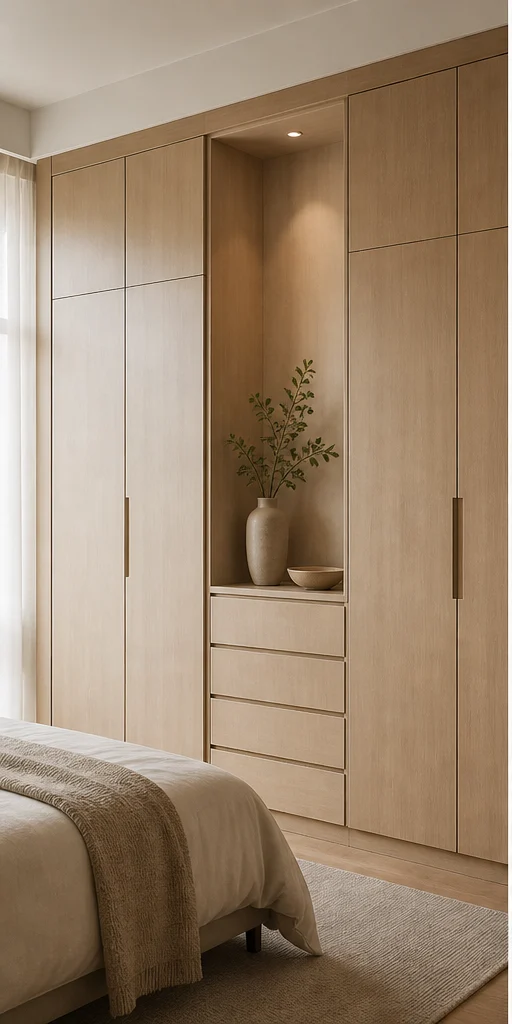
Serene Minimal draws calibrated plywood as chalk · pale oak · linen — nothing decorative survives unless it also does work. Core: Hardwood, gap-free. Thickness: 18mm carcass, 6mm back. Edge banding: 0.8mm PVC, colour-matched.
See this style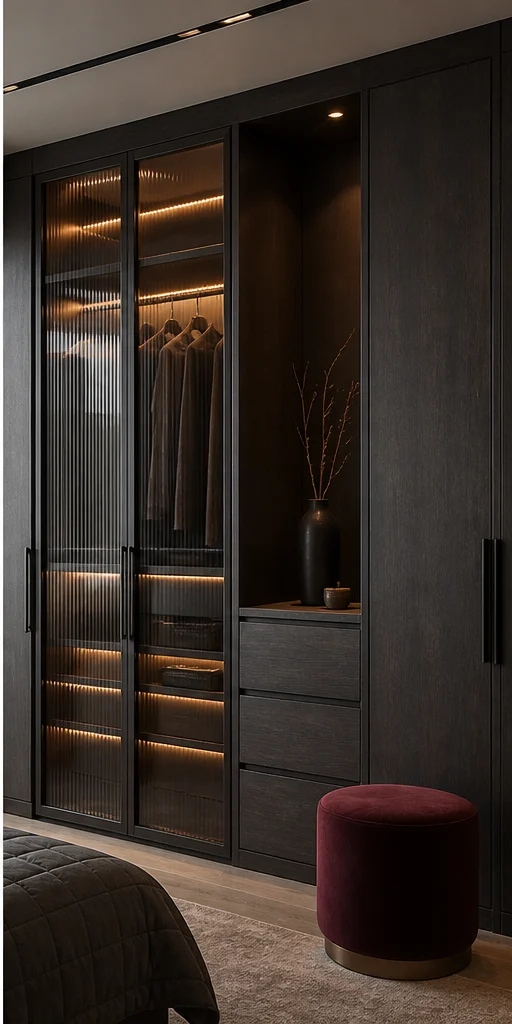
Bold Calibrated Plywood
Bold Contemporary draws calibrated plywood as charcoal · oxblood · smoked oak — high contrast, confident mass, a single saturated move per room. Core: Full hardwood, gurjan face. Thickness: 18mm with 12mm shelving. Edge banding: 2mm PVC, laser-sealed.
See this styleHeritage Calibrated Plywood
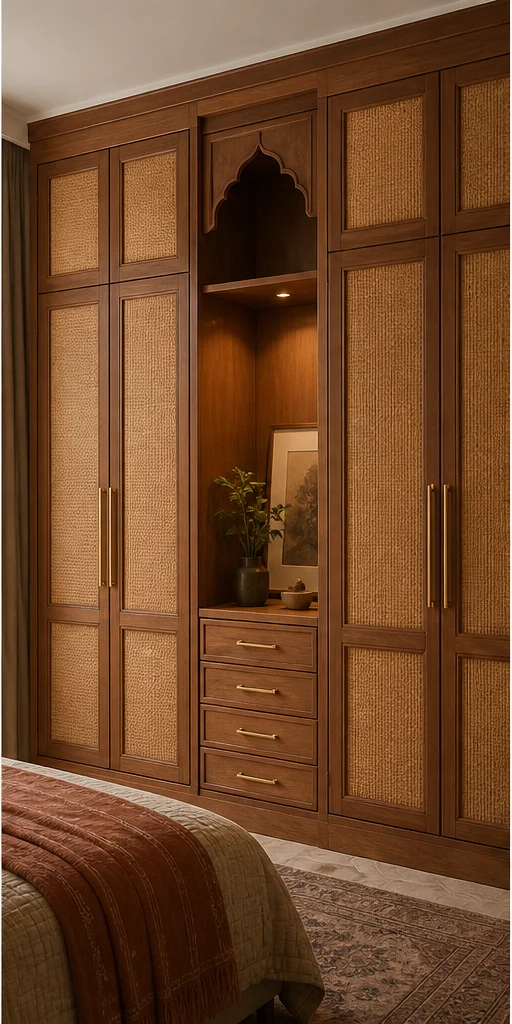
Modern Heritage draws calibrated plywood as teak · cane · antique brass — indian craft detailing on a contemporary frame — jaali, cane, inlay and hand-finished brass, used sparingly. Core: Solid hardwood with teak face. Thickness: 19mm, hand-planed. Edge banding: Solid timber lipping.
See this style Photo: flooringclarity · BY 2.0
Classic Calibrated Plywood
Classic Luxe draws calibrated plywood as ivory · statuario · gold — proportioned panelling, cornice and moulding, book-matched stone and warm gilt detail on ivory. Core: Hardwood with MDF face for paint. Thickness: 18mm with 25mm counter frame. Edge banding: Beaded timber lipping.
See this style Photo: VillaEarlySunset · BY 2.0
Scandi Calibrated Plywood
Indo-Scandinavian draws calibrated plywood as birch · chalk · sage — pale timber, soft daylight and muted green — nordic restraint adapted for indian light, dust and humidity. Core: Birch-faced hardwood. Thickness: 18mm. Edge banding: 1mm matt PVC.
See this style Photo: andrechinn · BY 2.0
Deco Calibrated Plywood
Art Deco Glam draws calibrated plywood as emerald · brass · lacquer — fluting, fans and geometry. Core: Hardwood, calibrated for gloss. Thickness: 18mm, calibrated to ±0.2mm. Edge banding: 2mm acrylic edge, polished.
See this styleSpecification
Calibrated Plywood specification, style by style
This is the table we issue to the factory and the site. It is also what a warranty is enforced against, which is why it reads in grades and dimensions.
| Specification | Minimal | Bold | Heritage | Classic | Scandi | Deco |
|---|---|---|---|---|---|---|
| Grade | BWR, IS:303 | BWP, IS:710 | BWP marine, IS:710 | BWP with moulded face | BWR calibrated | BWP with lacquer-grade face |
| Core | Hardwood, gap-free | Full hardwood, gurjan face | Solid hardwood with teak face | Hardwood with MDF face for paint | Birch-faced hardwood | Hardwood, calibrated for gloss |
| Thickness | 18mm carcass, 6mm back | 18mm with 12mm shelving | 19mm, hand-planed | 18mm with 25mm counter frame | 18mm | 18mm, calibrated to ±0.2mm |
| Edge banding | 0.8mm PVC, colour-matched | 2mm PVC, laser-sealed | Solid timber lipping | Beaded timber lipping | 1mm matt PVC | 2mm acrylic edge, polished |
| Treatment | Termite and borer treated | Double vacuum-pressure treated | Hot-oil treated | Pressure treated, kiln dried | Boron treated | Pressure treated |
| Moisture content | 8–10% | 8–12% | 10–12% | 8–10% | 8–10% | 8–10% |
| Fixings | Concealed cam and dowel | Cam, dowel and metal gusset | Traditional joinery with dowels | Cam and dowel with corner blocks | Cam and dowel | Cam, dowel and aluminium profile |
| Warranty | Lifetime against borer and termite | Lifetime, transferable | Lifetime on frame | Lifetime on carcass | Lifetime | Lifetime on carcass and hardware |
Before you commit
How to choose calibrated plywood
Six checks that prevent the failures we are most often called to fix.
- Check the IS mark and the batch stamp on the edge of the sheet, not the sticker on the face. IS:710 is the boiling-water-proof grade; IS:303 BWR is the interior grade.
- Do the boil test on a sample if the supplier will allow it — a genuine BWP board survives four hours in boiling water without delamination.
- Look at the cut edge. A dense, gap-free core with even veneer layers is the whole story; visible voids will become soft spots under a hinge or a screw.
- Weight is a fair proxy for density. A light sheet of the same nominal grade almost always has a thinner or softer core.
- Specify the core by location: BWP for kitchen, bathroom and utility joinery, BWR for bedroom wardrobes, and never the reverse to save money.
- Ask what the edge banding is and how it is applied. Laser or PUR-bonded 2mm edges survive Indian humidity; heat-glued 0.5mm edges lift within two summers.
Bangalore
Calibrated Plywood in Bangalore
What the city's climate, water, housing stock and society rules mean for this specification.
Working in Bangalore means working around two practical constraints more than around climate. Apartment societies restrict working hours, service-lift access and debris removal; and the new high-rise stock along the eastern corridor is handed over as a bare shell, so calibrated plywood arrives at the same time as every other trade.
Most societies here allow work between roughly 9am and 6pm, restrict Sundays, require a service-lift booking and hold a debris deposit. That schedule is written into the programme at the start, because a plan that assumes twelve working hours a day will slip in its first week.
Traffic decides delivery windows more than distance does. Material moving to Whitefield, Sarjapur or Electronic City is scheduled outside peak hours, and large items are checked against the lift and stair turn before the order rather than on delivery day.
Dust along the metro and ORR construction corridors is a real specification input. Sealed joinery, washable finishes and casement or sliding windows with good seals pay for themselves in these pockets in the first year.
We survey in Bangalore at no charge, take our own dimensions and come back with a layout, a material direction and a line-by-line estimate.
Sizing
Calibrated Plywood by home size
Quantities below are the areas we typically specify calibrated plywood for, by home size. They assume a straight lay with a 10 to 12 per cent reserve from the same lot.
| Home size | Typical scope | Planning note |
|---|---|---|
| 1 BHK | 180–260 sq ft | Compact planning, one clear gesture |
| 2 BHK | 320–420 sq ft | Standard scope, most common brief |
| 3 BHK | 480–650 sq ft | Full scope with storage planned in litres |
| 4 BHK | 700–900 sq ft | Extended scope, bespoke elements |
| 4+ BHK / Villa | 1,100 sq ft and above | Villa scale, bespoke throughout |
Cost
What moves the price of calibrated plywood
We quote line by line rather than per square foot, because these are the items that actually differ between two estimates.
- Core grade. Moving a full kitchen from BWR to BWP is a meaningful jump and is the single most defensible upgrade in the estimate.
- Hardware quantity, not board area, drives most of the difference between two similar-looking runs.
- Edge banding thickness and bonding method.
- Factory pressing versus site carpentry — factory work costs more up front and less in rework, dust and time.
- Finish on the face: laminate, acrylic, veneer and PU sit at four quite different levels.
Process
How the work runs
Five stages, with the decisions each one locks.
We measure the space ourselves rather than working from the builder's drawing, note the services, water quality, daylight and society rules, and write down how the room is actually used. Calibrated Plywood is specified against that survey, not against a catalogue.
Plans, elevations and details, with the specification written as grades and dimensions. You approve an elevation, not a render — this is the stage where changes cost nothing.
Material, finish, hardware and services are locked, and the estimate becomes a line-by-line document. We tell you exactly what this date locks and what can still change afterwards.
Factory production runs to the approved drawing while site work is prepared. Material is checked against the approved sample on arrival, in daylight, and stored correctly until the programme calls for it.
Installation, testing, snagging and a documentation file with drawings, warranties, decor codes and hardware models. A first-year service visit is scheduled at handover.
Living with it
Maintaining calibrated plywood
The honest routine, and the mistakes that cost the most to undo.
Care and maintenance
- Keep standing water off horizontal edges, especially around the sink cut-out and the hob. Wipe the base of the sink cabinet weekly for the first month to catch a slow leak early.
- Tighten hinges once in the first year. Boards settle, and a door that drops a millimetre puts all the load on two screws.
- Do not clean shutters with a soaking cloth. Water finds the edge band seam and lifts it.
- Keep the interior ventilated. Wardrobes on external walls in humid cities benefit from a 10mm rear gap and a vent hole in the plinth.
What goes wrong
- Mixing grades inside one kitchen to trim the estimate. The cheapest carcass in the run decides how long the kitchen lasts.
- Screwing hinges into an unsupported edge. Hinge plates need a solid core behind them or they pull out within two years.
- Ignoring the plinth. A carcass sitting on the floor in a wash-prone kitchen wicks water up the end panel; an adjustable leg-and-plinth system does not.
- Assuming a factory finish forgives a bad site. Boards move with humidity — the room has to be dry and the levels true before anything is fixed.
Detailing
Calibrated Plywood detailing notes
The small decisions that separate built work from assembled work.
Every exposed edge in a wet zone should be sealed before assembly, not after. The failure always starts at an unsealed cut edge under a sink.
Back panels do structural work. A 6mm grooved-in back keeps a tall unit square; a stapled-on back does not.
Shelf spans over 900mm need either a thicker board or a mid support, or they will bow visibly within a year under normal load.
Where a carcass meets a wet wall, leave a 10mm ventilated gap. Boards fail from trapped moisture far more often than from spills.
Questions
Calibrated Plywood — answered
What grade of Calibrated Plywood should a kitchen use?
Boiling-water-proof — IS:710 — for every carcass in the kitchen, utility and bathroom. The interior grade is acceptable for bedroom wardrobes in a dry city, but the price difference is small enough that most projects standardise on the higher grade.
How do I verify quality on delivery?
Check the IS stamp and batch number on the sheet edge, look at the cut edge for core voids, and weigh a sheet against the declared density. Photograph the stamps on the delivery — that record is what a warranty claim turns on.
Does Calibrated Plywood come with a warranty?
Reputable manufacturers warrant against borer, termite and delamination for the life of the board. The warranty is only worth what the invoice records, so ensure the grade and batch appear on it.
How long will joinery built from it last?
Fifteen to twenty-five years in normal residential use when the grade matches the room and the edges are sealed. Failures in the first five years are almost always a moisture or a hardware problem, not the board.
Can it be refinished later?
The carcass stays; the face changes. Re-laminating or re-veneering shutters on a sound carcass is a fraction of the cost of a new kitchen, which is the practical argument for spending on the core.
Is a thicker board always better?
No. 18mm is right for carcasses and 25mm for a working counter frame. Beyond that you are paying for weight that the hardware then has to carry.
Do you work on calibrated plywood projects across Bangalore?
Yes — Bangalore is where most of our projects are, from apartments along Sarjapur Road, Whitefield and Hebbal to independent homes in Jayanagar, Indiranagar and Malleshwaram. We survey the space ourselves, work within the society's access and working-hour rules, and hand over with a documentation file. There is a dedicated page for our work in the city if you want the full picture.
Does Bangalore's climate or water affect this choice?
The climate helps and the water does not. Mild year-round temperatures are kinder to timber and joinery than almost any other Indian city, so craft detailing lasts. Hard borewell water in the eastern and northern corridors is the real constraint — it scales glass, chrome and stone, and it changes what we specify and what maintenance we ask the family to commit to.
Explore more
More in Plywood
Related pages
Next step
Planning calibrated plywood for your home?
Send your floor plan and we come back with a layout, a material direction and a line-by-line estimate. Free survey across Bangalore.