Automation and AV
Access Control
Access Control for Bangalore homes — the dimensions, hardware and detailing that decide whether it still works in year five.
Overview
Access Control, in plain specification
Written for the decision, not for the mood board.
Every access control we build starts from how the room is used at its busiest hour. Circulation, reach and storage volume come first; elevations come second. It is a slower way to start and it removes most of the changes that would otherwise appear halfway through production.
A good access control is invisible in use — everything within reach, nothing in the way, no door fouling another. Achieving that is a matter of dimensions and hardware rather than of style, which is why the specification table below matters more than the photographs.
The specification below is the one we issue to the factory and the site, which is why it reads as dimensions and grades rather than as adjectives. It is also what a warranty is enforced against — a specification that cannot be measured cannot be claimed on.
Six house styles
Access Control in six personalities
The same brief resolved six ways. Each carries its own material, finish and detailing.
Minimal Access Control
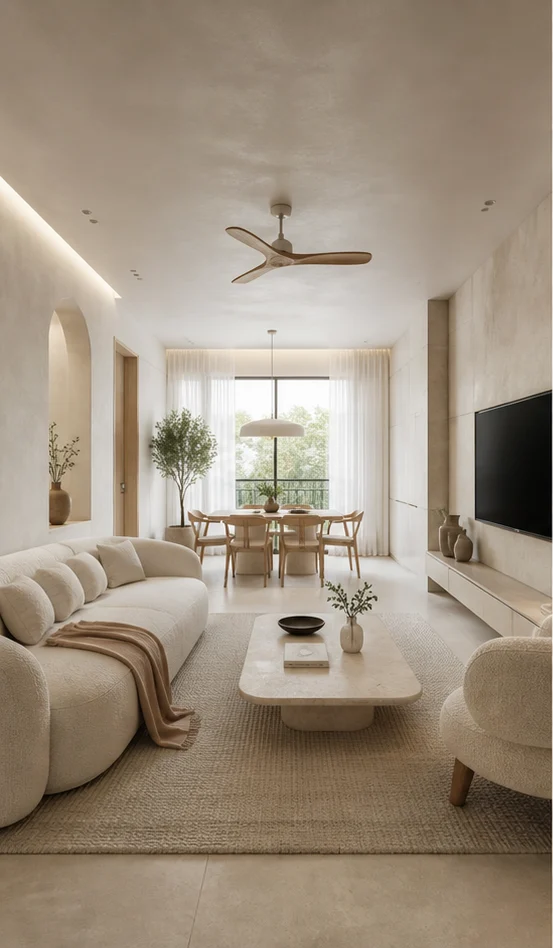
Serene Minimal treats access control as chalk · pale oak · linen: nothing decorative survives unless it also does work. Control: App and wall keypad. Network: Mesh Wi-Fi, 3 nodes. Power backup: UPS on hub.
See this style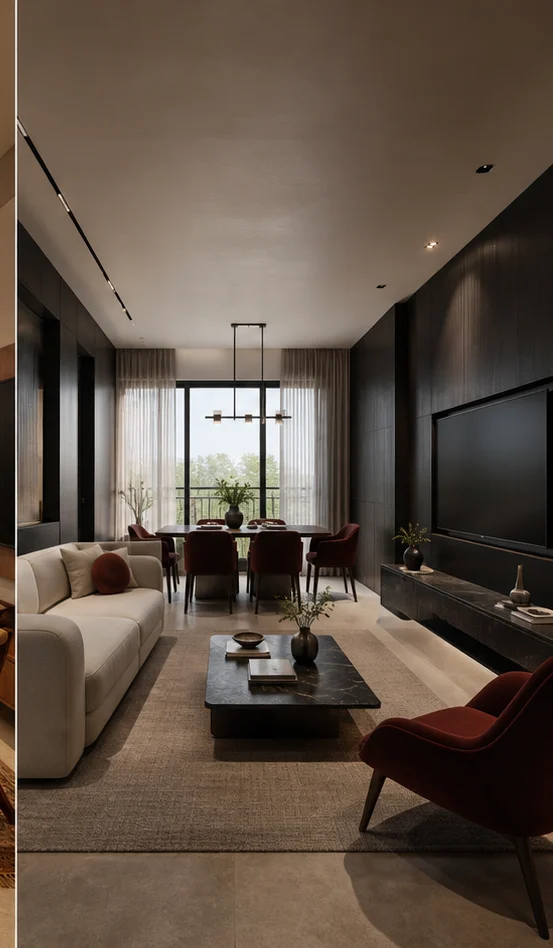
Bold Access Control
Bold Contemporary treats access control as charcoal · oxblood · smoked oak: high contrast, confident mass, a single saturated move per room. Control: Keypads, app, voice. Network: Structured cabling to every room. Power backup: UPS on hub and network.
See this styleHeritage Access Control
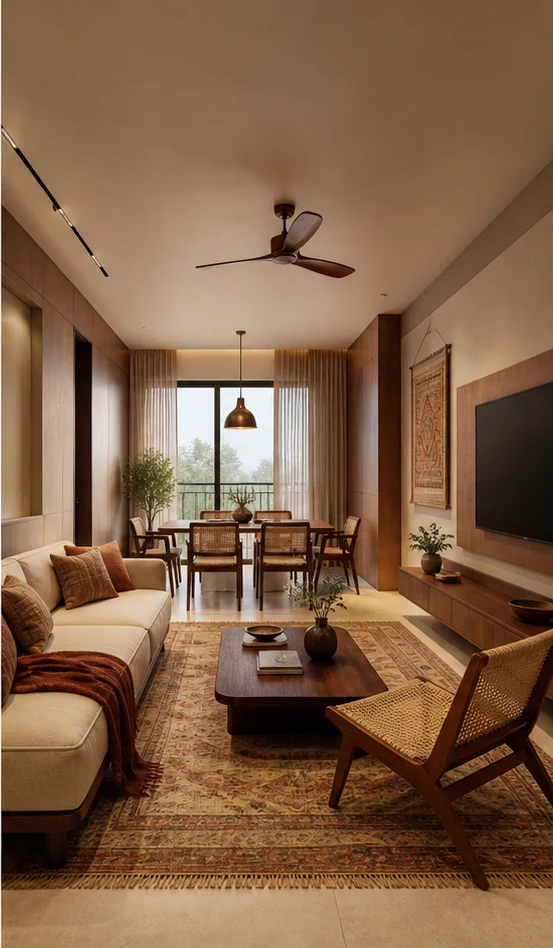
Modern Heritage treats access control as teak · cane · antique brass: indian craft detailing on a contemporary frame — jaali, cane, inlay and hand-finished brass, used sparingly. Control: Wall keypad. Network: Mesh Wi-Fi. Power backup: UPS on hub.
See this style Photo: Foto Miki Digital · PDM 1.0
Classic Access Control
Classic Luxe treats access control as ivory · statuario · gold: proportioned panelling, cornice and moulding, book-matched stone and warm gilt detail on ivory. Control: Scene keypads. Network: Structured cabling. Power backup: UPS on panel.
See this style Photo: flossyflotsam · BY 2.0
Scandi Access Control
Indo-Scandinavian treats access control as birch · chalk · sage: pale timber, soft daylight and muted green — nordic restraint adapted for indian light, dust and humidity. Control: App. Network: Mesh Wi-Fi. Power backup: UPS on hub.
See this style Photo: footloosiety · BY 2.0
Deco Access Control
Art Deco Glam treats access control as emerald · brass · lacquer: fluting, fans and geometry. Control: Scene keypads with touch panel. Network: Structured with fibre backbone. Power backup: UPS on panel and network.
See this styleSpecification
Access Control specification, style by style
This is the table we issue to the factory and the site. It is also what a warranty is enforced against, which is why it reads in grades and dimensions.
| Specification | Minimal | Bold | Heritage | Classic | Scandi | Deco |
|---|---|---|---|---|---|---|
| Protocol | Wi-Fi and Zigbee | Wired KNX | Zigbee | Wired with wireless keypads | Wi-Fi | Wired KNX with app |
| Control | App and wall keypad | Keypads, app, voice | Wall keypad | Scene keypads | App | Scene keypads with touch panel |
| Network | Mesh Wi-Fi, 3 nodes | Structured cabling to every room | Mesh Wi-Fi | Structured cabling | Mesh Wi-Fi | Structured with fibre backbone |
| Power backup | UPS on hub | UPS on hub and network | UPS on hub | UPS on panel | UPS on hub | UPS on panel and network |
| Fallback | Manual switch retained | Manual override at panel | Manual switch | Manual override | Manual switch | Manual override |
| Scenes | Four per room | Six per room with astro timer | Four | Six | Four | Six with astro and away mode |
| Integration | Lighting and curtains | Lighting, curtains, AC, AV, security | Lighting | Lighting, curtains, AC | Lighting | Full integration with AV |
| Commissioning | Half a day | Two days with handover training | Half a day | One day | Half a day | Two days |
Before you commit
How to choose access control
Six checks that prevent the failures we are most often called to fix.
- Decide wired or wireless before the electrical first fix. A wired system cannot be added later without opening walls; a wireless one can.
- Insist on a manual fallback for every automated circuit. A house where the lights cannot be switched by hand when the network is down is a design failure.
- Keep the scene logic simple. Four scenes people remember beat twenty scenes nobody uses.
- Ask who supports the system in your city and what happens when the installer's business changes. Proprietary systems live or die on local support.
- Plan the network first. Almost every 'automation problem' turns out to be a Wi-Fi coverage problem.
- Put the hub, router and any UPS somewhere ventilated and accessible, not sealed inside a joinery cavity.
Bangalore
Access Control in Bangalore
What the city's climate, water, housing stock and society rules mean for this specification.
Most of our work is in Bangalore, and the city sets a few conditions worth knowing before specifying access control. The climate is the kindest in India to timber and joinery — no extreme dry heat, no coastal salt — but the monsoon runs long, and humidity between June and October is what tests every edge, seal and ventilation gap in a home.
Balcony enclosure rules vary sharply between societies, and a few refuse them entirely. Anything involving a balcony gets checked against the society's own rules before design, not after — including in Indiranagar and Koramangala, where older buildings often have their own restrictions.
The mild climate is a genuine advantage: solid timber and veneer move far less here than in Delhi or Chennai, which makes craft detailing more durable and more affordable than it would be elsewhere. It is one of the few Indian cities where that is true year-round.
Hard borewell water in Whitefield, Sarjapur Road, Hebbal and Yelahanka leaves scale on glass, chrome and stone within months. Where the supply is hard we specify surfaces and fittings that tolerate it, and we tell the family the honest maintenance routine rather than leaving them to discover it.
Our Bangalore projects run with a named project manager and a written weekly site report, which is what keeps a fit-out on programme in a city with restricted working hours.
Sizing
Access Control by home size
Sizing below is what we plan access control to in each home size. These are working dimensions from completed projects, not catalogue minimums.
| Home size | Typical scope | Planning note |
|---|---|---|
| 1 BHK | Compact, single run | Compact planning, one clear gesture |
| 2 BHK | Standard, two runs | Standard scope, most common brief |
| 3 BHK | Full specification | Full scope with storage planned in litres |
| 4 BHK | Extended with island or dresser | Extended scope, bespoke elements |
| 4+ BHK / Villa | Bespoke, villa scale | Villa scale, bespoke throughout |
Cost
What moves the price of access control
We quote line by line rather than per square foot, because these are the items that actually differ between two estimates.
- Wired versus wireless, which is a decision about walls as much as about budget.
- Number of controlled circuits, not the number of rooms.
- Keypads and touch panels, which are per-location hardware.
- Network infrastructure, frequently under-budgeted.
- Commissioning and handover training, which is what makes the system usable.
Process
How the work runs
Five stages, with the decisions each one locks.
We measure the space ourselves rather than working from the builder's drawing, note the services, water quality, daylight and society rules, and write down how the room is actually used. Access Control is specified against that survey, not against a catalogue.
Plans, elevations and details, with the specification written as grades and dimensions. You approve an elevation, not a render — this is the stage where changes cost nothing.
Material, finish, hardware and services are locked, and the estimate becomes a line-by-line document. We tell you exactly what this date locks and what can still change afterwards.
Factory production runs to the approved drawing while site work is prepared. Material is checked against the approved sample on arrival, in daylight, and stored correctly until the programme calls for it.
Installation, testing, snagging and a documentation file with drawings, warranties, decor codes and hardware models. A first-year service visit is scheduled at handover.
Living with it
Maintaining access control
The honest routine, and the mistakes that cost the most to undo.
Care and maintenance
- Update firmware on a schedule rather than automatically, so a bad update can be rolled back.
- Keep the network gear on a UPS; brownouts, not surges, are what actually corrupt hubs.
- Keep a written record of device names, rooms and scenes. Reconfiguring an undocumented system is a rebuild.
- Test the manual fallback twice a year.
What goes wrong
- Automating first and planning the network last.
- Removing manual switches entirely.
- Sealing hubs and drivers into inaccessible joinery.
- Building a scene structure so elaborate that the household reverts to using their phones for everything.
Detailing
Access Control detailing notes
The small decisions that separate built work from assembled work.
Keypads belong at the door you actually enter by, at switch height, labelled in plain words rather than icons.
Curtain motors need a power point at the track end and a conduit path — both are electrical first-fix decisions.
Leave a service loop of cable at every device. It costs nothing now and saves opening a ceiling later.
Put AV equipment in a ventilated, accessible cupboard rather than behind a fixed panel; it will need service.
Questions
Access Control — answered
Does Access Control need to be planned before construction?
A wired system does — conduits, back boxes and cable routes are first-fix work. A wireless system can be retro-fitted into a finished home, which is its main advantage.
What happens when the internet is down?
A properly designed system keeps working locally: scenes, keypads and manual switches all function without the internet. Only remote access and voice control stop.
Can I still use normal switches?
Yes, and you should. We keep a manual path for every automated circuit as a matter of policy.
How long does commissioning take?
Half a day for a wireless lighting and curtain system, up to two days for a full wired installation including handover training and written documentation.
Will it become obsolete?
Controllers and apps change faster than wiring. Choosing an open protocol and keeping the cabling generous is what protects the investment.
Is it secure?
On a segregated network, with default credentials changed and firmware kept current, yes. Most incidents trace back to a default password on an internet-exposed device.
Do you work on access control projects across Bangalore?
Yes — Bangalore is where most of our projects are, from apartments along Sarjapur Road, Whitefield and Hebbal to independent homes in Jayanagar, Indiranagar and Malleshwaram. We survey the space ourselves, work within the society's access and working-hour rules, and hand over with a documentation file. There is a dedicated page for our work in the city if you want the full picture.
Does Bangalore's climate or water affect this choice?
The climate helps and the water does not. Mild year-round temperatures are kinder to timber and joinery than almost any other Indian city, so craft detailing lasts. Hard borewell water in the eastern and northern corridors is the real constraint — it scales glass, chrome and stone, and it changes what we specify and what maintenance we ask the family to commit to.
Explore more
More in Security & Access
Related pages
Next step
Planning access control for your home?
Send your floor plan and we come back with a layout, a material direction and a line-by-line estimate. Free survey across Bangalore.