Bathrooms
Quartz Vanity
What good quartz vanity looks like in specification rather than in photographs, drawn six ways across our house styles.
Overview
Quartz Vanity, in plain specification
Written for the decision, not for the mood board.
Every quartz vanity we build starts from how the room is used at its busiest hour. Circulation, reach and storage volume come first; elevations come second. It is a slower way to start and it removes most of the changes that would otherwise appear halfway through production.
A good quartz vanity is invisible in use — everything within reach, nothing in the way, no door fouling another. Achieving that is a matter of dimensions and hardware rather than of style, which is why the specification table below matters more than the photographs.
Two homes can specify quartz vanity identically and get different results, because site conditions differ: slab level, wall plumb, humidity, water hardness and how the household lives. The specification is a starting point that we adjust against the survey.
Six house styles
Quartz Vanity in six personalities
The same brief resolved six ways. Each carries its own material, finish and detailing.
Minimal Quartz Vanity
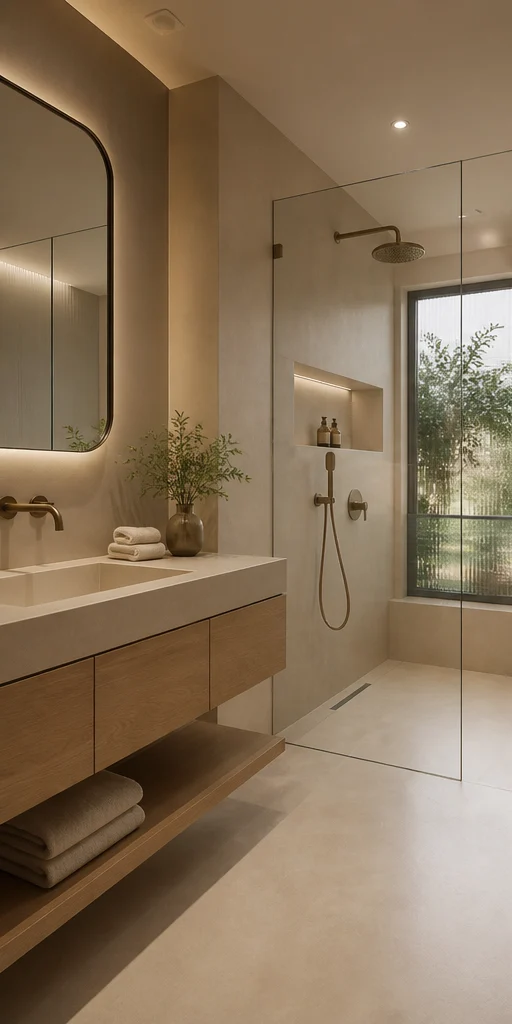
Serene Minimal treats quartz vanity as chalk · pale oak · linen: nothing decorative survives unless it also does work. Floor fall: 1:60 to linear drain. Waterproofing: Two-coat membrane, 300mm upstand. Vanity: Wall-hung, 900mm.
See this style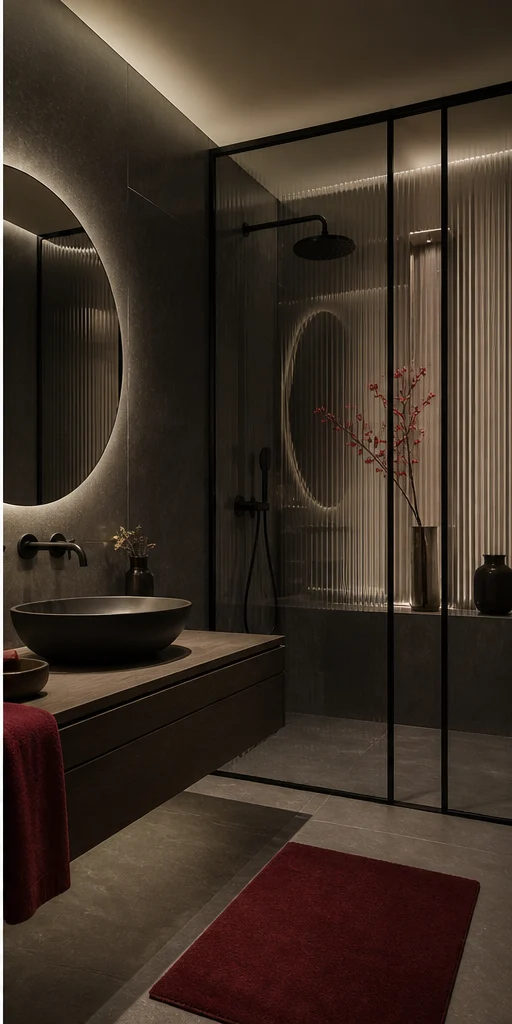
Bold Quartz Vanity
Bold Contemporary treats quartz vanity as charcoal · oxblood · smoked oak: high contrast, confident mass, a single saturated move per room. Floor fall: 1:50 to linear drain. Waterproofing: Two-coat with 1.8m shower upstand. Vanity: Wall-hung, 1200mm double.
See this styleHeritage Quartz Vanity
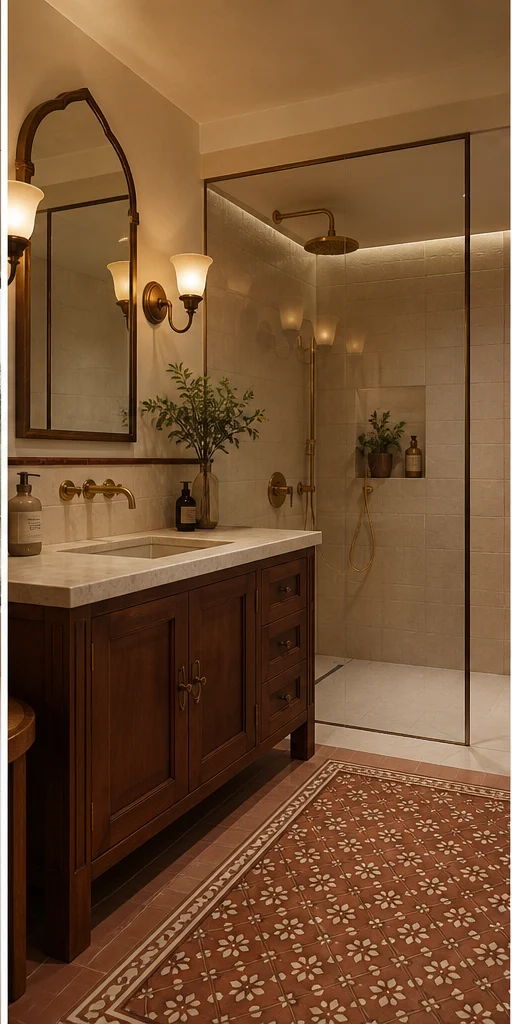
Modern Heritage treats quartz vanity as teak · cane · antique brass: indian craft detailing on a contemporary frame — jaali, cane, inlay and hand-finished brass, used sparingly. Floor fall: 1:50 to point drain. Waterproofing: Cement-based, full height. Vanity: Timber, floor standing.
See this style Photo: andrechinn · BY 2.0
Classic Quartz Vanity
Classic Luxe treats quartz vanity as ivory · statuario · gold: proportioned panelling, cornice and moulding, book-matched stone and warm gilt detail on ivory. Floor fall: 1:60 to point drain. Waterproofing: Two-coat, 1.5m upstand. Vanity: Wall-hung with marble top.
See this style Photo: KB Collection Hotels & Resorts · BY 2.0
Scandi Quartz Vanity
Indo-Scandinavian treats quartz vanity as birch · chalk · sage: pale timber, soft daylight and muted green — nordic restraint adapted for indian light, dust and humidity. Floor fall: 1:60. Waterproofing: Two-coat. Vanity: Wall-hung, 750mm.
See this style Photo: Tracy Hunter · BY 2.0
Deco Quartz Vanity
Art Deco Glam treats quartz vanity as emerald · brass · lacquer: fluting, fans and geometry. Floor fall: 1:50 to linear drain. Waterproofing: Two-coat, full height in shower. Vanity: Wall-hung with lacquer front.
See this styleSpecification
Quartz Vanity specification, style by style
This is the table we issue to the factory and the site. It is also what a warranty is enforced against, which is why it reads in grades and dimensions.
| Specification | Minimal | Bold | Heritage | Classic | Scandi | Deco |
|---|---|---|---|---|---|---|
| Layout | Wet and dry separated | Walk-in shower with screen | Traditional wet room | Enclosure with bath | Compact wet-dry | Walk-in with feature wall |
| Floor fall | 1:60 to linear drain | 1:50 to linear drain | 1:50 to point drain | 1:60 to point drain | 1:60 | 1:50 to linear drain |
| Waterproofing | Two-coat membrane, 300mm upstand | Two-coat with 1.8m shower upstand | Cement-based, full height | Two-coat, 1.5m upstand | Two-coat | Two-coat, full height in shower |
| Vanity | Wall-hung, 900mm | Wall-hung, 1200mm double | Timber, floor standing | Wall-hung with marble top | Wall-hung, 750mm | Wall-hung with lacquer front |
| Sanitaryware | Wall-hung WC, concealed cistern | Wall-hung with sensor flush | Floor mounted | Wall-hung, concealed | Wall-hung | Wall-hung, concealed |
| Shower | Thermostatic, hand and overhead | Thermostatic with body jets | Overhead with hand shower | Thermostatic, rain head | Thermostatic | Rain head with brass finish |
| Ventilation | 100mm inline extract, timer | 150mm inline extract | Window plus extract | Inline extract | Inline extract | Inline extract with humidistat |
| Water pressure | 1.5 bar minimum | 2 bar with pump | 1 bar | 1.5 bar | 1.5 bar | 2 bar with pump |
Before you commit
How to choose quartz vanity
Six checks that prevent the failures we are most often called to fix.
- Waterproofing is the entire specification. Everything else is finish, and no finish survives a failed membrane.
- Check the water pressure before selecting a shower. A rain head at 0.8 bar is a disappointment that costs money to discover.
- Separate wet and dry zones even in a small bathroom. A screen and a fall to a linear drain make a 5×7 bathroom usable.
- Confirm the drain positions and the possible fall before designing the layout; drains are the least movable thing in the room.
- Specify extraction properly — 6 to 8 air changes per hour with a run-on timer. Ventilation is what keeps a bathroom from becoming a mould problem.
- Choose slip rating for wet floors: R10 minimum, and prefer a smaller format tile in the shower zone for more grout grip and a truer fall.
Bangalore
Quartz Vanity in Bangalore
What the city's climate, water, housing stock and society rules mean for this specification.
Most of our work is in Bangalore, and the city sets a few conditions worth knowing before specifying quartz vanity. The climate is the kindest in India to timber and joinery — no extreme dry heat, no coastal salt — but the monsoon runs long, and humidity between June and October is what tests every edge, seal and ventilation gap in a home.
The mild climate is a genuine advantage: solid timber and veneer move far less here than in Delhi or Chennai, which makes craft detailing more durable and more affordable than it would be elsewhere. It is one of the few Indian cities where that is true year-round.
Hard borewell water in Whitefield, Sarjapur Road, Hebbal and Yelahanka leaves scale on glass, chrome and stone within months. Where the supply is hard we specify surfaces and fittings that tolerate it, and we tell the family the honest maintenance routine rather than leaving them to discover it.
Most societies here allow work between roughly 9am and 6pm, restrict Sundays, require a service-lift booking and hold a debris deposit. That schedule is written into the programme at the start, because a plan that assumes twelve working hours a day will slip in its first week.
Our Bangalore projects run with a named project manager and a written weekly site report, which is what keeps a fit-out on programme in a city with restricted working hours.
Sizing
Quartz Vanity by home size
Sizing below is what we plan quartz vanity to in each home size. These are working dimensions from completed projects, not catalogue minimums.
| Home size | Typical scope | Planning note |
|---|---|---|
| 1 BHK | Compact, single run | Compact planning, one clear gesture |
| 2 BHK | Standard, two runs | Standard scope, most common brief |
| 3 BHK | Full specification | Full scope with storage planned in litres |
| 4 BHK | Extended with island or dresser | Extended scope, bespoke elements |
| 4+ BHK / Villa | Bespoke, villa scale | Villa scale, bespoke throughout |
Cost
What moves the price of quartz vanity
We quote line by line rather than per square foot, because these are the items that actually differ between two estimates.
- Sanitaryware and brassware tier, which spans a very wide range.
- Waterproofing and civil correction to falls and drains.
- Stone versus tile on walls, and the amount of cutting involved.
- Concealed cisterns, thermostatic valves and any body jets, all of which are in-wall work.
- Glass: a frameless 10mm screen is a significant line item on its own.
Process
How the work runs
Five stages, with the decisions each one locks.
We measure the space ourselves rather than working from the builder's drawing, note the services, water quality, daylight and society rules, and write down how the room is actually used. Quartz Vanity is specified against that survey, not against a catalogue.
Plans, elevations and details, with the specification written as grades and dimensions. You approve an elevation, not a render — this is the stage where changes cost nothing.
Material, finish, hardware and services are locked, and the estimate becomes a line-by-line document. We tell you exactly what this date locks and what can still change afterwards.
Factory production runs to the approved drawing while site work is prepared. Material is checked against the approved sample on arrival, in daylight, and stored correctly until the programme calls for it.
Installation, testing, snagging and a documentation file with drawings, warranties, decor codes and hardware models. A first-year service visit is scheduled at handover.
Living with it
Maintaining quartz vanity
The honest routine, and the mistakes that cost the most to undo.
Care and maintenance
- Squeegee the shower glass after use. Hard water in most Indian cities deposits scale that etches glass permanently within a year.
- Renew silicone at the floor–wall junction every two to three years; it is a consumable, not a permanent seal.
- Clean the drain trap monthly and check the extract fan grille quarterly.
- Use neutral cleaners on stone; acidic descalers belong on ceramic and chrome only.
What goes wrong
- Skimping on waterproofing height in the shower zone.
- A floor fall set by eye rather than by level, which leaves standing water in one corner.
- Choosing a large-format tile for a shower floor, which cannot follow the fall.
- No ventilation, or extraction ducted into a false ceiling instead of outside.
Detailing
Quartz Vanity detailing notes
The small decisions that separate built work from assembled work.
A wall-hung vanity and WC make the floor read continuous and make cleaning genuinely easier. It costs a frame and is worth it.
Niches should be set out to the tile module, not measured in millimetres from the corner. A niche that lands on a cut tile looks wrong forever.
Put a light inside the shower on its own switch. Bathrooms are usually lit for the mirror and dark exactly where you stand.
Set the mirror light either side at face height rather than above. Overhead light on a face produces the shadows you shave and apply make-up around.
Questions
Quartz Vanity — answered
How long does a bathroom take?
Three to five weeks including demolition, plumbing first fix, waterproofing and its curing, tiling, second fix and glass. Waterproofing curing time cannot be compressed, and the glass is measured only after tiling.
What waterproofing is used?
A two-coat liquid membrane over the full floor with an upstand at the walls, taken to 1.8m in the shower zone, with reinforcement tape at every junction and a flood test before tiling.
Can a quartz vanity be done without breaking the floor?
Only if the existing falls and drains work. Where the fall is wrong, breaking the floor is unavoidable — and covering a bad fall with new tile is the single most common false economy in bathroom work.
How do I stop hard-water marks?
A squeegee after every use, a protective coating on the glass, and where the supply is very hard, a softener. Nothing else keeps glass clear in cities with hard water.
What ventilation is needed?
Mechanical extraction sized for 6 to 8 air changes per hour, ducted outside, with a run-on timer. A window alone is not enough during the monsoon.
Is underfloor heating worth it?
In most Indian cities, no. In hill stations and northern winters, it changes the room completely and has to be planned before the screed.
Do you work on quartz vanity projects across Bangalore?
Yes — Bangalore is where most of our projects are, from apartments along Sarjapur Road, Whitefield and Hebbal to independent homes in Jayanagar, Indiranagar and Malleshwaram. We survey the space ourselves, work within the society's access and working-hour rules, and hand over with a documentation file. There is a dedicated page for our work in the city if you want the full picture.
Does Bangalore's climate or water affect this choice?
The climate helps and the water does not. Mild year-round temperatures are kinder to timber and joinery than almost any other Indian city, so craft detailing lasts. Hard borewell water in the eastern and northern corridors is the real constraint — it scales glass, chrome and stone, and it changes what we specify and what maintenance we ask the family to commit to.
Explore more
More in Bathroom Vanities
Related pages
Next step
Planning quartz vanity for your home?
Send your floor plan and we come back with a layout, a material direction and a line-by-line estimate. Free survey across Bangalore.