Kitchen appliances
Built-In Oven
What good built-in oven looks like in specification rather than in photographs, drawn six ways across our house styles.
Overview
Built-In Oven, in plain specification
Written for the decision, not for the mood board.
Every built-in oven we build starts from how the room is used at its busiest hour. Circulation, reach and storage volume come first; elevations come second. It is a slower way to start and it removes most of the changes that would otherwise appear halfway through production.
A good built-in oven is invisible in use — everything within reach, nothing in the way, no door fouling another. Achieving that is a matter of dimensions and hardware rather than of style, which is why the specification table below matters more than the photographs.
Two homes can specify built-in oven identically and get different results, because site conditions differ: slab level, wall plumb, humidity, water hardness and how the household lives. The specification is a starting point that we adjust against the survey.
Six house styles
Built-In Oven in six personalities
The same brief resolved six ways. Each carries its own material, finish and detailing.
Minimal Built-In Oven
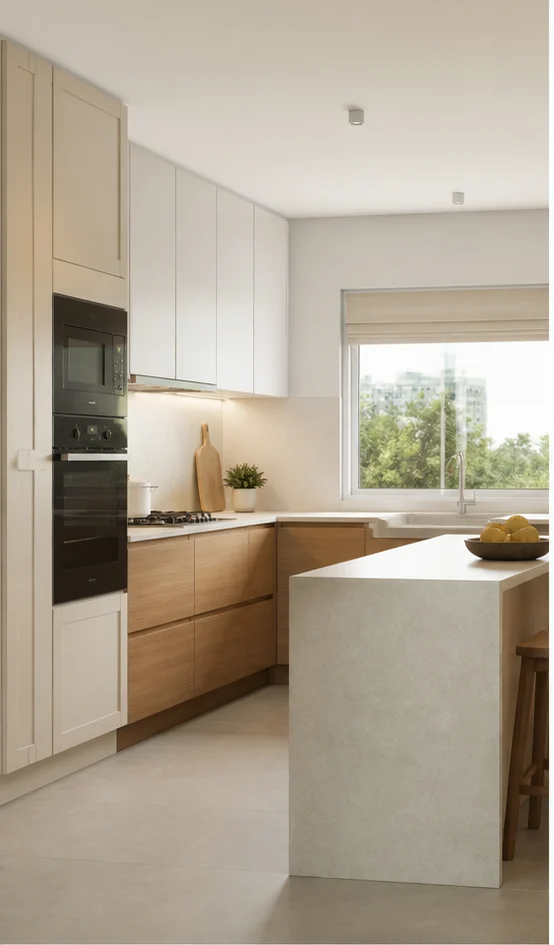
Serene Minimal treats built-in oven as chalk · pale oak · linen: nothing decorative survives unless it also does work. Service: 16A dedicated point. Ventilation clearance: 50mm rear, 10mm sides. Water point: Not required.
See this style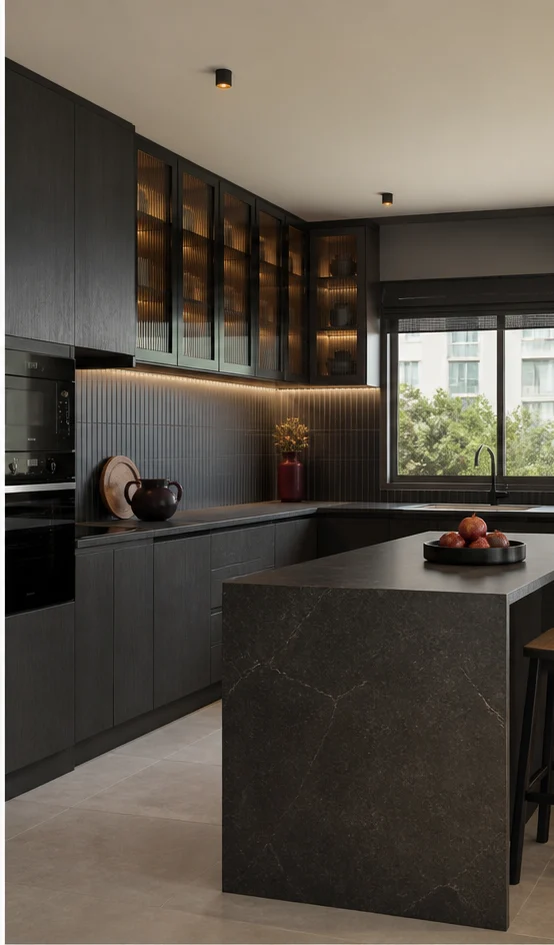
Bold Built-In Oven
Bold Contemporary treats built-in oven as charcoal · oxblood · smoked oak: high contrast, confident mass, a single saturated move per room. Service: 16A with isolator. Ventilation clearance: 50mm rear. Water point: 15mm feed with isolation.
See this styleHeritage Built-In Oven
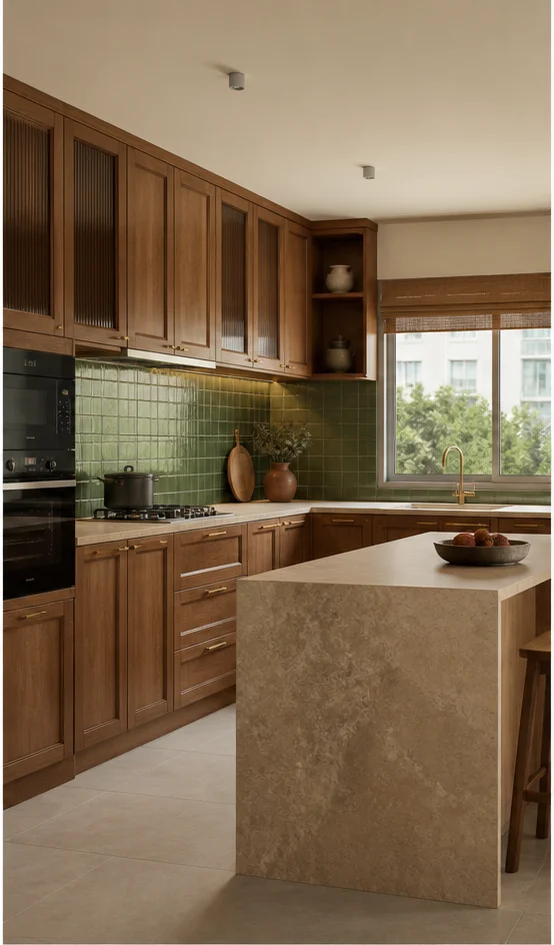
Modern Heritage treats built-in oven as teak · cane · antique brass: indian craft detailing on a contemporary frame — jaali, cane, inlay and hand-finished brass, used sparingly. Service: 16A. Ventilation clearance: 50mm rear. Water point: 15mm feed.
See this style Photo: Jeremy Levine Design · BY 2.0
Classic Built-In Oven
Classic Luxe treats built-in oven as ivory · statuario · gold: proportioned panelling, cornice and moulding, book-matched stone and warm gilt detail on ivory. Service: 16A with isolator. Ventilation clearance: 50mm rear. Water point: 15mm feed with isolation.
See this style Photo: Jeremy Levine Design · BY 2.0
Scandi Built-In Oven
Indo-Scandinavian treats built-in oven as birch · chalk · sage: pale timber, soft daylight and muted green — nordic restraint adapted for indian light, dust and humidity. Service: 16A. Ventilation clearance: 40mm rear. Water point: Not required.
See this style Photo: Jeremy Levine Design · BY 2.0
Deco Built-In Oven
Art Deco Glam treats built-in oven as emerald · brass · lacquer: fluting, fans and geometry. Service: 16A, two circuits. Ventilation clearance: 50mm rear. Water point: 15mm feed.
See this styleSpecification
Built-In Oven specification, style by style
This is the table we issue to the factory and the site. It is also what a warranty is enforced against, which is why it reads in grades and dimensions.
| Specification | Minimal | Bold | Heritage | Classic | Scandi | Deco |
|---|---|---|---|---|---|---|
| Aperture | 600x590mm | 600x595mm | 600x590mm | 600x595mm | 450x590mm | 900x595mm |
| Service | 16A dedicated point | 16A with isolator | 16A | 16A with isolator | 16A | 16A, two circuits |
| Ventilation clearance | 50mm rear, 10mm sides | 50mm rear | 50mm rear | 50mm rear | 40mm rear | 50mm rear |
| Water point | Not required | 15mm feed with isolation | 15mm feed | 15mm feed with isolation | Not required | 15mm feed |
| Drainage | Not required | 32mm trapped waste | 32mm waste | 32mm trapped waste | Not required | 32mm trapped waste |
| Noise level | Under 45dB | Under 42dB | Under 48dB | Under 44dB | Under 45dB | Under 42dB |
| Panel | Integrated, matching shutter | Stainless front | Timber front | Painted front | Integrated | Lacquered front |
| Service access | Front pull-out | Front pull-out | Side access | Front pull-out | Front pull-out | Front pull-out |
Before you commit
How to choose built-in oven
Six checks that prevent the failures we are most often called to fix.
- Choose appliances before the cabinetry is drawn. Every one of them dictates an aperture, a clearance, a power point and sometimes a water and waste connection.
- Confirm the exact model, not the range. Aperture dimensions vary by 5–10mm within a single manufacturer's line, and 5mm is the difference between fitted and forced.
- Check the electrical load against the flat's sanctioned load. Ovens, hobs and dishwashers running together trip an undersized board.
- Ask about service coverage in your city before buying. An imported appliance with no local service is a five-year problem.
- Plan the ducting route for extraction at the same time as the appliance choice; a long or crushed duct halves the effective performance.
- Leave a serviceable front. Anything that can be pulled forward for repair without dismantling the run will be repaired; anything that cannot, will be replaced.
Bangalore
Built-In Oven in Bangalore
What the city's climate, water, housing stock and society rules mean for this specification.
Working in Bangalore means working around two practical constraints more than around climate. Apartment societies restrict working hours, service-lift access and debris removal; and the new high-rise stock along the eastern corridor is handed over as a bare shell, so built-in oven arrives at the same time as every other trade.
Dust along the metro and ORR construction corridors is a real specification input. Sealed joinery, washable finishes and casement or sliding windows with good seals pay for themselves in these pockets in the first year.
Balcony enclosure rules vary sharply between societies, and a few refuse them entirely. Anything involving a balcony gets checked against the society's own rules before design, not after — including in Indiranagar and Koramangala, where older buildings often have their own restrictions.
The mild climate is a genuine advantage: solid timber and veneer move far less here than in Delhi or Chennai, which makes craft detailing more durable and more affordable than it would be elsewhere. It is one of the few Indian cities where that is true year-round.
We survey in Bangalore at no charge, take our own dimensions and come back with a layout, a material direction and a line-by-line estimate.
Sizing
Built-In Oven by home size
Sizing below is what we plan built-in oven to in each home size. These are working dimensions from completed projects, not catalogue minimums.
| Home size | Typical scope | Planning note |
|---|---|---|
| 1 BHK | Compact, single run | Compact planning, one clear gesture |
| 2 BHK | Standard, two runs | Standard scope, most common brief |
| 3 BHK | Full specification | Full scope with storage planned in litres |
| 4 BHK | Extended with island or dresser | Extended scope, bespoke elements |
| 4+ BHK / Villa | Bespoke, villa scale | Villa scale, bespoke throughout |
Cost
What moves the price of built-in oven
We quote line by line rather than per square foot, because these are the items that actually differ between two estimates.
- Brand tier and whether the appliance is integrated or freestanding.
- Extraction performance and ducting work.
- Electrical upgrades where the existing board cannot carry the load.
- Panel fronts to match the joinery.
- Local service availability, which changes the total cost of ownership more than the purchase price does.
Process
How the work runs
Five stages, with the decisions each one locks.
We measure the space ourselves rather than working from the builder's drawing, note the services, water quality, daylight and society rules, and write down how the room is actually used. Built-In Oven is specified against that survey, not against a catalogue.
Plans, elevations and details, with the specification written as grades and dimensions. You approve an elevation, not a render — this is the stage where changes cost nothing.
Material, finish, hardware and services are locked, and the estimate becomes a line-by-line document. We tell you exactly what this date locks and what can still change afterwards.
Factory production runs to the approved drawing while site work is prepared. Material is checked against the approved sample on arrival, in daylight, and stored correctly until the programme calls for it.
Installation, testing, snagging and a documentation file with drawings, warranties, decor codes and hardware models. A first-year service visit is scheduled at handover.
Living with it
Maintaining built-in oven
The honest routine, and the mistakes that cost the most to undo.
Care and maintenance
- Clean chimney baffle filters monthly in an Indian kitchen; degrease the duct annually.
- Run a dishwasher maintenance cycle monthly and check the filter weekly.
- Descale anything that heats water on a quarterly schedule in hard-water cities.
- Register warranties at handover and keep the model numbers with the project file.
What goes wrong
- Finalising cabinetry before appliances, then cutting a carcass on site to fit.
- Recirculating hoods where the cooking is daily and Indian.
- Ignoring the sanctioned electrical load.
- Placing an appliance where its door cannot fully open against an adjacent wall.
Detailing
Built-In Oven detailing notes
The small decisions that separate built work from assembled work.
Set the oven at a height where the middle shelf is at hand level, not at floor level. It costs a cabinet and changes daily use.
Give the dishwasher a position within the sink zone so plumbing runs are short and the loading path is natural.
Keep the microwave out of the tall unit stack unless it is at eye level; overhead is a burn risk when lifting hot dishes.
Plan a landing surface beside every hot appliance — the missing 300mm of counter beside an oven is the most common daily annoyance.
Questions
Built-In Oven — answered
When should appliances be chosen?
Before the cabinetry drawing is frozen. Apertures, clearances, power points and water connections all follow the model, and changing the model after production has started means re-cutting panels.
Does Built-In Oven need a dedicated electrical point?
Most built-in appliances do, usually 16A with an accessible isolator. That point has to be positioned so it is reachable without pulling the appliance out.
Integrated or freestanding?
Integrated for a continuous elevation and a quieter kitchen; freestanding where service access and future replacement matter more than the look.
How is servicing handled later?
Design a pull-forward path for anything with a motor or a pump. If an appliance can be brought out on its own, it will be serviced rather than replaced.
What about Indian cooking?
Extraction is the whole question. Ducted extraction at 90cm width, short duct runs and monthly filter cleaning are what keep a kitchen — and the joinery around it — clean.
Is the warranty affected by installation?
Yes. Most manufacturers require installation to their clearance and electrical specification, which is another reason those numbers go into the drawing before production.
Do you work on built-in oven projects across Bangalore?
Yes — Bangalore is where most of our projects are, from apartments along Sarjapur Road, Whitefield and Hebbal to independent homes in Jayanagar, Indiranagar and Malleshwaram. We survey the space ourselves, work within the society's access and working-hour rules, and hand over with a documentation file. There is a dedicated page for our work in the city if you want the full picture.
Does Bangalore's climate or water affect this choice?
The climate helps and the water does not. Mild year-round temperatures are kinder to timber and joinery than almost any other Indian city, so craft detailing lasts. Hard borewell water in the eastern and northern corridors is the real constraint — it scales glass, chrome and stone, and it changes what we specify and what maintenance we ask the family to commit to.
Explore more
More in Kitchen Appliances
Related pages
Next step
Planning built-in oven for your home?
Send your floor plan and we come back with a layout, a material direction and a line-by-line estimate. Free survey across Bangalore.