Soft furnishings
Smart Blinds
Smart Blinds, planned around how the room is used before how it looks — layout, hardware, services and the six house styles we draw it in.
Overview
Smart Blinds, in plain specification
Written for the decision, not for the mood board.
A good smart blinds is invisible in use — everything within reach, nothing in the way, no door fouling another. Achieving that is a matter of dimensions and hardware rather than of style, which is why the specification table below matters more than the photographs.
Smart Blinds is engineered before it is styled. The layout, the services behind it, the hardware carrying it and the clearances around it all get resolved on a drawing long before a finish is picked. Done in that order, the finish becomes a free choice. Done in reverse, the finish becomes a compromise.
Where smart blinds interacts with services — a duct, a drain, a conduit, an AC route — the service wins. Every attractive detail that ignored a service has been rebuilt at some point, usually at the client’s cost, which is why we resolve them together on one drawing.
Within smart blinds specifically, one thing changes the decision: the smart grade is a specification, not a description — we write down what it means in dimensions and finish before it is priced.
Six house styles
Smart Blinds in six personalities
The same brief resolved six ways. Each carries its own material, finish and detailing.
Minimal Smart Blinds
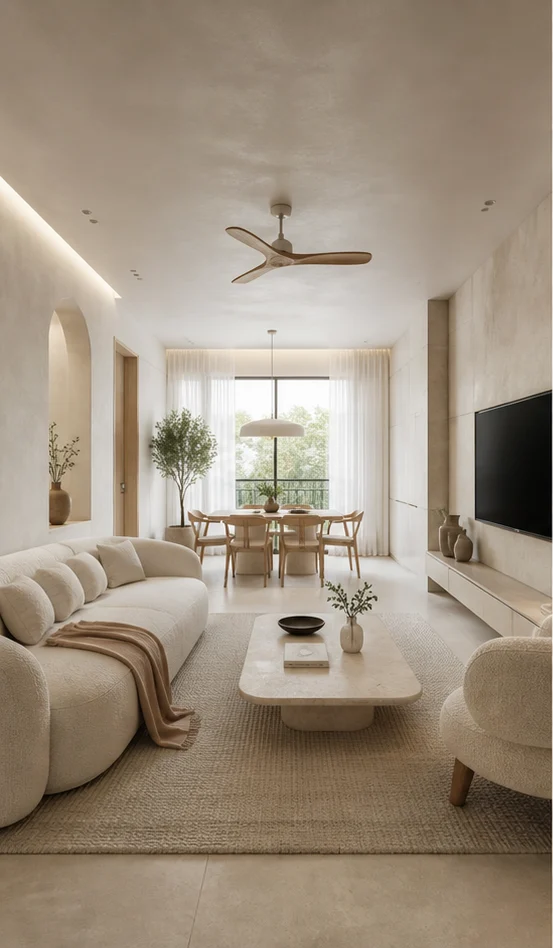
Serene Minimal treats smart blinds as chalk · pale oak · linen: nothing decorative survives unless it also does work. Heading: Ripple fold. Fullness: 2.2x. Lining: Dim-out.
See this style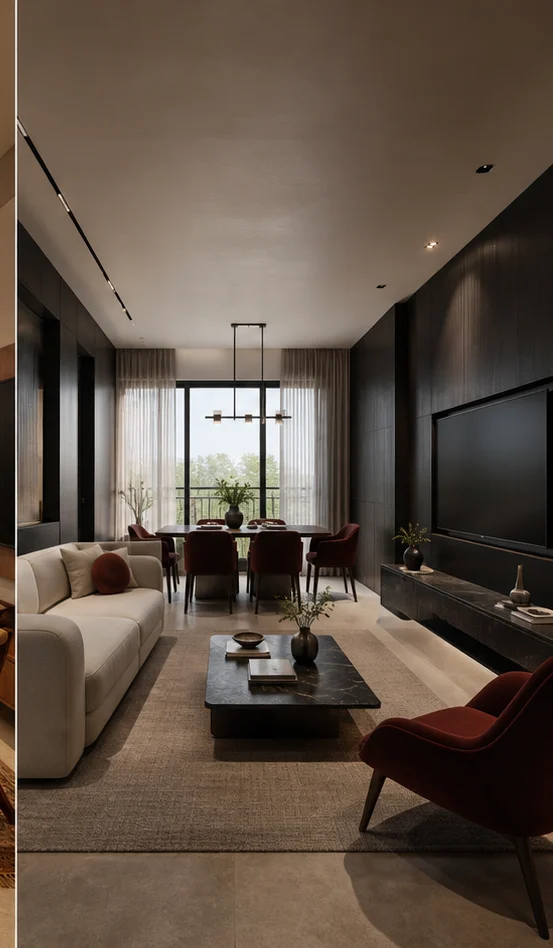
Bold Smart Blinds
Bold Contemporary treats smart blinds as charcoal · oxblood · smoked oak: high contrast, confident mass, a single saturated move per room. Heading: Wave heading on track. Fullness: 2.5x. Lining: Blackout with interlining.
See this styleHeritage Smart Blinds
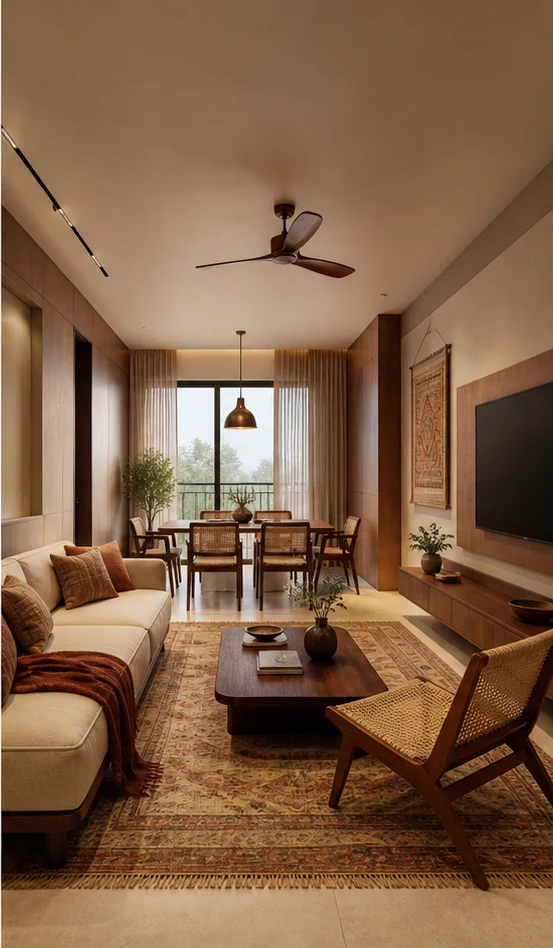
Modern Heritage treats smart blinds as teak · cane · antique brass: indian craft detailing on a contemporary frame — jaali, cane, inlay and hand-finished brass, used sparingly. Heading: Pinch pleat. Fullness: 2x. Lining: Cotton lining.
See this style Photo: Foto Miki Digital · PDM 1.0
Classic Smart Blinds
Classic Luxe treats smart blinds as ivory · statuario · gold: proportioned panelling, cornice and moulding, book-matched stone and warm gilt detail on ivory. Heading: Goblet pleat. Fullness: 2.5x. Lining: Blackout with interlining.
See this style Photo: flossyflotsam · BY 2.0
Scandi Smart Blinds
Indo-Scandinavian treats smart blinds as birch · chalk · sage: pale timber, soft daylight and muted green — nordic restraint adapted for indian light, dust and humidity. Heading: Ripple fold. Fullness: 2x. Lining: Dim-out.
See this style Photo: footloosiety · BY 2.0
Deco Smart Blinds
Art Deco Glam treats smart blinds as emerald · brass · lacquer: fluting, fans and geometry. Heading: Wave with concealed track. Fullness: 2.5x. Lining: Blackout.
See this styleSpecification
Smart Blinds specification, style by style
This is the table we issue to the factory and the site. It is also what a warranty is enforced against, which is why it reads in grades and dimensions.
| Specification | Minimal | Bold | Heritage | Classic | Scandi | Deco |
|---|---|---|---|---|---|---|
| Fabric | Linen blend, 280gsm | Velvet, 400gsm | Handloom cotton | Silk blend with lining | Wool blend | Velvet with blackout lining |
| Heading | Ripple fold | Wave heading on track | Pinch pleat | Goblet pleat | Ripple fold | Wave with concealed track |
| Fullness | 2.2x | 2.5x | 2x | 2.5x | 2x | 2.5x |
| Lining | Dim-out | Blackout with interlining | Cotton lining | Blackout with interlining | Dim-out | Blackout |
| Track | Recessed ceiling track | Motorised track | Timber pole | Motorised with pelmet | Ceiling track | Motorised, concealed |
| Drop | Ceiling to floor, 10mm clearance | Ceiling to floor, breaking | Sill length | Ceiling to floor | Ceiling to floor | Ceiling to floor |
| Light control | 60% dim | Full blackout | Filtered | Full blackout | 60% dim | Full blackout |
| Cleaning | Dry clean | Dry clean | Gentle wash | Dry clean | Dry clean | Dry clean |
Before you commit
How to choose smart blinds
Six checks that prevent the failures we are most often called to fix.
- Hang from the ceiling, not from just above the window. It is the cheapest way to make a room feel taller and it hides an uneven window head.
- Decide the light performance first — filter, dim-out or full blackout — because that decides the lining, not the fabric.
- Check fullness in the quote. Below 2x, curtains look flat and mean; the fabric quantity is where a cheap quote hides.
- Plan the track before the false ceiling. A recessed track has to be built into the ceiling, and retro-fitting means a surface pelmet.
- For motorised systems, plan the power point at the track end during electrical first fix.
- See fabric in a large piece against the room's own light — colour under showroom light is not the colour you will live with.
Bangalore
Smart Blinds in Bangalore
What the city's climate, water, housing stock and society rules mean for this specification.
Most of our work is in Bangalore, and the city sets a few conditions worth knowing before specifying smart blinds. The climate is the kindest in India to timber and joinery — no extreme dry heat, no coastal salt — but the monsoon runs long, and humidity between June and October is what tests every edge, seal and ventilation gap in a home.
Most societies here allow work between roughly 9am and 6pm, restrict Sundays, require a service-lift booking and hold a debris deposit. That schedule is written into the programme at the start, because a plan that assumes twelve working hours a day will slip in its first week.
Traffic decides delivery windows more than distance does. Material moving to Whitefield, Sarjapur or Electronic City is scheduled outside peak hours, and large items are checked against the lift and stair turn before the order rather than on delivery day.
Dust along the metro and ORR construction corridors is a real specification input. Sealed joinery, washable finishes and casement or sliding windows with good seals pay for themselves in these pockets in the first year.
Our Bangalore projects run with a named project manager and a written weekly site report, which is what keeps a fit-out on programme in a city with restricted working hours.
Sizing
Smart Blinds by home size
Sizing below is what we plan smart blinds to in each home size. These are working dimensions from completed projects, not catalogue minimums.
| Home size | Typical scope | Planning note |
|---|---|---|
| 1 BHK | Compact, single run | Compact planning, one clear gesture |
| 2 BHK | Standard, two runs | Standard scope, most common brief |
| 3 BHK | Full specification | Full scope with storage planned in litres |
| 4 BHK | Extended with island or dresser | Extended scope, bespoke elements |
| 4+ BHK / Villa | Bespoke, villa scale | Villa scale, bespoke throughout |
Cost
What moves the price of smart blinds
We quote line by line rather than per square foot, because these are the items that actually differ between two estimates.
- Fabric price per metre multiplied by fullness — the multiplier, not the metre rate, decides the total.
- Lining and interlining.
- Track type: manual, corded, or motorised with app control.
- Height of drop and whether the fabric is railroaded to avoid seams.
- Making: hand-finished headings cost more and hang visibly better.
Process
How the work runs
Five stages, with the decisions each one locks.
We measure the space ourselves rather than working from the builder's drawing, note the services, water quality, daylight and society rules, and write down how the room is actually used. Smart Blinds is specified against that survey, not against a catalogue.
Plans, elevations and details, with the specification written as grades and dimensions. You approve an elevation, not a render — this is the stage where changes cost nothing.
Material, finish, hardware and services are locked, and the estimate becomes a line-by-line document. We tell you exactly what this date locks and what can still change afterwards.
Factory production runs to the approved drawing while site work is prepared. Material is checked against the approved sample on arrival, in daylight, and stored correctly until the programme calls for it.
Installation, testing, snagging and a documentation file with drawings, warranties, decor codes and hardware models. A first-year service visit is scheduled at handover.
Living with it
Maintaining smart blinds
The honest routine, and the mistakes that cost the most to undo.
Care and maintenance
- Vacuum with a brush head monthly, top to bottom.
- Dry clean rather than wash anything lined or interlined; washing shrinks the two layers differently.
- Rotate which side is drawn to even out sun exposure.
- Check motorised track alignment and battery levels annually.
What goes wrong
- Curtains hung at window head height in a room with a 10ft ceiling.
- Ordering fabric before the track and the ceiling detail are confirmed.
- Skipping the lining on a west-facing window, which fades the fabric in a year.
- Underestimating stack width, so the curtains never fully clear the glass.
Detailing
Smart Blinds detailing notes
The small decisions that separate built work from assembled work.
A recessed track reads as light coming from a slot rather than as a curtain track, and it is the detail that makes drapery look architectural.
Let curtains stack clear of the glass. Allow 20 to 25% of the window width per side or you lose that much daylight permanently.
Floor clearance of 10mm looks crisp; a 20mm break looks softer. Choose deliberately, and measure after the flooring is laid.
In bedrooms, blackout only works if the lining, the return at the wall and the ceiling track all cooperate. Any one of them missing leaves a light line.
Questions
Smart Blinds — answered
How much fabric does a window need?
Between 2x and 2.5x the track width for a proper hang, plus allowances for pattern repeat and hems. That multiplier is the biggest single factor in both the look and the price.
Should curtains touch the floor?
Either 10mm clear for a crisp line or a deliberate 20mm break for a softer one. Anything in between looks like a measuring error, and the measurement is taken after the floor is laid.
Are motorised tracks worth it?
For tall windows, wide runs and bedrooms, yes — they get used, where a heavy manual curtain often stops being drawn. Plan the power point during electrical first fix.
What lining do I need for a bedroom?
Blackout with a return at the wall and a ceiling-recessed or pelmet-covered track. Blackout fabric alone still leaks light around the edges.
How is Smart Blinds cleaned?
Monthly vacuuming and periodic dry cleaning. Washing lined curtains at home is the usual cause of uneven shrinkage.
How long is the lead time?
Three to five weeks from final measurement, and the measurement happens after flooring and ceilings are complete.
Do you work on smart blinds projects across Bangalore?
Yes — Bangalore is where most of our projects are, from apartments along Sarjapur Road, Whitefield and Hebbal to independent homes in Jayanagar, Indiranagar and Malleshwaram. We survey the space ourselves, work within the society's access and working-hour rules, and hand over with a documentation file. There is a dedicated page for our work in the city if you want the full picture.
Does Bangalore's climate or water affect this choice?
The climate helps and the water does not. Mild year-round temperatures are kinder to timber and joinery than almost any other Indian city, so craft detailing lasts. Hard borewell water in the eastern and northern corridors is the real constraint — it scales glass, chrome and stone, and it changes what we specify and what maintenance we ask the family to commit to.
Explore more
More in Blinds
Related pages
Next step
Planning smart blinds for your home?
Send your floor plan and we come back with a layout, a material direction and a line-by-line estimate. Free survey across Bangalore.