Wardrobes and storage
Sliding Wardrobes
Sliding Wardrobes for Bangalore homes — the dimensions, hardware and detailing that decide whether it still works in year five.
Overview
Sliding Wardrobes, in plain specification
Written for the decision, not for the mood board.
Sliding Wardrobes is engineered before it is styled. The layout, the services behind it, the hardware carrying it and the clearances around it all get resolved on a drawing long before a finish is picked. Done in that order, the finish becomes a free choice. Done in reverse, the finish becomes a compromise.
The parts of sliding wardrobes that fail first are the parts nobody looks at — hinges, runners, seals, fixings and the edge nobody sealed. That is why our specification names hardware by model and the substrate by grade, and why our estimates look different from ones written by category.
The specification below is the one we issue to the factory and the site, which is why it reads as dimensions and grades rather than as adjectives. It is also what a warranty is enforced against — a specification that cannot be measured cannot be claimed on.
Six house styles
Sliding Wardrobes in six personalities
The same brief resolved six ways. Each carries its own material, finish and detailing.
Minimal Sliding Wardrobes
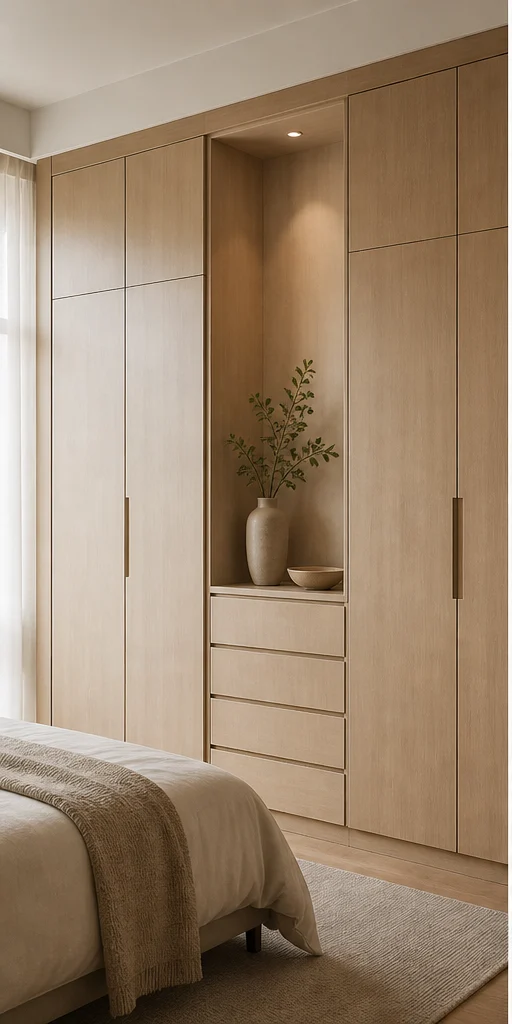
Serene Minimal treats sliding wardrobes as chalk · pale oak · linen: nothing decorative survives unless it also does work. Depth: 600mm. Hanging: Long hang 1500mm, short hang 2x1000mm. Drawers: Four soft-close, felt lined.
See this style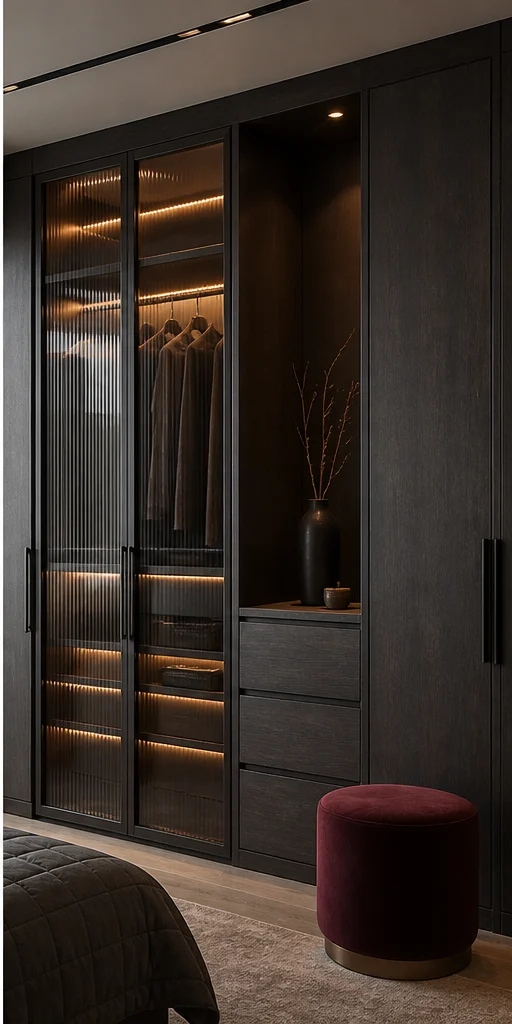
Bold Sliding Wardrobes
Bold Contemporary treats sliding wardrobes as charcoal · oxblood · smoked oak: high contrast, confident mass, a single saturated move per room. Depth: 650mm. Hanging: Long hang with pull-down rail. Drawers: Six, with jewellery tray.
See this styleHeritage Sliding Wardrobes
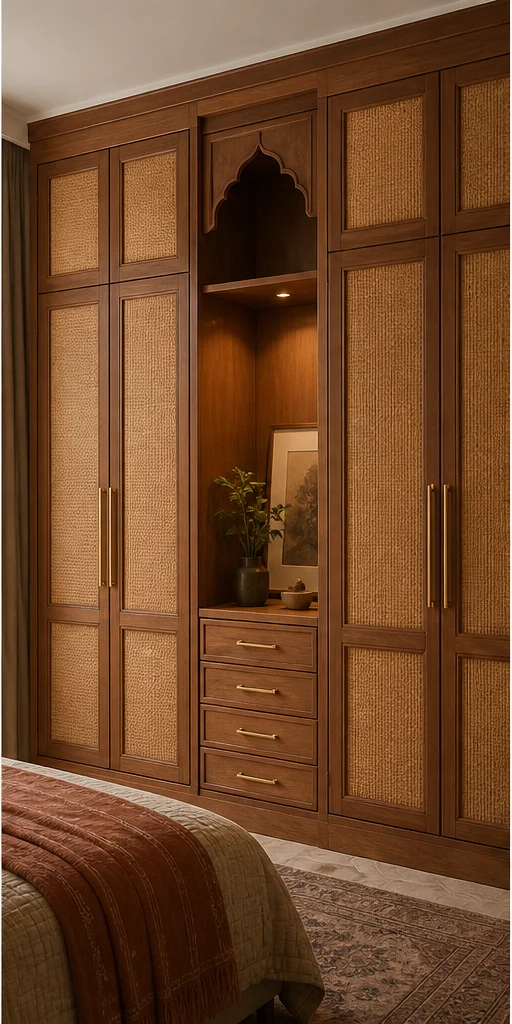
Modern Heritage treats sliding wardrobes as teak · cane · antique brass: indian craft detailing on a contemporary frame — jaali, cane, inlay and hand-finished brass, used sparingly. Depth: 600mm with loft 600mm. Hanging: Long and short hang, cotton bags. Drawers: Four with cotton lining.
See this style Photo: flooringclarity · BY 2.0
Classic Sliding Wardrobes
Classic Luxe treats sliding wardrobes as ivory · statuario · gold: proportioned panelling, cornice and moulding, book-matched stone and warm gilt detail on ivory. Depth: 620mm. Hanging: Long hang with dress rail. Drawers: Six with velvet insert.
See this style Photo: VillaEarlySunset · BY 2.0
Scandi Sliding Wardrobes
Indo-Scandinavian treats sliding wardrobes as birch · chalk · sage: pale timber, soft daylight and muted green — nordic restraint adapted for indian light, dust and humidity. Depth: 600mm. Hanging: Short hang, double tier. Drawers: Four.
See this style Photo: andrechinn · BY 2.0
Deco Sliding Wardrobes
Art Deco Glam treats sliding wardrobes as emerald · brass · lacquer: fluting, fans and geometry. Depth: 650mm. Hanging: Long hang with lit rail. Drawers: Six, lacquer front.
See this styleSpecification
Sliding Wardrobes specification, style by style
This is the table we issue to the factory and the site. It is also what a warranty is enforced against, which is why it reads in grades and dimensions.
| Specification | Minimal | Bold | Heritage | Classic | Scandi | Deco |
|---|---|---|---|---|---|---|
| Configuration | Floor to ceiling, hinged | Sliding, three shutter | Hinged with loft | Hinged with dresser | Sliding, two shutter | Hinged with fluted front |
| Depth | 600mm | 650mm | 600mm with loft 600mm | 620mm | 600mm | 650mm |
| Hanging | Long hang 1500mm, short hang 2x1000mm | Long hang with pull-down rail | Long and short hang, cotton bags | Long hang with dress rail | Short hang, double tier | Long hang with lit rail |
| Drawers | Four soft-close, felt lined | Six, with jewellery tray | Four with cotton lining | Six with velvet insert | Four | Six, lacquer front |
| Internal finish | Matt white | Grey woodgrain | Cedar-lined | Ivory with beading | Birch | Charcoal with brass rail |
| Lighting | Sensor strip on rail | Sensor strip, both rails | Warm strip on shelf | Sensor strip with dimmer | Sensor strip | Profile light behind mirror |
| Shutter finish | Matt laminate | High-gloss acrylic | Teak veneer | PU with beading | Matt laminate | Fluted lacquer with brass |
| Ventilation | Rear 10mm gap, plinth vents | Rear gap with vent grille | Louvred back | Rear gap | Rear gap | Rear gap with grille |
Before you commit
How to choose sliding wardrobes
Six checks that prevent the failures we are most often called to fix.
- Measure what you own before deciding the internal layout. Hanging length, folded stacks and bag storage are three different problems and most wardrobes solve only the first.
- Floor-to-ceiling almost always beats a wardrobe with a loft above it. The gap on top collects dust and stores nothing you can reach.
- For sliding shutters, remember you can only ever open half the wardrobe. In a small bedroom that is a fair trade; in a dressing area it is not.
- Check the wall before the design. Wardrobes against an external or bathroom-adjacent wall need a ventilated gap or the back panel will grow mould.
- Insist on soft-close on every drawer and door. It is the difference between joinery that stays aligned and joinery that loosens.
- Plan the mirror position with the room's light, not the wardrobe elevation. A mirror facing a window is a glare source, not a dressing mirror.
Bangalore
Sliding Wardrobes in Bangalore
What the city's climate, water, housing stock and society rules mean for this specification.
Bangalore is an unusually easy city to build interiors in and an unusually easy one to get wrong for a single reason: water. Borewell supply across the eastern and northern corridors is hard, and that hardness decides how sliding wardrobes looks after two years far more than the material grade does.
Dust along the metro and ORR construction corridors is a real specification input. Sealed joinery, washable finishes and casement or sliding windows with good seals pay for themselves in these pockets in the first year.
Balcony enclosure rules vary sharply between societies, and a few refuse them entirely. Anything involving a balcony gets checked against the society's own rules before design, not after — including in Indiranagar and Koramangala, where older buildings often have their own restrictions.
The mild climate is a genuine advantage: solid timber and veneer move far less here than in Delhi or Chennai, which makes craft detailing more durable and more affordable than it would be elsewhere. It is one of the few Indian cities where that is true year-round.
For Bangalore homes we hold material with the grade and batch recorded, and we plan deliveries around society access rules rather than around our own convenience.
Sizing
Sliding Wardrobes by home size
Sizing below is what we plan sliding wardrobes to in each home size. These are working dimensions from completed projects, not catalogue minimums.
| Home size | Typical scope | Planning note |
|---|---|---|
| 1 BHK | Compact, single run | Compact planning, one clear gesture |
| 2 BHK | Standard, two runs | Standard scope, most common brief |
| 3 BHK | Full specification | Full scope with storage planned in litres |
| 4 BHK | Extended with island or dresser | Extended scope, bespoke elements |
| 4+ BHK / Villa | Bespoke, villa scale | Villa scale, bespoke throughout |
Cost
What moves the price of sliding wardrobes
We quote line by line rather than per square foot, because these are the items that actually differ between two estimates.
- Shutter finish and any profiling on the front.
- Internal accessories: pull-downs, trays, racks and lighting add up quickly.
- Sliding hardware, which costs several times a hinge system.
- Height — a floor-to-ceiling wardrobe uses more board and more edge banding per running foot.
- Mirror work and any lacquered glass.
Process
How the work runs
Five stages, with the decisions each one locks.
We measure the space ourselves rather than working from the builder's drawing, note the services, water quality, daylight and society rules, and write down how the room is actually used. Sliding Wardrobes is specified against that survey, not against a catalogue.
Plans, elevations and details, with the specification written as grades and dimensions. You approve an elevation, not a render — this is the stage where changes cost nothing.
Material, finish, hardware and services are locked, and the estimate becomes a line-by-line document. We tell you exactly what this date locks and what can still change afterwards.
Factory production runs to the approved drawing while site work is prepared. Material is checked against the approved sample on arrival, in daylight, and stored correctly until the programme calls for it.
Installation, testing, snagging and a documentation file with drawings, warranties, decor codes and hardware models. A first-year service visit is scheduled at handover.
Living with it
Maintaining sliding wardrobes
The honest routine, and the mistakes that cost the most to undo.
Care and maintenance
- Leave the doors open for an hour after the monsoon starts and once a month through it. Trapped humid air is what makes a wardrobe smell.
- Vacuum the sliding track quarterly. Grit in the track is the reason sliders get heavy and eventually jump.
- Tighten hinge screws at the end of the first year.
- Keep silica or camphor in the folded-stack section in coastal cities.
What goes wrong
- Designing all shelves and no drawers, which produces storage that gets stacked and never re-sorted.
- Putting a wardrobe hard against a damp external wall with no ventilation gap.
- Sliding doors in a room too small for the shutter widths — the usable opening becomes narrower than the clothes.
- Forgetting the loft ladder or the loft access entirely.
Detailing
Sliding Wardrobes detailing notes
The small decisions that separate built work from assembled work.
A 100mm plinth recess lets you stand close without stubbing your toes, and hides the floor level tolerance at the same time.
Sensor lighting on the hanging rail is the single upgrade people notice daily.
Where the wardrobe meets the ceiling, a shadow gap absorbs the ceiling's unevenness far more gracefully than a scribed filler.
Keep the handle line continuous across the elevation; a broken handle line makes an otherwise clean run look busy.
Questions
Sliding Wardrobes — answered
Sliding or hinged for a sliding wardrobes?
Hinged if the room can spare 600mm of swing, because you see the whole interior at once and it costs less. Sliding where the bed is close to the wardrobe, accepting that half the run is always covered.
How deep should it be?
600mm internally for hanging clothes on a standard rail. Below 550mm, shirts touch the back and the doors rub, which is the most common fault in a badly measured wardrobe.
How do I stop clothes smelling damp?
Ventilate. A 10mm rear gap, plinth vents and doors left open for an hour a month through the monsoon will do more than any product.
Can a sliding wardrobes be built around an existing bed layout?
Yes — the wardrobe follows the room. What has to be checked first is the door swing, the fan sweep and the switchboard positions, which are the three things that force redesign late.
What internal accessories are actually worth it?
Soft-close drawers, a pull-down rail where the run is above 2.1m, and sensor lighting. Most other accessories look useful in a showroom and are used twice at home.
Is it warranted?
Carcass, hardware and factory finishes carry a lifetime warranty on our standard scope, subject to normal domestic use and the ventilation we specify.
Do you work on sliding wardrobes projects across Bangalore?
Yes — Bangalore is where most of our projects are, from apartments along Sarjapur Road, Whitefield and Hebbal to independent homes in Jayanagar, Indiranagar and Malleshwaram. We survey the space ourselves, work within the society's access and working-hour rules, and hand over with a documentation file. There is a dedicated page for our work in the city if you want the full picture.
Does Bangalore's climate or water affect this choice?
The climate helps and the water does not. Mild year-round temperatures are kinder to timber and joinery than almost any other Indian city, so craft detailing lasts. Hard borewell water in the eastern and northern corridors is the real constraint — it scales glass, chrome and stone, and it changes what we specify and what maintenance we ask the family to commit to.
Explore more
More in Wardrobes & Storage
Related pages
Next step
Planning sliding wardrobes for your home?
Send your floor plan and we come back with a layout, a material direction and a line-by-line estimate. Free survey across Bangalore.