Mandir Designs · Classic Luxe
Classic Mandir — Ivory and Gold
Orientation, ventilation and material come before ornament. Teak and marble survive lamp heat and soot; laminate does not. Proportioned panelling, cornice and moulding, book-matched stone and warm gilt detail on ivory.
 Photo: archer10 (Dennis) · BY-SA 2.0
Specification
Mandir in Classic Luxe
| Detail | Specification |
|---|---|
| Style | Classic Luxe |
| Palette | Ivory · Statuario · Gold |
| Layout | Wall-mounted with marble base |
| Body material | White marble with a moulded base |
| Backdrop | Book-matched marble with gold inlay |
| Doors | Glazed doors with a gilt frame |
| Lighting | Gilt cove with a small chandelier |
| Home size | Room dimension |
|---|---|
| 1 BHK | 2×3 feet niche |
| 2 BHK | 3×4 feet unit |
| 3 BHK | 4×5 feet alcove |
| 4 BHK | 5×6 feet room |
| 4+ BHK / Villa | 6×8 feet dedicated room |
Storage features
- Marble-topped base with two drawers
- A glazed cabinet for silver items
- Hidden storage in the plinth
Special features
- A marble base with gold-inlay detailing
- A moulded gilt frame around the alcove
- Symmetrical composition with a small chandelier
Ideal forFormal homes wanting the mandir as a designed centrepiece
Other styles
Mandir in the other five styles
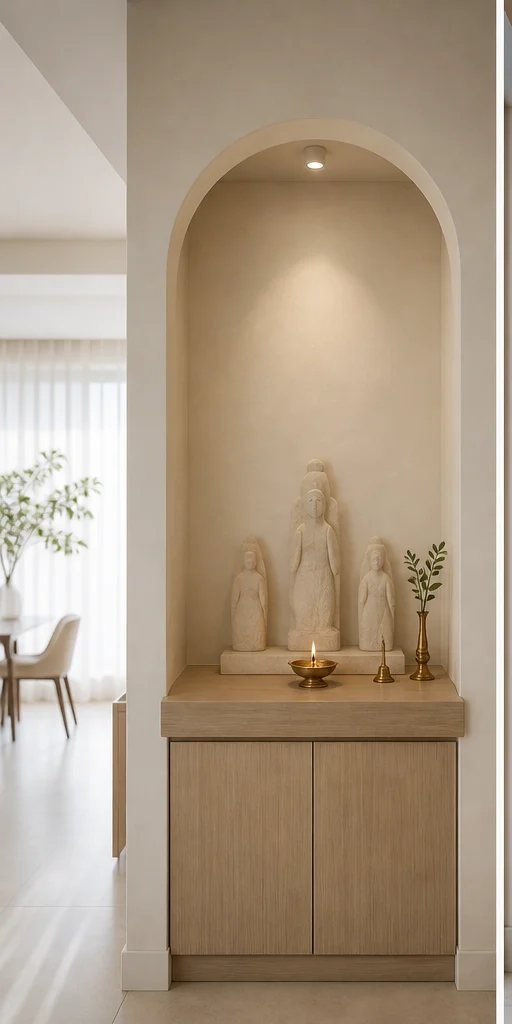
Minimal Mandir
Chalk · Pale Oak · Linen
See this style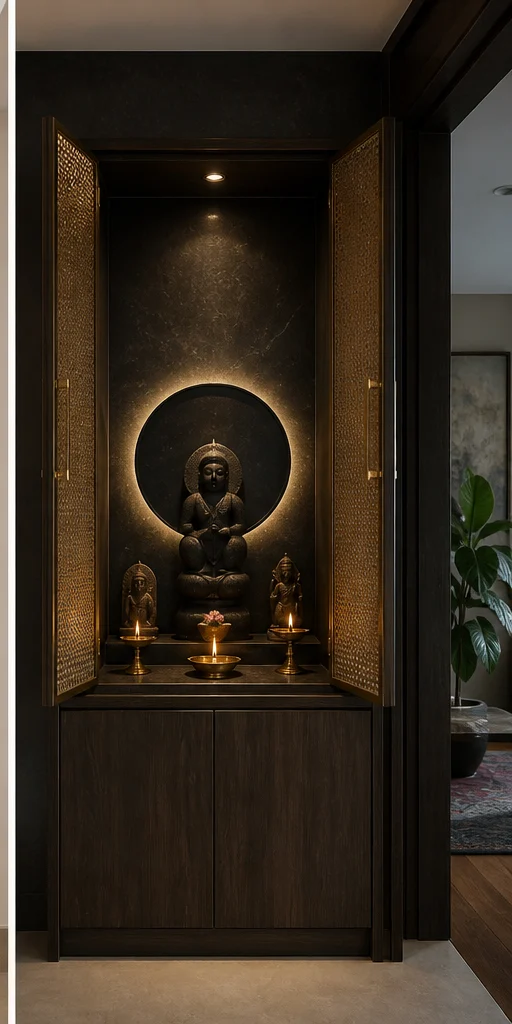
Bold Mandir
Charcoal · Oxblood · Smoked Oak
See this style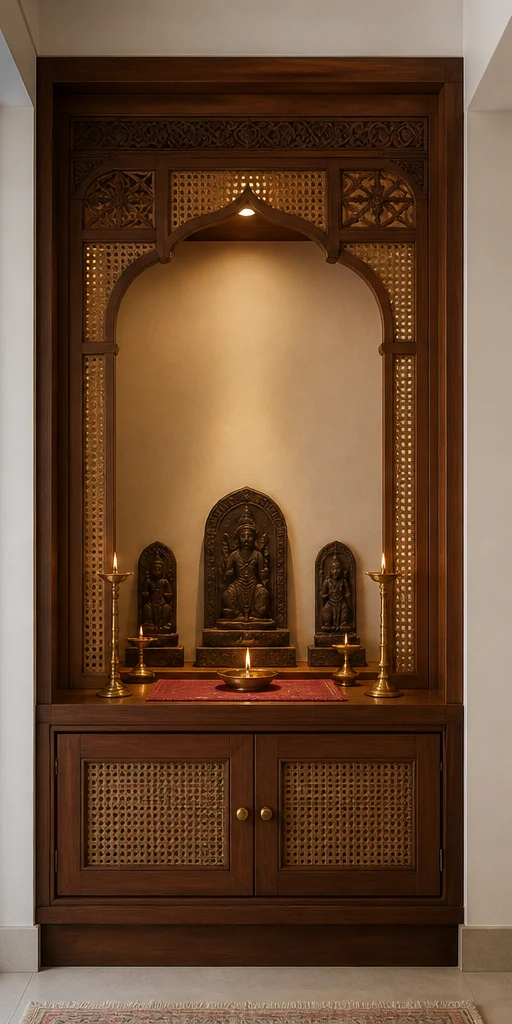
Heritage Mandir
Teak · Cane · Antique Brass
See this style Photo: archer10 (Dennis) · BY-SA 2.0
Scandi Mandir
Birch · Chalk · Sage
See this style Photo: mckaysavage · BY 2.0
Deco Mandir
Emerald · Brass · Lacquer
See this styleDetail
Specifying and living with this mandir designs
A specification is only as good as what happens after handover. mandir designs in this style is chosen as much for how it ages as for how it photographs on day one — the joinery finish, the hardware grade and the way an edge is sealed all show up in year three, long after the render is forgotten.
Classic Luxe is a coherent palette rather than a fixed rule, and most finished homes borrow across two styles rather than committing to one throughout. What rarely works is switching the palette room to room within one sightline — the transition needs a threshold, a change of material, or a corridor to read as intentional rather than accidental.
The specification below is what we issue to the factory and the site for this exact style and layout. It is also what a warranty is enforced against, which is why it is written as grades and dimensions rather than as adjectives.
Nothing on this page is a fixed catalogue item. The layout, the palette and every material line are redrawn against your own room dimensions before anything is priced — what you see here is the starting specification, not the finished drawing.
Classic Luxe suits a household that already knows roughly what it wants a mandir designs to feel like, rather than one still deciding between opposites — the palette is distinctive enough that it rewards commitment and looks unresolved applied half-heartedly.
Worth checking before sign-off
- Start from how the room is actually used at 8pm on a weekday, not from a mood board. Every good plan is a use plan first.
- Fix the circulation before the furniture. A room where you cannot walk between two pieces without turning sideways has failed regardless of finish.
- Identify the one focal wall and commit to it. Rooms with three feature walls read as noise.
- Work with the daylight the room actually has. North light, west glare and a shaded courtyard need three different palettes.
- Decide the storage requirement in litres, not in cabinets. Households consistently underestimate this and then add furniture that ruins the plan.
- Set the electrical and lighting layout against the furniture plan before any ceiling work begins.
Living with it
- Re-coat high-traffic paint every four to five years; corridors and entrance walls fail long before bedrooms.
- Service the joinery once a year — hinge adjustment, runner cleaning, silicone check.
- Rotate soft furnishings and rugs to even out sun exposure.
- Keep a project file with paint codes, laminate decors, hardware models and photographs of the services before they were covered.
Mistakes worth avoiding
- Designing the ceiling before the furniture layout is fixed.
- Too many finishes in one room. Three materials, used with intent, beat seven.
- Under-planning storage and adding it later as freestanding furniture.
- Choosing colour under showroom light rather than in the room's own light at the hour it matters.
The classic luxe palette does not carry an inherent price premium over the other five — what changes the estimate is ceiling and lighting complexity., which applies whichever style you choose, and flooring, especially where the existing floor comes up., which is more common in this palette specifically. Furniture and soft furnishings, which are frequently left out of the initial budget entirely.
Questions
Pooja Room questions
Which direction should a pooja room face?
The north-east quadrant is traditionally preferred, with the person praying facing east or north. Where the plan does not allow it, the north-east corner of any room is the usual compromise.
Should the pooja unit have doors?
It depends on use. Daily worship favours an open niche; homes that light camphor and want the space closed between rituals are better served by shutters, ideally ventilated.
How do I deal with smoke and soot?
Ventilate above the unit — a jaali back panel, a grille, or proximity to a window. Avoid laminate directly above the lamp; stone, marble or solid timber handles heat and soot far better.
Can a pooja unit go in the kitchen?
It is common in compact flats but traditionally avoided, particularly beside the sink or the hob. If there is no alternative, place it on the north-east wall away from the wet zone.
What material lasts best for a mandir?
Solid teak or marble. Both take heat, oil and soot without delaminating, and both age into the space rather than looking worn.
Next step
Build this mandir.
Send the plan and the dimensions. We adapt this design to your room and price it line by line.