Mirror Wardrobe Designs · Modern Heritage
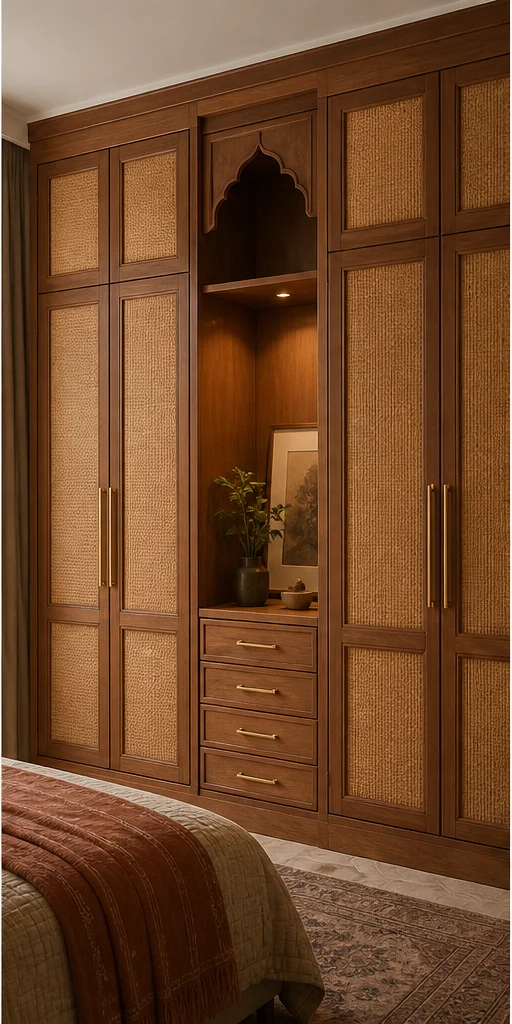
Heritage Mirror Wardrobe — Teak and Antique Brass
A full-height mirror on the wardrobe face saves a dressing unit and returns light into the room. Backing and fixing decide whether it lasts. Indian craft detailing on a contemporary frame — jaali, cane, inlay and hand-finished brass, used sparingly.
Specification
Mirror Wardrobe in Modern Heritage
| Detail | Specification |
|---|---|
| Style | Modern Heritage |
| Palette | Teak · Cane · Antique Brass |
| Layout | Walk-in with cane fronts |
| Core material | Solid teak frame, ply panels |
| Shutter finish | Teak veneer with cane inserts |
| Internal finish | Natural cane-lined shelves |
| Handles | Antique brass drop pulls |
| Home size | Room dimension |
|---|---|
| 1 BHK | 6×7 feet run |
| 2 BHK | 8×7 feet run |
| 3 BHK | 10×8 feet run |
| 4 BHK | 12×9 feet run |
| 4+ BHK / Villa | Walk-in, 8×10 feet |
Storage features
- Dedicated sari section with 450mm-deep shelves
- Cane-fronted drawer bank for jewellery
- Ventilated shoe rack at the base of the run
Special features
- Cane inserts that ventilate the carcass in humid months
- Teak beading framing each shutter
- A carved jaali panel closing the walk-in entrance
Ideal forHouseholds with large sari, sherwani and heirloom textile collections
Other styles
Mirror Wardrobe in the other five styles
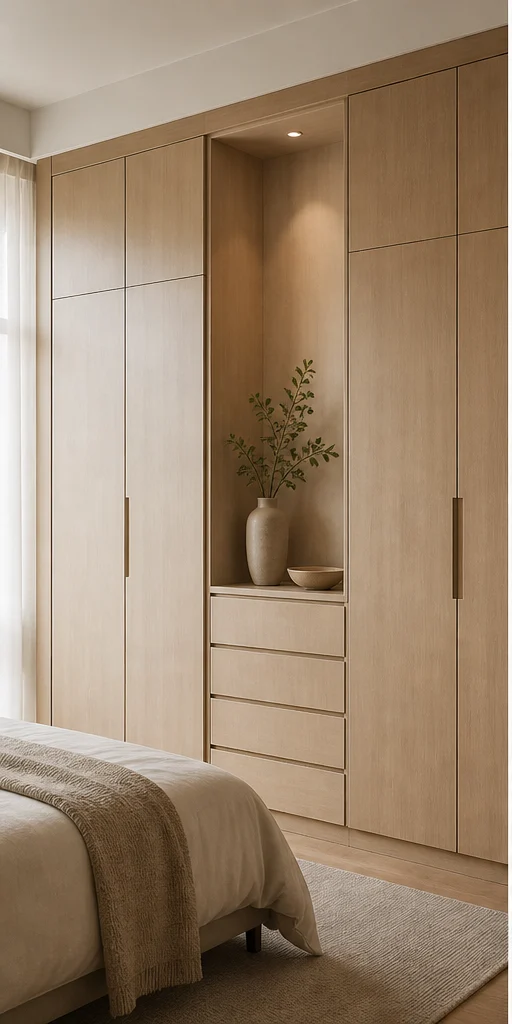
Minimal Mirror Wardrobe
Chalk · Pale Oak · Linen
See this style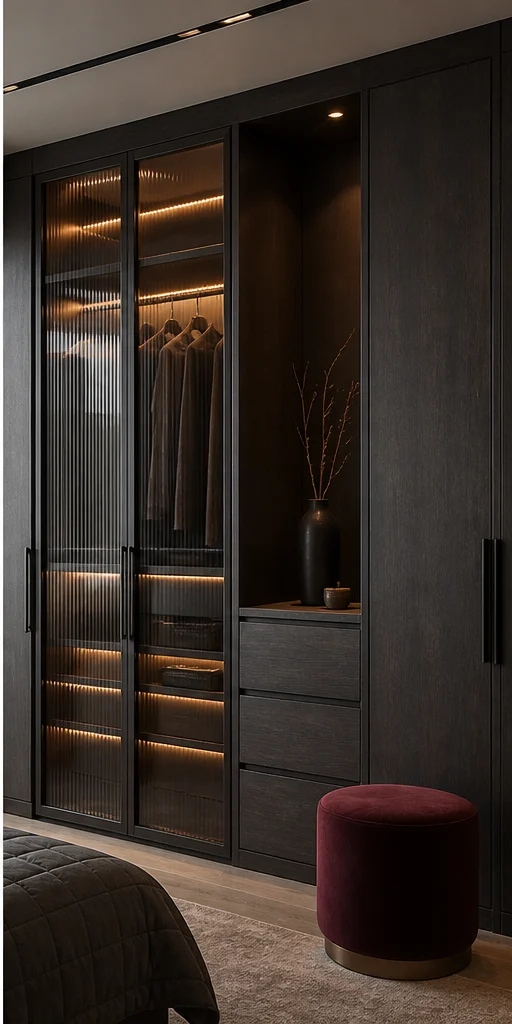
Bold Mirror Wardrobe
Charcoal · Oxblood · Smoked Oak
See this style Photo: flooringclarity · BY 2.0
Classic Mirror Wardrobe
Ivory · Statuario · Gold
See this style Photo: VillaEarlySunset · BY 2.0
Scandi Mirror Wardrobe
Birch · Chalk · Sage
See this style Photo: andrechinn · BY 2.0
Deco Mirror Wardrobe
Emerald · Brass · Lacquer
See this styleDetail
Specifying and living with this mirror wardrobe designs
Indian craft detailing on a contemporary frame — jaali, cane, inlay and hand-finished brass, used sparingly. That governs every material decision on this page — the layout and the storage strategy come first, and mirror wardrobe designs is where the modern heritage palette gets applied to a plan that already works.
A specification is only as good as what happens after handover. mirror wardrobe designs in this style is chosen as much for how it ages as for how it photographs on day one — the joinery finish, the hardware grade and the way an edge is sealed all show up in year three, long after the render is forgotten.
Modern Heritage is a coherent palette rather than a fixed rule, and most finished homes borrow across two styles rather than committing to one throughout. What rarely works is switching the palette room to room within one sightline — the transition needs a threshold, a change of material, or a corridor to read as intentional rather than accidental.
The specification below is what we issue to the factory and the site for this exact style and layout. It is also what a warranty is enforced against, which is why it is written as grades and dimensions rather than as adjectives.
Nothing on this page is a fixed catalogue item. The layout, the palette and every material line are redrawn against your own room dimensions before anything is priced — what you see here is the starting specification, not the finished drawing.
Modern Heritage suits a household that already knows roughly what it wants a mirror wardrobe designs to feel like, rather than one still deciding between opposites — the palette is distinctive enough that it rewards commitment and looks unresolved applied half-heartedly.
This reads best in a home where at least the adjoining rooms share the same direction, even if not the same materials. Modern Heritage carried into one room and abandoned at the next doorway tends to make both rooms look like an afterthought rather than a choice.
If you are drawn to modern heritage but unsure it will hold up to daily use, that is worth raising directly at the survey — the palette can usually be adapted toward more forgiving materials without losing the character that made it appealing in the first place.
Worth checking before sign-off
- Measure what you own before deciding the internal layout. Hanging length, folded stacks and bag storage are three different problems and most wardrobes solve only the first.
- Floor-to-ceiling almost always beats a wardrobe with a loft above it. The gap on top collects dust and stores nothing you can reach.
- For sliding shutters, remember you can only ever open half the wardrobe. In a small bedroom that is a fair trade; in a dressing area it is not.
- Check the wall before the design. Wardrobes against an external or bathroom-adjacent wall need a ventilated gap or the back panel will grow mould.
- Insist on soft-close on every drawer and door. It is the difference between joinery that stays aligned and joinery that loosens.
- Plan the mirror position with the room's light, not the wardrobe elevation. A mirror facing a window is a glare source, not a dressing mirror.
Living with it
- Leave the doors open for an hour after the monsoon starts and once a month through it. Trapped humid air is what makes a wardrobe smell.
- Vacuum the sliding track quarterly. Grit in the track is the reason sliders get heavy and eventually jump.
- Tighten hinge screws at the end of the first year.
- Keep silica or camphor in the folded-stack section in coastal cities.
Mistakes worth avoiding
- Designing all shelves and no drawers, which produces storage that gets stacked and never re-sorted.
- Putting a wardrobe hard against a damp external wall with no ventilation gap.
- Sliding doors in a room too small for the shutter widths — the usable opening becomes narrower than the clothes.
- Forgetting the loft ladder or the loft access entirely.
The modern heritage palette does not carry an inherent price premium over the other five — what changes the estimate is shutter finish and any profiling on the front., which applies whichever style you choose, and internal accessories: pull-downs, trays, racks and lighting add up quickly., which is more common in this palette specifically. Sliding hardware, which costs several times a hinge system.
Detailing
Finer points of this mirror wardrobe designs
A 100mm plinth recess lets you stand close without stubbing your toes, and hides the floor level tolerance at the same time.
Sensor lighting on the hanging rail is the single upgrade people notice daily.
Where the wardrobe meets the ceiling, a shadow gap absorbs the ceiling’s unevenness far more gracefully than a scribed filler.
Keep the handle line continuous across the elevation; a broken handle line makes an otherwise clean run look busy.
Questions
Mirror Wardrobe Designs in Modern Heritage — answered
Sliding or hinged for a mirror Wardrobe Designs?
Hinged if the room can spare 600mm of swing, because you see the whole interior at once and it costs less. Sliding where the bed is close to the wardrobe, accepting that half the run is always covered.
How deep should it be?
600mm internally for hanging clothes on a standard rail. Below 550mm, shirts touch the back and the doors rub, which is the most common fault in a badly measured wardrobe.
How do I stop clothes smelling damp?
Ventilate. A 10mm rear gap, plinth vents and doors left open for an hour a month through the monsoon will do more than any product.
Can a mirror Wardrobe Designs be built around an existing bed layout?
Yes — the wardrobe follows the room. What has to be checked first is the door swing, the fan sweep and the switchboard positions, which are the three things that force redesign late.
What internal accessories are actually worth it?
Soft-close drawers, a pull-down rail where the run is above 2.1m, and sensor lighting. Most other accessories look useful in a showroom and are used twice at home.
Questions
Wardrobe questions
Sliding or hinged — which should I choose?
Hinged doors give you the full opening and cost less; sliding doors need no swing clearance, which matters when the bed is under 900mm from the wardrobe face. Sliding costs about 15–20% more because of the track and framing.
How deep does a wardrobe need to be?
600mm finished depth for hanging on a standard rail. You can drop to 450mm only if you hang clothes front-to-back on a pull-out rail, which halves capacity.
Is a loft unit worth building?
In Indian apartments, yes — it is the cheapest storage in the house. Keep it to a 450mm-high shelf with lift-up flaps rather than doors, so nothing swings into your face.
How do I stop a wardrobe smelling musty in the monsoon?
Ventilate the carcass: cane or perforated inserts in at least one shutter, a 25mm gap behind the back panel, and camphor or silica in the sari section.
Can mirrors be added without a separate dressing unit?
Yes. A full-height mirror on one shutter or the end return does the job and returns light to the room. Back it with ply, never fix mirror to a hollow panel.
Next step
Build this mirror wardrobe.
Send the plan and the dimensions. We adapt this design to your room and price it line by line.